Orchid watering can seem complicated, especially when different varieties have different needs and growing conditions vary from one home to another. Water too frequently, and the roots may suffocate or rot. Water too infrequently, and the roots can dry out, leaving the leaves limp, wrinkled, or dehydrated.
The good news is that successful orchid watering does not require a rigid schedule or complicated equipment. The key is to understand how orchids use water, recognize when their roots and growing medium need moisture, and adjust your routine to suit the plant.
This complete guide explains when to water orchids, how much water to use, which watering methods work best, and how to avoid common mistakes. It also covers water quality, misting, seasonal adjustments, overwatering recovery, and how to care for orchids while you are away.
Whether you are growing a Phalaenopsis orchid on a windowsill or caring for a collection of different orchid species, these principles will help you develop a more reliable watering routine.
Understanding How Orchids Need Water
Orchids are not all alike. Their watering requirements depend on their natural habitat, root structure, potting medium, temperature, humidity, and growth stage.
Many commonly grown orchids, including Phalaenopsis, are epiphytes. In nature, they grow attached to trees rather than rooted in ordinary soil. Their roots are adapted to absorb moisture while exposed to air, then dry between periods of rainfall.
This is why growing orchids in dense garden soil and keeping their roots constantly wet can cause serious problems.
Most cultivated epiphytic orchids benefit from three basic conditions:
- Adequate moisture: Water must reach the roots and hydrate the growing medium.
- Good drainage: Excess water must escape rather than remain trapped around the roots.
- Air circulation: The roots need oxygen, not continuous saturation.
The goal is not to keep an orchid completely dry or permanently wet. It is to provide enough water for healthy growth while allowing the root environment to recover air between waterings.
Terrestrial orchids and some species with different growth habits may need different moisture conditions, so identify your orchid when possible before adopting a routine.
When Should You Water an Orchid?
The best time to water an orchid is when its growing medium and root condition indicate that watering is needed, rather than simply because a particular day has arrived.
For many Phalaenopsis orchids grown in bark, watering is appropriate when the medium is approaching dryness and the roots visible through the pot have turned silvery or pale green. The exact timing depends on the pot, the environment, and the plant’s condition.
Watering early in the day is often practical because it gives splashed water on the leaves and crown more time to dry. However, the most important factors are correct timing, thorough hydration, and avoiding standing water in vulnerable areas.
Signs that an orchid may be ready for water
- The pot feels noticeably lighter than it did after watering.
- The bark or other growing medium has become mostly dry.
- Visible Phalaenopsis roots have turned silvery rather than remaining green.
- The pot has little remaining condensation, if condensation is normally visible.
- The growing conditions indicate that moisture is being used quickly.
No single sign is perfect. Root color, for example, varies among orchid types, and the surface of the medium may dry faster than the center.
For a more detailed diagnosis, read How to Tell When an Orchid Needs Water.
How Often Should You Water an Orchid?
There is no universal watering frequency that works for every orchid. A plant in a warm room in a small bark-filled pot may need water much sooner than one growing in a cool room in a large pot with moisture-retentive moss.
For many indoor Phalaenopsis orchids, watering approximately every 7–10 days can be a starting point, but some conditions require more frequent watering while others require less. This is a reference range, not a fixed rule.
| Growing condition | Effect on watering |
|---|---|
| Warm temperatures | The medium often dries faster |
| Cool temperatures | The medium may remain wet longer |
| High humidity | Water loss from the medium may slow |
| Low humidity | The medium may dry more quickly |
| Small pots | Often dry faster than large pots |
| Coarse bark | Usually dries faster than dense moss |
| Dense sphagnum moss | Can retain moisture for longer |
| Active growth | Water demand may increase |
| Damaged or reduced roots | Water uptake may be lower |
Pot ventilation, plant size, airflow, light exposure, and the type of container also influence drying time.
Check the plant regularly and use the condition of the medium and roots to decide whether to water. Avoid watering automatically every Sunday or every three days simply because that routine worked for another orchid.
For a deeper explanation of schedules and environmental factors, see How Often Should You Water an Orchid?.
How to Water an Orchid Correctly
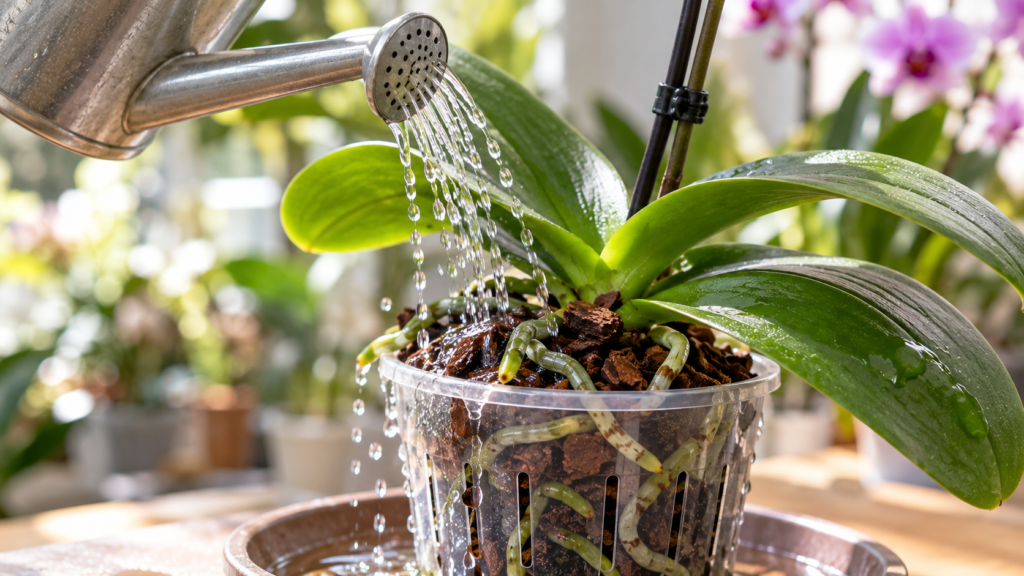
For most commonly grown epiphytic orchids in pots, the aim is to wet the root system and growing medium thoroughly, then allow excess water to drain away.
Follow these steps:
- Check the plant first. Inspect the roots, pot weight, and growing medium to determine whether watering is necessary.
- Use suitable water. Room-temperature water is generally a practical choice. Consider mineral content if your tap water is very hard or heavily treated.
- Wet the medium thoroughly. Pour water evenly over the surface, avoiding unnecessary accumulation in the crown and leaf joints.
- Let the water drain. Allow excess water to escape through the drainage holes.
- Empty any outer container. Never leave the orchid standing in a cachepot or saucer filled with water.
- Check the crown and leaves. If water collects between the leaves, gently remove it, particularly when airflow is limited.
The objective is to hydrate the roots without leaving them in stagnant water.
Should you pour a little water or water thoroughly?
A small splash may wet only part of the medium, leaving dry pockets around the roots. In many bark-grown orchids, thorough watering followed by complete drainage is more effective than repeatedly adding small amounts.
However, a plant with severely damaged roots or an unusual growing setup may need a more carefully adjusted approach. The watering method should suit the plant’s actual condition.
Read How to Water an Orchid Without Causing Root Rot for more detail on the relationship between watering and root health.
How Much Water Does an Orchid Need?
There is no reliable universal volume, such as 100 or 250 milliliters, that suits every orchid pot. The appropriate amount depends on the pot size, medium, root mass, and how quickly water can pass through the container.
For many potted epiphytic orchids, a useful approach is to apply enough water to wet the medium throughout and allow excess water to flow freely from the drainage holes.
The amount poured into the pot is not necessarily the amount retained by the plant. Some water remains around the roots and in the medium, while the rest drains away.
A practical method
- Water evenly across the medium rather than targeting only one spot.
- Continue until the medium has been thoroughly wetted and water runs from the drainage holes.
- Allow the pot to drain fully before returning it to a decorative container.
- Recheck the pot’s weight as it dries to learn how it feels when it is ready for the next watering.
For an orchid growing in sphagnum moss, be particularly careful not to assume that a dry-looking surface means the center of the pot is dry. Conversely, coarse bark may drain quickly while still retaining some moisture around the roots.
Why drainage holes do not guarantee safe watering
Drainage holes are important, but they cannot compensate for every problem. A dense medium may remain waterlogged, the pot may be too large for the root system, or airflow may be poor. An orchid can develop root problems even when the container has drainage holes.
Learn more in Can You Overwater an Orchid Even With Drainage Holes?.
How to Prevent Root Rot When Watering
Root rot commonly develops when orchid roots remain excessively wet for too long, particularly when the medium is compacted, decomposing, or poorly aerated. Watering frequency matters, but the condition of the potting medium and roots matters just as much.
Healthy Phalaenopsis roots are usually firm. Roots exposed to light may appear green when wet and silvery when dry. Rotten roots are often brown or black, soft, mushy, or hollow, and their outer tissue may slide off.
Practices that help protect orchid roots
- Use an appropriate orchid potting medium that provides adequate air space.
- Choose a pot that fits the root system rather than one with excessive unused space.
- Make sure the container has functional drainage holes.
- Allow the medium to approach the appropriate dryness before watering again.
- Avoid leaving water in an outer pot or saucer.
- Inspect the medium periodically for decomposition or compaction.
- Repot when the medium has broken down or the roots need attention.
Do not confuse healthy aerial roots with damaged roots. Aerial roots may extend outside the pot and appear silvery or green depending on moisture and light.
If your orchid is showing signs of root damage, assess its roots and growing medium rather than simply reducing water without investigating the cause.
Choosing the Best Water for Orchids
Water quality can affect orchid health over time. Different water sources contain different amounts of dissolved minerals, salts, and treatment chemicals.
Tap water
Tap water is convenient and suitable for many orchids, depending on local water quality. However, hard water or water with high dissolved mineral content can leave deposits in the pot and around the roots.
If you notice a persistent white crust on the medium or pot, investigate the water’s mineral content and fertilizer practices.
Rainwater
Clean rainwater can be a useful option because it often contains fewer dissolved minerals than hard tap water. Collect it in a clean container and avoid water contaminated by dirty roofs, chemicals, or other pollutants.
Distilled or reverse-osmosis water
Distilled and reverse-osmosis water contain very few dissolved minerals. They can be useful when tap water is unsuitable, but they also contain little calcium or magnesium. Orchids grown with these water sources may need an appropriate fertilizer program that supplies necessary nutrients.
Which should you choose?
Use water that is clean, suitable for your orchid, and compatible with your fertilizing routine. There is no single best source for every grower because municipal water chemistry varies considerably.
Explore the differences in What Is the Best Water for Orchids: Tap, Rain, or Distilled?.
Should You Soak Orchids or Water Them From the Top?
Both top watering and soaking can work, provided the roots receive adequate moisture and the orchid drains properly afterward.
Top watering
Top watering involves pouring water over the growing medium until it is thoroughly wet and excess water drains from the pot.
Advantages include:
- Simple, quick watering.
- Easy use of fresh water for each plant.
- The ability to flush some accumulated fertilizer salts through the medium.
Avoid directing large amounts of water into the crown of a Phalaenopsis orchid.
Soaking
Soaking involves placing the pot in water for a limited period so the medium and roots can absorb moisture. It can be helpful when dry bark initially repels water or when the medium is difficult to wet evenly.
However, do not use the same water for multiple orchids, especially if pests or disease are suspected. Shared water can spread pathogens between plants. After soaking, allow the pot to drain completely.
Which method is better?
Neither method is automatically superior. The best option depends on the medium, pot design, root condition, and your ability to drain the plant thoroughly. For most home growers, careful top watering is a straightforward default.
See Should You Soak Orchids or Water Them From the Top? for a more detailed comparison.
Is Misting Orchids Helpful or Harmful?
Misting is often recommended as a way to increase humidity, but it is not a substitute for watering the roots.
Spraying an orchid’s leaves or aerial roots may temporarily wet the surface, yet the effect on overall humidity is usually limited and short-lived. Misting may also leave water trapped in the crown or leaf joints, especially in still, humid conditions.
When misting may be useful
Misting may briefly wet aerial roots or provide limited surface moisture in certain growing environments. If you mist, do it in a way that allows surfaces to dry promptly and avoid leaving water pooled around the crown.
Better ways to manage humidity
- Group plants while maintaining adequate airflow.
- Use a room humidifier when appropriate.
- Monitor humidity with a hygrometer.
- Keep orchids away from stagnant, poorly ventilated spaces.
- Water the growing medium directly when the plant needs water.
Humidity and root watering serve different purposes. A humid room does not automatically mean the growing medium stays wet, and frequent misting does not compensate for a dehydrated root system.
For a more complete assessment, read Is Misting Orchids Helpful or Harmful?.
Adjusting Watering for Hot or Humid Weather
Orchid watering needs change as the environment changes. Higher temperatures, stronger light, increased airflow, and lower humidity can make the growing medium dry faster. Cooler weather and high humidity can slow drying.
During hot weather, check the pot more frequently. Do not assume that every orchid needs daily watering, because pot size and medium can produce very different results.
During humid weather, pay attention to the center of the pot rather than relying on the surface alone. Medium that remains wet for several days may indicate that watering needs to be less frequent or that airflow and drainage should be improved.
Adjust your routine using observations
- Check the pot’s weight and medium moisture.
- Inspect visible roots where possible.
- Record how many days the pot takes to approach dryness.
- Compare drying time after changes in temperature, humidity, or airflow.
- Adjust the next watering based on the evidence, not the calendar alone.
Avoid making sudden, extreme changes based on one unusually hot or humid day. Watch the actual condition of the plant and medium.
For seasonal and environmental examples, see How to Adjust Orchid Watering in Hot or Humid Weather.
How to Water Orchids When You Are Away on Vacation
Preparing orchids for an absence is mostly about matching their watering needs to the length of the trip and the environment in which they will remain.
For a short trip, a healthy orchid may need no special watering arrangement if it has been watered appropriately before you leave and the medium is expected to retain sufficient moisture. For a longer absence, the plant’s potting medium, room temperature, humidity, and usual drying time become more important.
Before leaving
- Check each plant individually.
- Water orchids that genuinely need water, allowing them to drain completely.
- Avoid soaking every plant simply because you are leaving.
- Keep plants in suitable light and temperature conditions.
- Avoid placing orchids in direct, intense sun to reduce water loss.
- Ask a trusted person to check plants during a longer trip if necessary.
Do not leave orchids standing in full saucers of water as a blanket solution. Prolonged saturation can damage roots, particularly in dense media or cool conditions.
If someone else will care for your collection, provide simple instructions based on each plant’s condition rather than asking them to water every orchid on a fixed schedule.
Use How to Water Orchids When You Are Away on Vacation to plan for longer absences.
What to Do if You Overwater an Orchid
Overwatering is not simply the act of giving an orchid too much water once. Problems usually arise when the roots remain wet for too long or the medium does not provide enough oxygen.
Signs of possible overwatering include persistently wet medium, soft or mushy roots, yellowing leaves, a sour smell from the pot, and declining plant condition. Some of these symptoms can also result from other problems, so inspect the roots and medium before deciding what is wrong.
Steps to take
1. Check the medium. Determine whether it is still saturated, compacted, or decomposing.
2. Inspect the roots. If root damage is suspected, remove the orchid carefully from its pot and examine the root system.
3. Remove rotten roots if necessary. Use a clean, sterilized cutting tool to remove clearly dead, mushy tissue. Avoid cutting firm, healthy roots unnecessarily.
4. Replace degraded medium. If the medium has broken down or remains wet for too long, repot into an appropriate fresh orchid medium and a suitable container.
5. Improve drainage and airflow. Make sure the pot drains freely and that the plant is not left standing in water.
6. Resume careful watering. Water according to the condition of the remaining roots and medium. A plant with substantial root loss may use less water because it has fewer functioning roots.
Do not try to repair root rot simply by leaving a severely damaged orchid dry for an extended period. The goal is to restore a healthy balance of moisture and oxygen, not to dehydrate the remaining roots.
For a step-by-step recovery plan, read What to Do When Your Orchid Has Been Overwatered.
Common Orchid Watering Mistakes
Even experienced growers can develop watering habits that do not suit a particular plant or environment.
Watering on a fixed schedule
A calendar can remind you to inspect your orchids, but it should not determine watering automatically. The medium may dry at different rates from week to week.
Giving only a small splash
Small amounts may fail to wet the entire root system, particularly in coarse bark. When watering is needed, hydrate the medium thoroughly and let it drain.
Leaving the pot in standing water
Water remaining in an outer container or saucer can keep the bottom of the medium saturated and reduce root aeration.
Assuming drainage holes solve everything
Drainage holes are necessary in many common orchid setups, but dense medium, oversized pots, and poor airflow can still create prolonged wet conditions.
Misting instead of watering the roots
Misting does not reliably hydrate the entire root system or growing medium.
Ignoring changes in the medium
Old bark and other organic media can break down over time, holding more moisture and restricting airflow. A watering routine that once worked may become unsuitable as the medium ages.
Treating every orchid the same
Different species, pots, and media have different needs. Start with the plant’s growth habit and adjust based on observation.
A Simple Orchid Watering Routine
A repeatable inspection routine can make orchid care easier without forcing every plant onto the same schedule.
| Step | What to check |
|---|---|
| 1. Inspect | Look at visible roots and the growing medium. |
| 2. Assess | Check pot weight and how dry the medium is. |
| 3. Decide | Water only if the plant’s conditions indicate it is needed. |
| 4. Hydrate | Wet the medium thoroughly using an appropriate method. |
| 5. Drain | Let all excess water escape from the pot. |
| 6. Finish | Empty outer containers and remove water trapped in the crown. |
| 7. Learn | Notice how long the pot takes to approach dryness. |
For Phalaenopsis orchids, visible root color can be particularly helpful when the roots can be seen through a transparent pot. Other orchid types may require different cues, so do not use one visual indicator for every species.
Over time, these observations help you develop a watering routine suited to your own growing environment.
Frequently Asked Questions
Should I water my orchid from the top or bottom?
Both can work. Top watering is a practical default because it allows you to wet the medium thoroughly and flush it with fresh water. Bottom watering or soaking can be useful in some setups, but the pot should drain completely afterward, and water should not be shared between plants.
Should orchid roots be wet or dry?
Orchid roots need access to moisture, but many epiphytic orchids also need air around their roots. Roots may be wet immediately after watering and then gradually dry as the medium loses moisture. They should not remain persistently waterlogged.
Can I water an orchid with ice cubes?
Ice cubes are not the preferred method. They make it difficult to wet the root system evenly, and very cold water contacting roots in a concentrated area may create unnecessary stress. Water at a moderate temperature and hydrate the medium evenly instead.
Is tap water safe for orchids?
Often, yes. Suitability depends on local water chemistry, particularly mineral content. If tap water leaves deposits or your orchid repeatedly struggles despite appropriate care, consider checking water quality and reviewing fertilizer practices.
Do orchids need less water after flowering?
Not necessarily. Watering needs are influenced more directly by the species, root condition, medium, temperature, light, and growth activity than by the simple fact that flowering has ended. Continue monitoring the plant rather than automatically reducing water.
Why are my orchid leaves wrinkled if I water regularly?
Wrinkled leaves can indicate inadequate water uptake, but adding more water is not always the solution. Damaged roots may be unable to absorb moisture even when the medium is wet. Inspect the root system and growing conditions before increasing watering frequency.
Should I water an orchid every day in hot weather?
Not automatically. Hot weather can make the medium dry faster, but daily watering may keep some pots too wet. Check the plant and medium more frequently and water when conditions indicate that it is needed.
Is it better to underwater or overwater an orchid?
Neither is ideal. Repeated dehydration can damage roots and leaves, while prolonged saturation can cause root loss. The goal is to provide enough moisture while maintaining the aeration the orchid needs.
Final Thoughts
Successful orchid watering comes down to understanding the plant rather than following a universal schedule. Learn how your orchid’s roots look when hydrated, how its growing medium dries, and how your local temperature and humidity affect that process.
Water thoroughly when needed, allow excess water to drain, and investigate root health whenever the plant shows signs of decline. These habits are more reliable than fixed watering calendars, frequent misting, or arbitrary measurements.
Start with the guidance in this article, then explore the linked supporting guides for specific questions about watering frequency, water quality, root rot, seasonal changes, and vacation care. Together, these resources will help you make better watering decisions and maintain healthier orchids over time.
Share this article