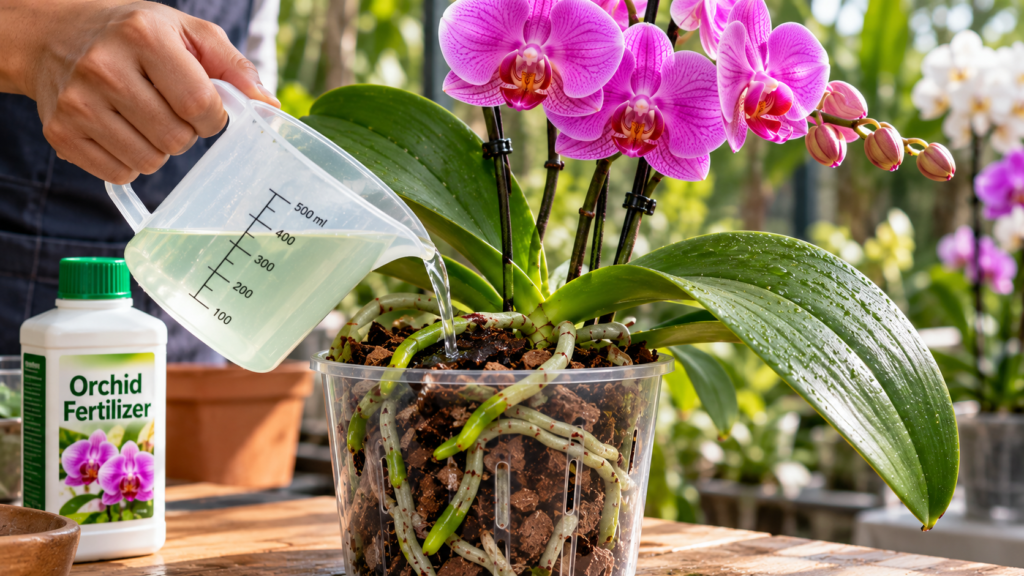
Knowing how often to fertilize orchids is essential for maintaining healthy roots, strong leaves, and consistent growth. Too little fertilizer may limit development when nutrients are unavailable in the growing medium, while excessive feeding can contribute to salt buildup and root damage.
Unfortunately, there is no single fertilizing schedule that works for every orchid. The ideal frequency depends on the orchid’s growth stage, species, growing medium, water quality, fertilizer concentration, and environmental conditions.
An orchid growing actively in warm conditions may benefit from regular feeding, while another entering a natural resting period may need significantly less fertilizer.
The goal is not to feed orchids as frequently as possible. It is to provide nutrients when the plant can use them while avoiding unnecessary accumulation of fertilizer salts.
This guide explains how often to fertilize different orchids, how to adjust feeding schedules throughout the year, and how to recognize when your current routine needs improvement.
1. How Often Should You Fertilize Orchids?
For many commonly cultivated orchids, a practical starting point is to apply a diluted fertilizer solution approximately every one to two weeks during active growth.
However, this is a general guideline rather than a universal rule.
Some growers prefer weak fertilizer applications more frequently, while others feed every few weeks. Both approaches can work when the fertilizer concentration, watering routine, and growing conditions are appropriate.
The important distinction is between fertilizer frequency and fertilizer strength.
Applying a weak solution regularly is not equivalent to applying a concentrated solution at the same frequency. The total amount of nutrients supplied over time matters.
Before choosing a schedule, consider these factors:
- Is the orchid actively producing new roots or leaves?
- Is the plant growing in bark, sphagnum moss, or another medium?
- Does the irrigation water contain significant dissolved minerals?
- Is the fertilizer concentrated or relatively dilute?
- Does the pot have adequate drainage?
- Is the orchid growing in warm, bright conditions or experiencing slower growth?
A healthy orchid with active roots generally has a greater capacity to use available nutrients than a stressed plant with damaged roots.
For a broader explanation of orchid nutrition, fertilizer selection, and application methods, read The Complete Guide to Fertilizing Orchids for Healthy Growth and Blooms.
2. Fertilizing Orchids During Active Growth
Active growth is generally the most suitable period for regular fertilizing.
During this stage, orchids may produce new leaves, roots, shoots, or pseudobulbs. These developing structures require nutrients to support cell growth and normal plant metabolism.
When environmental conditions are favorable, a consistent supply of appropriately diluted fertilizer can help support this development.
Signs That an Orchid Is Actively Growing
Look for:
- New green root tips extending from existing roots.
- New leaves emerging from the growing point.
- Developing pseudobulbs in orchids that produce them.
- New shoots or growths.
- Increasing root activity inside transparent pots.
These signs suggest that the plant is producing new tissues and may be able to use additional nutrients.
A Practical Feeding Frequency
For a healthy orchid in active growth, consider beginning with a diluted fertilizer application every one to two weeks.
Adjust this frequency according to the product instructions and growing conditions.
For example, an orchid growing actively in warm conditions with suitable light may maintain a regular feeding routine. A plant growing slowly in cooler conditions may need less frequent applications.
Do not increase fertilizer concentration simply because the orchid is producing new leaves or roots.
Healthy growth requires a balanced supply of nutrients, not excessive amounts of fertilizer.
3. How Often Should You Fertilize Phalaenopsis Orchids?
Phalaenopsis orchids are popular because many hybrids adapt well to indoor growing conditions.
They often produce new roots and leaves when temperature, light, humidity, and watering are suitable.
Many commonly grown Phalaenopsis hybrids do not have a pronounced dormant period. As a result, they may continue growing throughout much of the year.
Recommended Approach
A diluted fertilizer application every one to two weeks during active growth is a reasonable starting point for many healthy Phalaenopsis orchids.
However, adjust the routine when growth slows, roots become damaged, or environmental conditions change.
Phalaenopsis grown in bark may need a different feeding approach from plants grown in sphagnum moss.
Bark generally provides limited nutrients, while sphagnum moss retains more moisture and can contain some organic material. The amount of fertilizer needed also depends on the water and nutrients already entering the pot.
Avoid Feeding by Calendar Alone
A Phalaenopsis orchid that has stopped producing new roots or leaves may not benefit from receiving the same amount of fertilizer as an actively growing plant.
First examine its root condition and growing environment.
A lack of growth may indicate inadequate light, damaged roots, unsuitable temperatures, or other problems rather than a simple fertilizer deficiency.
4. How Often Should You Fertilize Cattleya Orchids?
Cattleya orchids produce pseudobulbs that store water and nutrients.
Many Cattleya species and hybrids have recognizable growth cycles. New shoots develop into pseudobulbs, which eventually mature and may produce flowers.
Fertilizing frequency should reflect this development.
During New Growth
When a Cattleya begins producing new roots and shoots, regular feeding can support development.
A diluted fertilizer application every one to two weeks may be appropriate under favorable growing conditions.
After the Pseudobulb Matures
When the new pseudobulb has matured and growth slows, the plant’s nutrient demand may decrease.
At this stage, reduce feeding if the plant is no longer actively growing.
The correct adjustment depends on the individual hybrid or species, environmental conditions, and whether new growth continues.
Do not assume every Cattleya follows exactly the same seasonal schedule.
5. How Often Should You Fertilize Dendrobium Orchids?
Dendrobium is a large and diverse orchid genus. Different groups have significantly different growth habits.
Some Dendrobium types grow continuously or nearly continuously under suitable conditions, while others have distinct seasonal growth and rest periods.
This difference makes it especially important to identify the type of Dendrobium being cultivated.
During Active Growth
Dendrobiums producing new canes, leaves, and roots can generally receive regular diluted fertilizer.
The frequency should reflect the plant’s growth activity and the conditions in which it is grown.
During Rest Periods
Some seasonal Dendrobium types require reduced watering and little or no fertilizer during their natural resting period.
Continuing a regular feeding schedule during dormancy may be unnecessary.
However, not every Dendrobium needs the same treatment. Some evergreen types continue growing and should not automatically be placed on a dry rest schedule.
6. How Often Should You Fertilize Oncidium and Paphiopedilum Orchids?
Oncidium alliance orchids and Paphiopedilum orchids have different growing characteristics, so their fertilizing routines should not automatically be identical.
Oncidium Alliance
Many Oncidium alliance orchids produce pseudobulbs and new growths during particular periods.
They benefit from suitable nutrition while developing new roots and pseudobulbs.
A diluted feeding schedule every one to two weeks during active growth can be a practical starting point for many cultivated plants.
Reduce feeding when growth slows significantly.
Paphiopedilum
Paphiopedilum orchids are generally grown in moisture-retentive media and have different root characteristics from many epiphytic orchids.
Their roots can be sensitive to excessive fertilizer concentrations.
Some growers use weak fertilizer applications more frequently rather than stronger solutions at longer intervals.
The appropriate schedule depends on the medium, water quality, and growth activity.
Avoid allowing concentrated fertilizer to accumulate in the pot.
7. Should You Fertilize Orchids Every Time You Water?
Some orchid growers follow a method commonly described as feeding weakly and regularly.
Under this approach, a small amount of fertilizer is included in many watering sessions during active growth.
The purpose is to provide nutrients consistently without exposing roots to highly concentrated fertilizer solutions.
However, this does not mean that every orchid should receive fertilizer every time it is watered.
When Frequent Weak Feeding May Work
This method may be suitable when:
- The orchid is actively growing.
- The fertilizer is diluted appropriately.
- The water source is suitable.
- The growing medium drains freely.
- The grower monitors mineral accumulation.
When It May Be Unsuitable
Frequent feeding may create problems when:
- The fertilizer concentration is too high.
- The irrigation water already contains substantial minerals.
- The orchid is entering dormancy.
- The roots are damaged.
- The potting medium retains excessive salts.
- Watering is too infrequent to prevent concentrated residues from accumulating.
If you choose frequent feeding, measure the fertilizer carefully and monitor the condition of the roots.
8. Does Growing Medium Affect Fertilizing Frequency?
Yes. The growing medium can influence how frequently an orchid needs fertilizer.
Different materials retain water, nutrients, and mineral residues differently.
Orchids Grown in Bark
Bark is commonly used for epiphytic orchids because it provides structure and allows air to circulate around the roots.
However, many bark-based mixes provide relatively little nutrition.
Orchids grown in bark may therefore depend more heavily on supplemental fertilizer.
Because bark dries relatively quickly in many growing environments, frequent watering may also influence how nutrients move through the pot.
Orchids Grown in Sphagnum Moss
Sphagnum moss retains more moisture than coarse bark.
Depending on its condition and composition, it may also contain some organic nutrients.
Because it retains water longer, growers should be careful about applying fertilizer repeatedly without considering how much solution remains around the roots.
Orchids Grown in Mixed Media
Many growers combine bark, moss, perlite, charcoal, and other materials.
These mixtures have different moisture and nutrient retention characteristics.
The correct feeding schedule should reflect the behavior of the actual medium rather than simply the name of one ingredient.
9. Should You Reduce Fertilizing During Winter?
Winter does not automatically mean that orchids should stop receiving fertilizer.
The important factor is whether the plant continues growing.
An orchid growing indoors under stable temperatures and adequate light may remain active throughout winter.
Another orchid exposed to cooler temperatures and shorter days may experience slower growth.
When to Reduce Feeding
Consider reducing fertilizer frequency when:
- New root growth becomes less active.
- Leaf or shoot development slows.
- Temperatures become less favorable for growth.
- Light levels decrease significantly.
- The orchid enters a natural seasonal rest period.
When to Continue Feeding
If the orchid continues producing healthy new growth under suitable conditions, there may be no reason to stop fertilizing simply because the calendar says winter.
For more detailed seasonal guidance, see How to Adjust Orchid Fertilizing During Active Growth and Rest Periods.
10. How Should You Adjust Fertilizing After Repotting?
Repotting can disturb roots and temporarily reduce the plant’s ability to absorb water and nutrients.
An orchid that has experienced significant root damage may need time to recover before returning to its normal feeding schedule.
Do not assume that a recently repotted orchid should immediately receive fertilizer at its previous concentration.
Instead, observe its recovery.
New root tips and resumed growth are useful indications that the plant is establishing itself in the new medium.
The appropriate waiting period depends on the extent of root disturbance and the plant’s overall condition.
For a more detailed explanation, read Should You Fertilize Orchids After Repotting?.
11. How to Prevent Fertilizer Salt Buildup
Regular fertilizing can cause mineral salts to accumulate in orchid pots, particularly when the fertilizer concentration is excessive or the irrigation water contains substantial dissolved minerals.
This is one reason why fertilizer frequency should never be considered separately from watering and water quality.
Signs to Watch For
Possible signs include:
- White crusty deposits on the potting medium.
- Mineral residue around drainage holes.
- Deposits on the inside of transparent containers.
- Damaged root tips.
- Declining root condition.
These symptoms do not always confirm fertilizer salt buildup, but they indicate that the growing medium and watering routine deserve closer inspection.
Flush the Potting Medium When Appropriate
Passing suitable water through the pot can help remove some accumulated soluble salts.
The container must have adequate drainage, and the water source should not introduce excessive minerals.
Flushing does not replace a sensible feeding schedule. If fertilizer concentration remains too high, salt accumulation may return.
For additional instructions, see Should You Flush Orchid Potting Media to Remove Fertilizer Salts?.
12. Common Signs That You Are Fertilizing Too Frequently
Frequent fertilizing is not necessarily harmful when the solution is appropriately diluted and the growing conditions support nutrient uptake.
Problems occur when the amount of fertilizer supplied exceeds what the plant and growing system can reasonably use.
Watch for:
- White mineral deposits on the growing medium.
- Brown or damaged root tips.
- Leaf-tip or leaf-margin damage.
- Roots that decline despite apparently adequate watering.
- A pattern of repeated fertilizer applications without periodic attention to salt accumulation.
These signs are not exclusive to overfertilizing. Root rot, poor drainage, unsuitable water, and other problems can produce similar symptoms.
If fertilizer damage is suspected, review the complete feeding routine rather than simply changing the fertilizer brand.
13. A Simple Orchid Fertilizing Schedule
The following table provides a starting framework for adjusting feeding frequency.
| Orchid condition | General feeding approach |
|---|---|
| Active root and leaf growth | Diluted fertilizer approximately every 1 to 2 weeks |
| Strong active growth in suitable conditions | Regular diluted feeding, adjusted to the product and water quality |
| Slow growth | Reduce feeding frequency |
| Natural dormancy | Little or no fertilizer when appropriate for the species |
| Recently repotted with damaged roots | Delay normal feeding until recovery begins |
| Severe root damage | Prioritize root recovery and correct growing conditions |
| Visible mineral accumulation | Review feeding practices and consider flushing |
This is not a universal calendar. It is a framework for making decisions based on the orchid’s actual condition.
14. Frequently Asked Questions
Can I Fertilize Orchids Once a Month?
Yes. Monthly feeding may be suitable for some orchids, particularly when growth is slow or the growing medium and water already supply some nutrients.
However, a monthly schedule may provide insufficient nutrition for an actively growing orchid in a relatively inert medium.
Observe the plant’s growth and adjust accordingly.
Is It Better to Fertilize Orchids Weekly or Monthly?
Neither schedule is automatically better.
Weekly feeding with a suitably diluted solution may work for an actively growing orchid. Monthly feeding may be more appropriate in other conditions.
The fertilizer concentration and total nutrient supply matter as much as frequency.
Should I Fertilize Orchids When They Have No Flowers?
Yes, if the orchid is actively growing and its nutritional needs justify feeding.
Leaves and roots continue developing outside the flowering period.
Fertilizing should be based on growth activity rather than whether flowers are present.
Can I Fertilize Orchids While They Are Blooming?
Healthy orchids can often continue receiving an appropriate fertilizer solution during flowering.
There is no need to increase fertilizer concentration to encourage larger or longer-lasting flowers.
For more information, read Can You Fertilize Orchids While They Are Blooming?.
What Happens If I Forget to Fertilize My Orchid?
Missing one or several fertilizer applications will not usually cause an immediate problem.
Orchids can use stored nutrients and may receive minerals from their growing environment and irrigation water.
Resume an appropriate feeding routine when the plant is actively growing. Do not compensate for missed applications by applying a stronger fertilizer solution.
Should I Fertilize a Weak Orchid More Frequently?
Not necessarily.
A weak orchid may have damaged roots, poor light, unsuitable watering, pests, or disease.
Increasing fertilizer frequency without identifying the underlying problem can make the situation worse.
Inspect the roots and growing conditions before changing the feeding schedule.
Conclusion
The best fertilizing frequency for orchids depends on how actively they are growing and the conditions in which they are cultivated.
For many healthy, actively growing orchids, a diluted fertilizer application approximately every one to two weeks is a practical starting point. However, some plants need less frequent feeding, while others can benefit from carefully managed weak feeding during sustained growth.
Pay attention to the orchid’s roots, leaves, growing medium, water quality, and seasonal behavior.
Avoid following a rigid schedule simply because it is recommended on a fertilizer package or by another grower.
A consistent, measured approach is more valuable than frequent feeding. When you understand the plant’s growth cycle and manage fertilizer concentration carefully, you can support healthy roots, stronger growth, and better long-term flowering potential.
Share this article