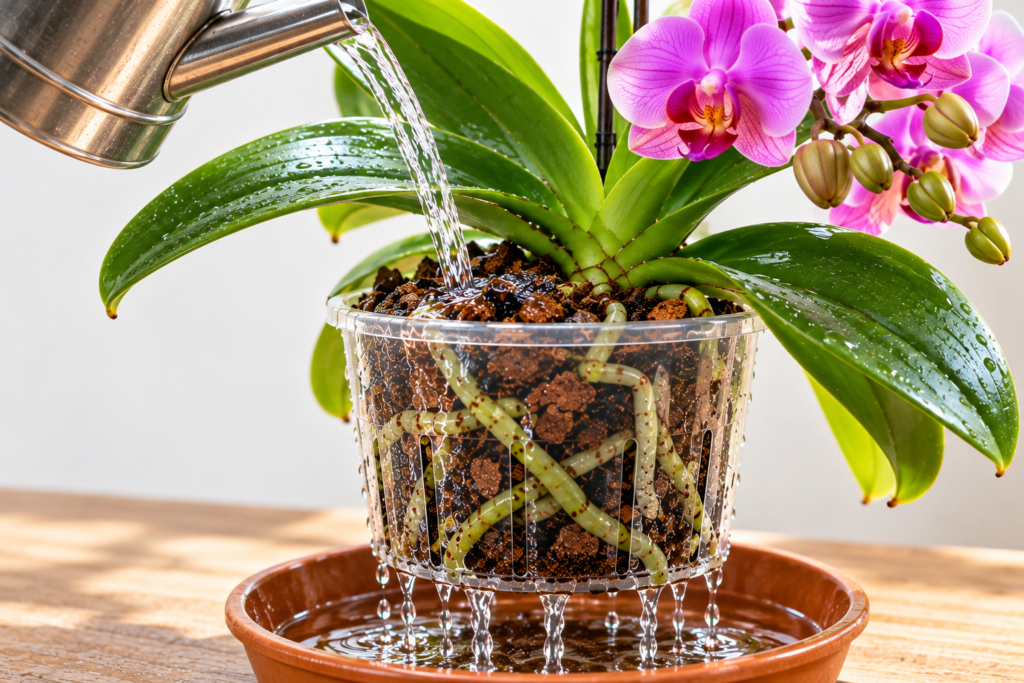
Yes, you can overwater an orchid even if its pot has drainage holes. Drainage holes allow excess water to escape, but they do not guarantee that the growing medium will dry quickly enough or that the roots will receive sufficient oxygen.
This is one reason orchid growers sometimes see root rot despite using pots designed specifically for orchids. The problem may not be the drainage holes themselves. It may be the watering frequency, the type of potting medium, the size of the pot, or the growing conditions.
Understanding how these factors work together will help you prevent root damage while keeping your orchid properly hydrated.
Why Drainage Holes Do Not Always Prevent Overwatering
Drainage holes serve an important purpose: they allow excess water to leave the pot after watering. However, some moisture naturally remains in the growing medium.
If the medium retains too much water, the roots may remain wet for an extended period even when water drains freely from the bottom.
Several conditions can contribute to this problem:
- Watering again before the medium has dried sufficiently.
- Using tightly packed sphagnum moss or another moisture-retentive medium.
- Growing an orchid in a pot that is too large for its root system.
- Using old, decomposed bark that has lost its structure.
- Keeping an orchid in a cool, humid environment where drying is slow.
- Placing the pot inside a decorative container that collects excess water.
Drainage is only one part of healthy orchid care. The growing medium must also provide an appropriate balance of moisture and air.
For a broader explanation of proper watering, read The Complete Guide to Watering Orchids: When, How, and How Much.
How Overwatering Affects Orchid Roots
Many popular orchids, including Phalaenopsis, are epiphytes. In nature, they grow attached to trees rather than in dense garden soil. Their roots absorb moisture while remaining exposed to air.
In cultivation, these orchids need a growing medium that holds enough moisture for the plant while maintaining spaces through which air can circulate.
When the medium remains saturated for too long, oxygen availability around the roots can decrease. Prolonged wet conditions may damage root tissue and increase the risk of root rot.
Damaged roots cannot absorb water and nutrients as effectively as healthy roots. As a result, an orchid may develop dehydrated-looking leaves even while its potting medium remains wet.
This is why adding more water is not always the right response to drooping or wrinkled leaves.
1. Watering Too Frequently
One of the most common causes of overwatering is watering according to a fixed calendar rather than checking the plant.
For example, an orchid may dry appropriately within a week in a warm room with coarse bark. The same plant may remain damp for much longer in a cooler room or a pot containing tightly packed moss.
If you water again simply because seven days have passed, you may keep the root zone continuously wet.
How to avoid this problem
Before watering, check:
- The condition of the growing medium.
- The weight of the pot.
- The appearance of visible roots.
- The temperature and humidity around the plant.
For many Phalaenopsis orchids, green roots often indicate hydration, while silvery roots may indicate that they have dried. Combine root color with the condition of the medium rather than relying on one sign alone.
Read How to Tell When an Orchid Needs Water for a more detailed guide to recognizing watering needs.
2. Using a Pot That Is Too Large
A large pot is not always better for an orchid.
When the pot contains much more growing medium than the root system can use, the medium may retain moisture for longer. The roots may occupy only a small portion of the container, leaving a large volume of damp medium around them.
This can be especially problematic when the medium is dense or the growing conditions slow evaporation.
Choose the right pot size
Select a pot that comfortably accommodates the root system without excessive unused space. There should still be enough room for healthy root growth.
When repotting, do not automatically move an orchid into a much larger container simply because the plant has grown taller or developed more leaves.
The root system, rather than the visible size of the foliage alone, should guide your choice.
3. Using the Wrong Potting Medium
The growing medium has a major influence on how long water remains around orchid roots.
Coarse orchid bark
Coarse bark generally allows good airflow and drains readily. It is a common choice for many epiphytic orchids, including Phalaenopsis.
However, bark can break down over time. As it decomposes, smaller particles may retain more moisture and reduce airflow.
Sphagnum moss
Sphagnum moss retains moisture effectively. This can be beneficial in suitable growing conditions, but tightly packed moss may remain wet for a long time.
The surface can also appear dry while the center of the pot remains damp.
Mixed media
Orchid mixes containing bark, moss, perlite, or other materials vary in how much water they retain. The correct watering routine depends on the mixture and the environment.
If your orchid repeatedly stays wet for too long, inspect the medium before assuming that the drainage holes are inadequate.
4. Leaving Water in an Outer Pot or Saucer
An orchid may have excellent drainage holes but still sit in standing water after watering.
This can happen when a plastic growing pot is placed inside a decorative cachepot or when excess water collects in a saucer.
If the bottom of the growing pot remains submerged, the lower portion of the medium may stay saturated for longer than intended.
What to do instead
After watering:
- Allow excess water to drain from the growing pot.
- Remove any water collected in the outer container or saucer.
- Check that the pot is not sitting in standing water.
- Return the orchid to its normal growing position once it has drained.
You can still use decorative pots. Just make sure they do not trap water around the growing pot.
5. Cool or Humid Conditions Can Slow Drying
Orchid watering needs change with the environment.
In warm conditions, the medium may dry relatively quickly. Cooler temperatures and high humidity can slow drying, especially when airflow is limited.
This means an orchid that previously needed frequent watering may require a longer interval between waterings after a change in weather or indoor conditions.
Adjust your routine
During cool or humid periods:
- Check the medium before watering.
- Pay attention to moisture deeper inside the pot.
- Avoid watering automatically according to your usual schedule.
- Maintain suitable airflow around the plant.
During warm or dry periods, check the orchid more frequently because the medium may dry faster. However, do not assume that hot weather always requires daily watering.
For additional guidance, see How to Adjust Orchid Watering in Hot or Humid Weather.
Signs Your Orchid May Be Overwatered
Overwatering can be difficult to identify because the symptoms sometimes resemble dehydration.
Look for a combination of warning signs rather than relying on a single symptom.
Roots that are soft or mushy
Healthy Phalaenopsis roots are generally firm. They may appear green when hydrated and silvery when dry.
Roots that become soft, mushy, hollow, or darkened may be damaged. Brown coloration alone does not always confirm root rot, so check the texture as well.
Leaves that become limp or wrinkled
An orchid with damaged roots may struggle to absorb water. Its leaves can become limp or wrinkled even when the medium is wet.
Do not respond by automatically watering more. Inspect the root system first.
Medium that stays wet for too long
If the pot remains damp much longer than usual, check whether the medium has decomposed, the pot is oversized, or the growing environment has changed.
An unpleasant smell
A sour or unpleasant smell from the growing medium may indicate decomposition or unhealthy conditions around the roots.
These signs suggest that the potting setup needs investigation. They do not all prove that overwatering is the only cause.
For more on recognizing root damage, read How to Water an Orchid Without Causing Root Rot.
How to Water an Orchid Correctly Even With Drainage Holes
The solution is not to give an orchid only a few drops of water. Many epiphytic orchids benefit from thorough watering when needed, followed by complete drainage.
Use this routine:
Step 1: Check whether watering is needed. Examine the roots, medium, and pot weight.
Step 2: Water the medium thoroughly. Pour water evenly over the growing medium so it becomes properly hydrated.
Step 3: Let excess water escape. Confirm that water flows freely through the drainage holes.
Step 4: Drain completely. Allow the pot to finish draining before returning it to an outer container.
Step 5: Empty the saucer. Do not leave the orchid standing in collected water.
Step 6: Monitor drying time. Learn how long your particular pot takes to approach dryness under your growing conditions.
This approach provides moisture without deliberately keeping the root zone saturated.
Should You Add More Drainage Holes?
Sometimes additional ventilation or drainage can improve a growing setup, but more holes are not always the first solution.
If water flows freely through the existing holes, the main issue may be the growing medium, pot size, watering frequency, or environment.
Inspect the complete setup before changing the container.
Consider a different pot or improved ventilation when the existing container drains poorly or retains moisture for too long. Choose a design appropriate for the orchid species and growing conditions.
Avoid making unnecessary changes to a healthy plant simply because you are concerned about overwatering.
What to Do if Your Orchid Has Already Been Overwatered
If the medium is wet but the roots remain firm, you may only need to allow the medium to approach the appropriate dryness before watering again.
If root rot is suspected, further inspection may be necessary.
- Carefully remove the orchid from its pot if the root system needs examination.
- Check the roots for soft, mushy, or hollow tissue.
- Use a clean, sterilized cutting tool to remove clearly rotten roots when necessary.
- Replace decomposed or unsuitable medium with a suitable fresh orchid mix.
- Choose a pot that fits the remaining root system and drains properly.
- Adjust watering to the condition of the remaining roots and the new medium.
An orchid with substantial root loss may use less water because fewer functioning roots remain. Monitor it carefully rather than returning immediately to its former watering schedule.
For a step-by-step recovery plan, read What to Do When Your Orchid Has Been Overwatered.
Frequently Asked Questions
Can water stay in an orchid pot even when it has drainage holes?
Yes. Drainage holes allow excess water to escape, but the growing medium can still retain moisture. The amount retained depends on the medium, pot size, and growing conditions.
Should I let orchid roots dry completely between waterings?
Not necessarily. Many epiphytic orchids benefit when the medium approaches dryness between waterings, but prolonged dehydration can also damage roots. The appropriate moisture level depends on the orchid species and growing setup.
How often should I water an orchid with drainage holes?
There is no universal schedule. Some indoor Phalaenopsis orchids may be watered approximately every 7–10 days under certain conditions, while others need water sooner or later. Check the roots and medium before watering.
Is a plastic orchid pot suitable?
Yes. Plastic pots can work well if they have adequate drainage and the growing medium suits the plant. Transparent plastic also makes it easier to inspect visible roots. The important factors are the complete growing setup and how quickly the medium dries.
Do yellow leaves always mean an orchid is overwatered?
No. Yellowing can result from natural leaf aging, root damage, light problems, nutrient issues, and other factors. Inspect the roots and growing medium before deciding what action to take.
Final Thoughts
Drainage holes are essential in many orchid-growing setups, but they do not make overwatering impossible. Roots can still suffer when the growing medium remains saturated for too long, the pot is oversized, or the environment slows drying.
Focus on the whole growing system: choose an appropriate pot and medium, water thoroughly when needed, allow excess water to drain, and empty any standing water from outer containers.
Most importantly, learn to recognize the condition of your orchid’s roots and growing medium. These observations will help you adjust your watering routine and maintain a healthier balance between moisture and airflow.
Master Orchid Care With The Complete Orchid Care Library
Want to become more confident in watering orchids, identifying root problems, and making better care decisions? The Complete Orchid Care Library brings together practical orchid care ebooks and visual guides to help you understand common orchid problems and care for your plants with greater confidence.
Get The Complete Orchid Care Library Here
Share this article