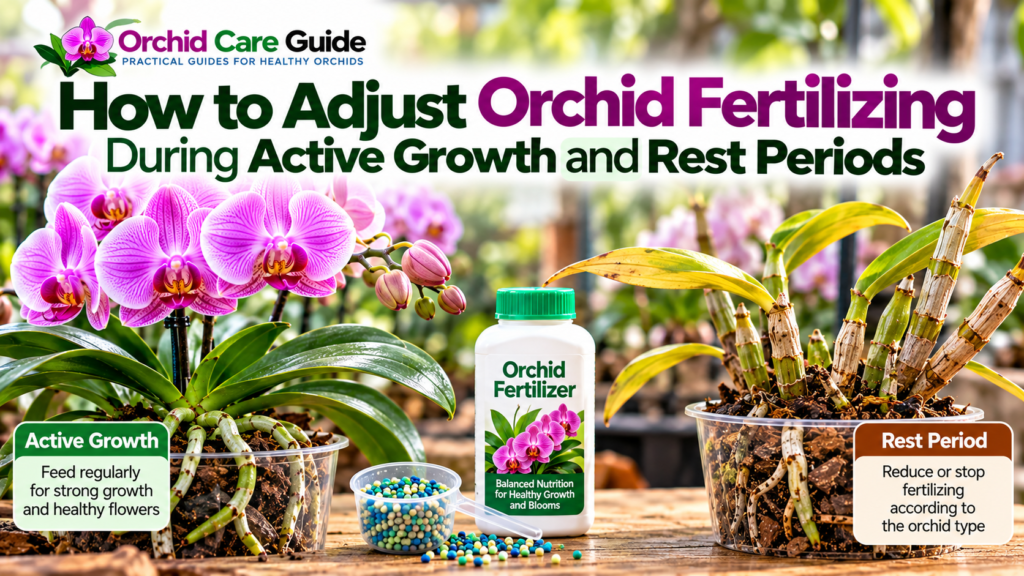
Orchids do not need the same amount of fertilizer throughout the year. Their nutritional requirements change as they produce new leaves, roots, shoots, and pseudobulbs, then slow down or enter a natural resting period.
Understanding these growth cycles helps you provide nutrients when an orchid can use them and avoid unnecessary feeding when growth has slowed. It can also reduce the risk of fertilizer salt buildup, root damage, and excessive vegetative growth.
The important point is that not every orchid follows the same seasonal schedule. Some continue growing throughout the year, while others need a distinct dry or cool rest before flowering. Your fertilizer routine should reflect the plant’s growth pattern, not simply the month on the calendar.
Why Orchid Fertilizing Should Change With the Growth Cycle
Fertilizer supplies essential nutrients that support leaf development, root growth, new shoots, and flowering. However, an orchid’s ability to use those nutrients depends partly on its current growth activity.
When an orchid is actively producing new roots, leaves, or pseudobulbs, it generally has a greater demand for nutrients. During a genuine rest period, growth and nutrient demand may decline considerably.
The American Orchid Society explains that fertilizer application should be matched to the orchid’s growth rate. It also emphasizes that different genera respond differently to seasonal conditions. For example, some orchids rest during winter, while Phalaenopsis can continue growing during that period.
This means a fixed feeding schedule can be unsuitable for a mixed orchid collection.
A plant receiving fertilizer every week may benefit during active growth but accumulate unnecessary salts when it stops growing. Conversely, an orchid that continues producing new roots may not benefit from having its fertilizer withheld simply because the weather has become cooler.
The goal is to adjust fertilizer according to visible growth, environmental conditions, and the specific requirements of the orchid.
How to Recognize Active Growth in Orchids
Active growth is the period when an orchid is developing new plant structures. These signs help you determine when regular, diluted feeding may be appropriate.
1. New roots are developing
New root growth is one of the clearest indicators of active development.
Look for fresh root tips that are green, reddish, or sometimes purple depending on the species. They may appear near the base of the plant or extend from the growing stem.
In Phalaenopsis, new roots often emerge around the base of the crown. In many Cattleya and other sympodial orchids, new roots develop from the base of a newly emerging growth.
When roots are actively developing and the plant is otherwise healthy, it is generally a suitable time to maintain a consistent, moderate fertilizer routine.
2. New leaves are emerging
New leaves indicate that the orchid is producing vegetative growth.
Phalaenopsis typically develops new leaves from the central crown. Other genera may produce leaves from new shoots or pseudobulbs.
As these structures develop, the plant uses nutrients to support new tissue formation. A suitable fertilizer program can help maintain healthy development.
However, new leaves alone do not justify stronger fertilizer concentrations. Consistent, diluted feeding is generally safer than applying concentrated fertilizer to accelerate growth.
3. New pseudobulbs or canes are developing
Many sympodial orchids, including Cattleya and some Dendrobium species, produce new growths that develop into pseudobulbs or canes.
These structures are important because they store water and nutrients that support future growth and flowering.
During this development stage, appropriate nutrition helps the plant produce strong, mature growths. As the pseudobulbs or canes approach maturity, fertilizer requirements may change.
4. The plant is growing consistently
Look at the orchid over several weeks rather than relying on a single observation.
If new roots, leaves, or shoots continue to appear, the plant is probably still actively growing.
Remember that flowering is not the only sign of activity. An orchid can be developing roots and leaves without producing a flower spike.
How to Fertilize During Active Growth
When an orchid is actively growing, maintain a regular feeding routine using a suitable orchid fertilizer at a diluted concentration.
A common approach is the weakly, weekly method, which means applying a relatively weak fertilizer solution during regular watering rather than using a strong concentration occasionally.
However, this is a general approach, not a universal requirement.
Iowa State University Extension recommends weak, balanced fertilizer during active growth, with half or quarter strength and application every other or every third watering as practical options. The University of Maryland Extension recommends light feeding for actively growing Phalaenopsis, generally every third or fourth watering.
These recommendations demonstrate why fertilizer frequency should be adapted to the plant and its growing environment.
Practical feeding guidelines
- Use a balanced orchid fertilizer appropriate for your growing conditions.
- Begin with a diluted concentration, often around one-quarter of the label recommendation.
- Apply fertilizer to an already hydrated root system rather than allowing concentrated fertilizer to contact dry roots.
- Adjust feeding frequency according to growth rate, watering frequency, and growing medium.
- Flush the pot periodically with plain water to help prevent fertilizer salt accumulation.
- Avoid increasing fertilizer concentration simply because the orchid appears to be growing slowly.
If you are unsure which fertilizer formula to use, read the guide to choosing the best fertilizer for orchids.
For a more detailed explanation of common fertilizer formulas, see orchid fertilizer ratios and what NPK numbers mean.
When and Why Orchids Enter a Rest Period
A rest period is a natural phase when certain orchids slow down or temporarily stop producing new growth.
Depending on the species, this may occur after flowering, during cooler months, or following the completion of a new pseudobulb or cane.
During this period, the plant may use stored energy and water rather than actively producing new structures.
Not all orchids have a pronounced dormancy.
For example:
- Phalaenopsis: Usually continues growing under suitable indoor conditions, although growth may slow during periods of lower light or cooler temperatures.
- Cattleya: Growth may slow after a pseudobulb matures. Some plants experience a quieter period, but Cattleyas do not generally require a completely dry winter dormancy.
- Dendrobium: Requirements vary considerably between species and groups. Some need a cooler, drier rest, while others continue growing with little interruption.
- Catasetum: Many enter a pronounced seasonal dormancy after their leaves fall, requiring a substantial reduction in watering and no fertilizer during dormancy.
- Habenaria: Some species have a seasonal dormant period during which their above-ground growth disappears and the underground storage structure remains inactive.
The American Orchid Society’s article on fertilizing orchids weakly weekly explains these differences and why some orchids should receive little or no fertilizer during dormancy.
The important lesson is to identify the orchid’s natural growth pattern before changing its feeding schedule.
How to Adjust Fertilizer During Rest Periods
When an orchid genuinely enters dormancy or stops producing new growth, reduce or discontinue fertilizer according to the species’ requirements.
Continuing to feed a plant that cannot use the supplied nutrients efficiently may contribute to salt accumulation in the growing medium.
Use these practical guidelines.
1. Reduce fertilizer as growth slows
Some orchids do not stop growing completely but gradually reduce their activity.
In this situation, reduce fertilizer frequency rather than automatically continuing the active-growth schedule.
For example, a plant previously receiving diluted fertilizer every second watering might receive fertilizer less frequently as new growth matures and environmental conditions become less favorable.
2. Stop feeding orchids in true dormancy
Orchids with a pronounced dormant period generally do not need regular fertilizer during that phase.
Catasetum and certain terrestrial orchids are examples of plants that may require fertilizer to be withheld during dormancy.
Do not confuse dormancy with a temporary pause in flowering. An orchid that has finished flowering may still be producing new roots or leaves and may continue to need nutrients.
3. Adjust watering as well as fertilizer
Rest periods often involve changes in water requirements.
Some Dendrobium groups need substantially less water during their cool rest. Certain dormant orchids should remain nearly dry until new growth appears.
However, never apply a dry-rest routine to an orchid simply because another genus requires it.
Watering requirements must follow the plant’s species or hybrid group, growing medium, temperature, and actual condition.
4. Resume feeding when new growth returns
When the orchid begins producing new roots, shoots, leaves, or pseudobulbs, gradually return to a suitable feeding schedule.
Start with a diluted fertilizer solution rather than immediately applying a strong concentration.
If the orchid has been dormant for an extended period, check the roots and growing medium before resuming regular watering and fertilizing.
How Different Orchid Genera Respond to Fertilizing Changes
A single fertilizer schedule cannot accommodate every orchid. The following comparison provides a general starting point.
| Orchid type | Active growth | Rest or slower growth |
|---|---|---|
| Phalaenopsis | Light, regular feeding while actively growing | Reduce or pause if growth slows under low light and cooler conditions |
| Cattleya | Feed during new root and pseudobulb development | Reduce feeding as growth matures and activity slows |
| Dendrobium nobile types | Feed during active cane development | Usually reduce or stop fertilizer during the cool, dry rest |
| Dendrobium Phalaenanthe types | Feed during active growth | Often require less pronounced seasonal adjustment |
| Catasetum | Feed during active leaf and pseudobulb development | Stop fertilizer during true dormancy |
| Paphiopedilum | Maintain light, consistent feeding during growth | Usually reduce feeding if growth slows, rather than imposing a dry dormancy |
These are broad cultural patterns, not rules for every species or hybrid. Dendrobium is particularly diverse, so identifying the group is essential before applying a seasonal rest routine.
For more information about the differences between orchid growth habits, consult the American Orchid Society’s orchid care resources.
Tropical Climates: Do Not Follow a Calendar Blindly
Many orchid care guides describe spring and summer as the active growing season and winter as the resting period.
That approach can be useful in temperate climates, but it does not always translate directly to tropical regions such as Indonesia.
In tropical growing environments, orchids may experience relatively consistent temperatures throughout the year. Instead of four distinct seasons, their growth can respond more strongly to:
- Rainfall patterns and dry periods.
- Changes in light intensity and day length.
- Temperature fluctuations.
- Humidity and air movement.
- Water availability.
- The natural growth cycle of the species.
A Phalaenopsis growing in a warm, bright location may continue producing roots and leaves throughout the year. Meanwhile, a Dendrobium species with a natural dry-rest requirement may still need a seasonal adjustment even in a tropical climate.
Therefore, observe the plant rather than assuming that December always means dormancy or that April always means active growth.
This distinction is especially important for growers who maintain several orchid genera in the same greenhouse.
Common Fertilizing Mistakes During Growth and Rest
Even experienced growers can make mistakes when adjusting fertilizer schedules.
Continuing the same feeding routine throughout the year
A fixed weekly schedule ignores changes in growth activity. Some orchids need less fertilizer when growth slows, while others continue to benefit from light feeding.
Stopping fertilizer immediately after flowering
Flowering and dormancy are not the same thing. Many orchids continue producing roots, leaves, or new pseudobulbs after their flowers fade.
If the plant remains actively growing, it may still benefit from appropriate nutrition.
For more details, read whether you should fertilize orchids while they are blooming.
Fertilizing a dormant orchid
Applying fertilizer during true dormancy provides little benefit and may contribute to salt accumulation, particularly when watering is also reduced.
Using stronger fertilizer to force new growth
More fertilizer does not necessarily produce faster or healthier growth.
Excessive feeding can damage roots, cause leaf-tip burn, and contribute to weak, overly lush growth.
If you notice white deposits on the growing medium or damaged root tips, investigate possible salt accumulation and fertilizer injury.
Ignoring water quality and growing medium
Fertilizer concentration is only one part of the equation.
Water containing substantial dissolved minerals can add to the total nutrient and salt load. Sphagnum moss and other moisture-retentive media may also retain fertilizer salts differently from coarse bark.
The American Orchid Society’s fertilizer guidance discusses how growing medium and water quality influence fertilizer management.
A Simple Fertilizer Adjustment Routine
Use the following routine as a starting point, then adapt it to the orchid’s needs.
| Plant condition | Fertilizer approach |
|---|---|
| New roots and leaves developing | Continue light, regular feeding |
| New pseudobulbs or canes developing | Maintain suitable diluted feeding |
| Growth approaching maturity | Gradually reduce feeding if activity slows |
| Flowers fading but new growth continues | Continue appropriate light feeding |
| True seasonal dormancy | Stop fertilizer when required by the species |
| New growth emerging after dormancy | Resume gradually with diluted fertilizer |
This approach is more reliable than applying the same fertilizer concentration and frequency to every plant.
For a broader overview of fertilizer frequency, read how often you should fertilize orchids.
If you have recently repotted an orchid, also consider its root condition before resuming fertilizer. See should you fertilize orchids after repotting?.
Frequently Asked Questions
Should I fertilize orchids every week during active growth?
Not necessarily. Weekly diluted feeding is a common approach, but other recommendations include feeding every second, third, or fourth watering. The appropriate frequency depends on fertilizer concentration, watering habits, growing medium, water quality, and orchid type.
Should I stop fertilizing orchids during winter?
Only if the orchid’s growth pattern and environmental conditions justify it. Some orchids enter dormancy during winter, while others, including many Phalaenopsis, can continue growing. Observe the plant rather than following the calendar alone.
Should I fertilize an orchid after it finishes flowering?
You can continue light feeding if the orchid is actively producing roots, leaves, or new pseudobulbs. The end of flowering does not automatically indicate dormancy.
How do I know when to start fertilizing again after dormancy?
Look for visible signs of renewed growth, such as new roots, leaves, shoots, or pseudobulbs. Resume watering and diluted fertilizer according to the species’ requirements.
Can too much fertilizer prevent orchids from flowering?
Excessive fertilizer can encourage lush vegetative growth at the expense of flowering in some circumstances. However, poor flowering can also result from inadequate light, unsuitable temperatures, or an incorrect seasonal rest. Fertilizer is only one part of successful flowering.
Final Thoughts
Successful orchid fertilizing is not about maintaining the same schedule throughout the year. It is about understanding when the plant is growing, when it is slowing down, and whether its particular species requires a genuine rest period.
During active growth, provide appropriate nutrition through a consistent, diluted feeding routine. As growth matures or dormancy begins, reduce or stop fertilizer when the orchid’s natural cycle requires it.
Most importantly, do not assume that every orchid follows the same seasonal pattern. Learn the growth habits of each genus, observe changes in roots and shoots, and adjust your fertilizer routine accordingly.
For a complete overview of fertilizer selection, application, nutrient management, and common mistakes, explore The Complete Guide to Fertilizing Orchids for Healthy Growth and Blooms.
Share this article