
Orchid fertilizer provides essential nutrients for healthy roots, leaves, and flowers. However, repeated fertilizer applications can leave mineral salts behind in the potting medium. Over time, these salts may accumulate around the roots, interfere with water absorption, and contribute to root damage.
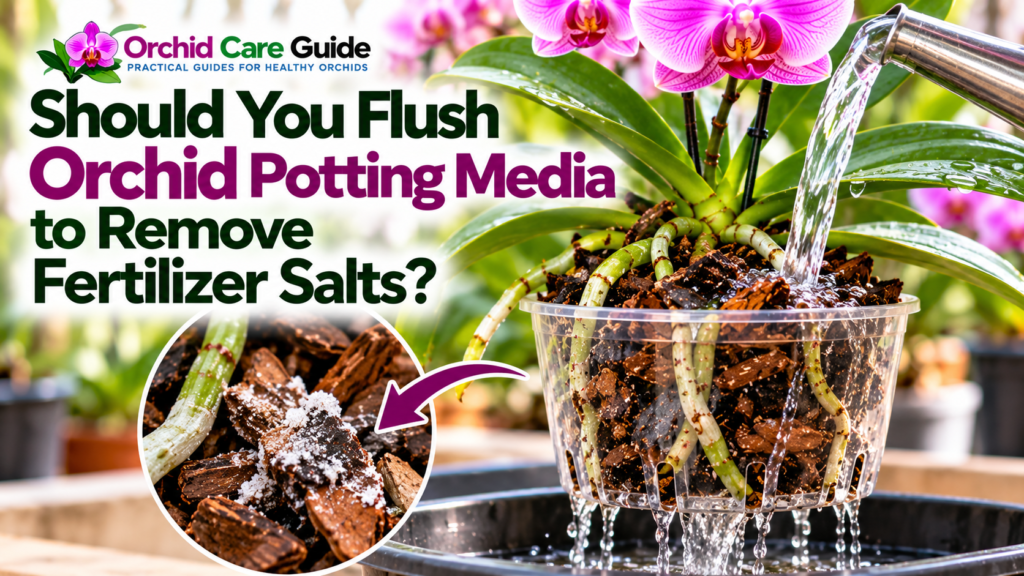
One way to manage this problem is flushing: watering the orchid thoroughly with plain water so dissolved salts can drain out through the bottom of the pot.
But should you flush orchid potting media regularly, or only when you notice white deposits? How much water should you use? And can flushing actually save an orchid that already has damaged roots?
The short answer is yes. Periodic flushing is a useful part of orchid care, especially when you use soluble fertilizer or mineral-rich water. However, flushing cannot correct every problem, and badly degraded potting media may need to be replaced.
This guide explains when and how to flush orchid potting media safely.
Why Do Fertilizer Salts Accumulate in Orchid Potting Media?
Most water-soluble orchid fertilizers contain mineral nutrients that dissolve in water. These dissolved nutrients are available for plant absorption, but the orchid does not use every mineral supplied with each application.
As water evaporates or is absorbed by the plant, some dissolved minerals remain behind.
Repeated watering and fertilizing can gradually increase the concentration of these substances in the growing medium.
Salt accumulation can come from several sources:
- Excessive fertilizer application: Using too much fertilizer or applying it too frequently can leave more mineral salts than the plant can use.
- Hard tap water: Water containing substantial dissolved minerals, including calcium and magnesium compounds, can leave deposits over time.
- Insufficient drainage: Water that remains in the pot or cannot drain freely may allow dissolved minerals to accumulate.
- Salt-retentive growing media: Sphagnum moss and some peat-based mixes can hold fertilizer salts more tightly than coarse, free-draining materials.
- Repeated watering without leaching: If water is applied in small amounts without periodically flushing the medium, accumulated minerals may remain around the roots.
The American Orchid Society explains that fertilizer minerals are chemically salts and that hard water can add to the total dissolved mineral load. Combining mineral-rich water with frequent fertilizer applications can increase the risk of salt accumulation.
This is why fertilizer strength, water quality, and growing medium should be considered together rather than treated as separate aspects of orchid care.
What Happens When Fertilizer Salts Build Up?
Orchid roots are sensitive to excessive concentrations of dissolved salts.
When the concentration of salts around the roots becomes too high, it can interfere with the movement of water into root tissues. This creates physiological stress even when the potting medium appears moist.
The damage may develop gradually.
1. Root tips become brown or black
Healthy orchid roots usually have firm tissue and active growing tips. Depending on the orchid and moisture conditions, healthy roots may appear green, silvery, or pale.
Excessive salt concentrations can damage sensitive root tips. You may notice brown or black areas, dead root tips, or roots that stop extending into the growing medium.
2. Root growth slows or stops
An orchid that is otherwise receiving suitable light, temperature, and watering may show unusually slow root development.
The American Orchid Society identifies poor root growth as a possible sign of excessive mineral salt concentration.
3. Leaf tips become brown
As root damage progresses, leaves may develop brown or black tips.
This symptom is not exclusive to fertilizer burn. Underwatering, low humidity, root rot, and other environmental problems can produce similar symptoms.
Look for additional evidence, such as salt crust on the potting medium and damaged roots, before concluding that fertilizer salts are responsible.
4. New growth becomes weaker
Severe salt accumulation can affect the plant’s overall development.
New roots may stop growing, leaves may become damaged, and pseudobulbs may develop poorly. If the problem continues, the orchid can become increasingly weak.
For more information about recognizing these symptoms, read How to Recognize Fertilizer Burn on Orchid Roots and Leaves.
When Should You Flush Orchid Potting Media?
Flushing is useful as routine maintenance and as a response to possible mineral accumulation.
You do not need to wait until an orchid shows visible damage. Preventive flushing can help keep soluble salts from reaching harmful concentrations.
Consider flushing in the following situations.
1. After repeated fertilizer applications
If you regularly use water-soluble fertilizer, periodically water with plain water to remove excess dissolved minerals.
Iowa State University Extension recommends skipping fertilizer at least once a month and thoroughly flushing orchid growing media with plain water.
The American Orchid Society also recommends flushing the root zone with fresh water at least monthly to help prevent mineral salt accumulation.
2. When white deposits appear
White or pale crusty deposits on the potting medium, pot surface, or mounting material may indicate accumulated minerals.
These deposits can originate from fertilizer or the water supply.
Flushing may help remove soluble deposits, but persistent crusting should prompt you to examine your water quality and fertilizer routine.
3. When you suspect overfertilization
If you have accidentally applied fertilizer at a much stronger concentration than recommended, flush the growing medium with plain water.
Do not add more fertilizer until you have assessed the orchid’s condition.
If root damage is already visible, flushing the medium may not be sufficient. The plant may need to be removed from its pot so damaged roots and deteriorated growing medium can be inspected.
4. When using mineral-rich water
If your tap water contains substantial dissolved minerals, regular flushing may be particularly important.
However, repeatedly flushing with the same mineral-rich water does not eliminate the underlying source of the problem. Consider testing your water or switching to a suitable lower-mineral source if accumulation continues.
How to Flush Orchid Potting Media Correctly
Flushing is straightforward, but drainage and the condition of the growing medium matter.
Follow these steps.
Step 1: Choose an appropriate time
Flush when the orchid needs watering or when the medium is suitable for thorough watering.
Avoid repeatedly soaking an orchid that is already wet, particularly if it is growing in moisture-retentive sphagnum moss.
The goal is to rinse accumulated minerals without keeping the roots excessively wet.
Step 2: Remove the decorative outer pot
If your orchid sits inside a decorative container, remove the growing pot first.
This allows water to drain freely and prevents the orchid from sitting in runoff containing dissolved salts.
Check that the growing pot has adequate drainage holes.
Step 3: Use plain, suitable water
Use water without added fertilizer.
Rainwater or appropriately treated low-mineral water can be useful when tap water is very hard.
The American Orchid Society identifies rainwater and fresh water without fertilizer as suitable options for flushing accumulated salts.
Use water at a comfortable, moderate temperature rather than extremely cold or hot water.
Step 4: Pour water slowly through the growing medium
Hold the orchid over a sink or suitable drainage area.
Pour water over the surface of the medium and allow it to pass through the pot and drain from the bottom.
Continue until the growing medium has been thoroughly wetted and excess water has flowed out.
The purpose is to dissolve and carry away soluble mineral residues, not simply wet the top layer of bark or moss.
Step 5: Allow the pot to drain completely
Let excess water escape through the drainage holes.
Empty the saucer or decorative container before returning the orchid to its usual location.
Never leave the growing pot standing in runoff water.
Step 6: Return to an appropriate watering routine
After flushing, allow the medium to dry according to the requirements of the orchid species and growing conditions.
Do not immediately repeat the process simply because the pot has been flushed.
For more information about watering practices, see the Complete Orchid Root Health and Diagnosis Guide.
How Much Water Should You Use?
There is no single exact volume that works for every orchid pot.
The amount depends on the pot size, growing medium, drainage, and how much mineral accumulation needs to be removed.
The important requirement is to use enough plain water to thoroughly wet the medium and allow dissolved minerals to drain out.
University of Maryland Extension recommends flushing indoor plant growing media from the top with several volumes of low-mineral water. Its general houseplant guidance describes using at least three times the container volume in fresh water for leaching.
That figure can be a useful reference, but it should not be applied blindly to every orchid.
A small orchid in coarse bark with excellent drainage behaves differently from one growing in tightly packed sphagnum moss.
For orchid growers, the practical priority is thorough rinsing combined with free drainage. If the medium remains saturated for too long, the watering approach or growing medium may need adjustment.
How Often Should You Flush Orchid Pots?
For many home growers, flushing approximately once a month is a practical starting point.
This is consistent with recommendations from Iowa State University Extension and the American Orchid Society.
However, monthly flushing is not an absolute rule.
The ideal frequency depends on several factors:
| Growing condition | Flushing approach |
|---|---|
| Regular soluble fertilizer use | Flush periodically, often monthly |
| Hard or mineral-rich water | Monitor deposits and consider more frequent leaching |
| Coarse bark with good drainage | Periodic thorough flushing is generally practical |
| Sphagnum moss or moisture-retentive media | Use careful, diluted feeding and avoid prolonged saturation |
| Low-mineral water and light fertilizer use | Less accumulation may occur, but continue monitoring |
| Visible salt deposits | Flush and investigate the source of the minerals |
Mounted orchids also need periodic rinsing because salts can accumulate around their roots and mounting material.
The American Orchid Society specifically recommends regular flushing for mounted plants.
Does Flushing Remove All Fertilizer Salts?
No. Flushing is useful, but it is not a complete solution to every salt accumulation problem.
Some minerals dissolve readily in water and can be carried out through the drainage holes. Others may remain attached to surfaces or become concentrated in areas that water does not reach effectively.
The growing medium also makes a difference.
The American Orchid Society notes that sphagnum moss and peat-based mixes can retain fertilizer salts more tightly, making them more difficult to flush than coarse or inorganic media.
If a growing medium has deteriorated, become compacted, or developed severe mineral accumulation, repeated flushing may not restore suitable root conditions.
In those cases, repotting into fresh, appropriate medium may be necessary.
When Should You Repot Instead of Flushing?
Flushing is most useful when the growing medium remains structurally sound and the salt accumulation is relatively manageable.
Repotting becomes more appropriate when the medium itself has become unsuitable.
Consider replacing the growing medium when:
- The bark has broken down into fine particles.
- The medium remains wet for too long.
- The roots are extensively damaged.
- Mineral deposits remain severe despite thorough flushing.
- The growing medium has become compacted and poorly aerated.
- The orchid has a serious root problem requiring inspection and removal of dead tissue.
The American Orchid Society recommends removing old medium and thoroughly flushing roots with plain water when an orchid has suffered fertilizer injury.
After repotting, avoid immediately applying concentrated fertilizer. Allow the plant to recover and resume feeding when its root condition and new growth indicate that it is ready.
Read Should You Fertilize Orchids After Repotting? for more detailed guidance.
Fertilizer Salts or Hard Water Deposits: How to Tell the Difference
Not every white deposit on an orchid pot is caused by fertilizer.
Hard water can leave mineral residues, particularly when the water contains substantial calcium carbonate and other dissolved minerals.
Fertilizer residues can also appear as white crystalline coatings.
Both may contribute to mineral accumulation around the root zone, and both can harm plants when concentrations become excessive.
| Observation | Possible explanation |
|---|---|
| White crust on bark or pot surface | Fertilizer salts, hard water minerals, or both |
| White deposits on leaves | Often mineral residue from hard water |
| Deposits increasing after fertilizer applications | Possible fertilizer salt accumulation |
| Deposits appearing even without fertilizer | Possible mineral-rich water |
| Brown root tips and poor root growth | Possible salt injury, but other causes must be ruled out |
Visual inspection alone cannot reliably identify the exact chemical composition of a deposit.
If the problem repeatedly returns, examine your water source and fertilizer concentration rather than relying on flushing alone.
University of Maryland Extension provides a useful explanation of mineral and fertilizer salt deposits on indoor plants.
Common Mistakes When Flushing Orchid Potting Media
1. Using fertilizer solution instead of plain water
The purpose of flushing is to remove excess dissolved minerals.
Adding more fertilizer defeats that purpose.
Use plain water without fertilizer during the flushing process.
2. Flushing without checking drainage
If water cannot escape freely, flushing can leave the orchid sitting in saturated medium.
Check the drainage holes and remove any water collected in the outer pot or saucer.
3. Using small amounts of water repeatedly
A light splash may wet only part of the growing medium.
For effective leaching, water must pass through the medium and carry dissolved minerals out of the container.
4. Assuming flushing will repair dead roots
Flushing may remove soluble salts, but it cannot restore dead or severely damaged root tissue.
Inspect the plant if root damage is suspected.
5. Ignoring water quality
If hard water is the main source of mineral deposits, flushing with the same water may provide only temporary improvement.
Consider a more suitable water source and review the fertilizer routine.
6. Applying fertilizer immediately after a serious salt problem
If the orchid has experienced fertilizer injury, adding more fertilizer too soon can worsen the stress.
Allow the plant to recover and use a diluted feeding routine when appropriate.
Frequently Asked Questions
Should I flush orchid pots every time I water?
Not necessarily. Thorough watering with good drainage is important, but a dedicated leaching routine with plain water is commonly recommended periodically, often monthly. The frequency depends on water quality, fertilizer use, and growing medium.
Can I flush orchids with tap water?
Yes, if the water is suitable and does not contain excessive dissolved minerals. If your tap water is very hard or has high total dissolved solids, consider rainwater or another suitable low-mineral source.
Can flushing damage orchid roots?
Flushing with suitable water is generally safe when the pot drains properly. Problems are more likely when the orchid remains saturated, the medium is poorly aerated, or the roots are already compromised.
Should I fertilize immediately after flushing?
You do not need to. Allow excess water to drain and follow the orchid’s normal watering and feeding requirements. If flushing was performed because of suspected fertilizer injury, withhold additional fertilizer until the plant has been assessed and is recovering.
Does flushing remove white mineral deposits from the outside of clay pots?
Flushing the growing medium may reduce soluble salts inside the pot, but it will not necessarily remove crusty deposits attached to the outside or inner walls of a clay container.
The pot may need to be cleaned separately. In severe cases, replacing it may be more practical.
Is flushing necessary if I use rainwater?
Rainwater generally contains fewer dissolved minerals than many tap water supplies, which can reduce the risk of mineral accumulation. However, fertilizer salts can still build up when soluble fertilizers are applied repeatedly. Periodic flushing remains useful.
Final Thoughts
Flushing orchid potting media is a simple but important maintenance practice. It helps remove accumulated soluble minerals from fertilizer and water before they reach concentrations that can damage sensitive roots.
For many growers, a thorough flush with plain water approximately once a month is a practical starting point.
However, the best routine depends on the orchid, water quality, fertilizer concentration, growing medium, and drainage.
Do not treat flushing as a substitute for correct fertilizing. Use an appropriate fertilizer concentration, monitor mineral deposits, maintain good drainage, and replace deteriorated growing medium when necessary.
For a complete understanding of orchid nutrition, fertilizer selection, feeding schedules, and salt management, explore The Complete Guide to Fertilizing Orchids for Healthy Growth and Blooms.
Share this article