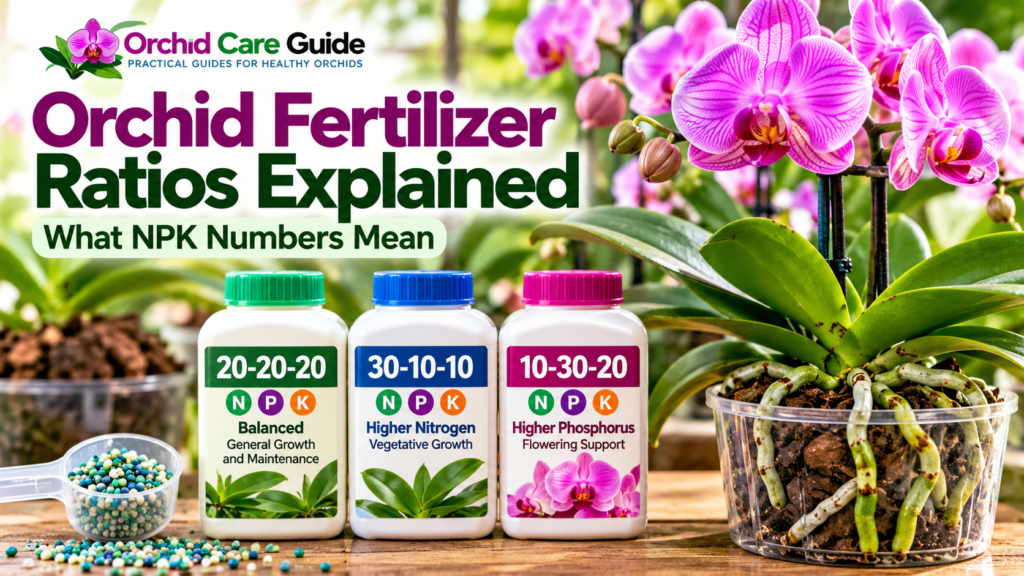
Choosing an orchid fertilizer can be confusing when every bottle displays a different combination of numbers. You may see formulas such as 20-20-20, 30-10-10, 10-30-20, or 10-10-10. These numbers represent the fertilizer’s NPK analysis, showing the relative amounts of three primary plant nutrients.
Understanding NPK helps orchid growers choose fertilizer more intelligently. However, a formula with a higher phosphorus number does not automatically produce more flowers, and a high nitrogen formula is not necessarily the best choice for every orchid.
The right fertilizer depends on the plant’s growth stage, growing medium, water quality, root condition, and overall growing environment.
This guide explains what each NPK number means, compares common orchid fertilizer ratios, and shows how to interpret fertilizer labels without relying on marketing claims.
1. What Do the Three NPK Numbers Mean?
NPK stands for three primary plant nutrients:
- N: Nitrogen
- P: Phosphorus
- K: Potassium
The numbers appear in the same order on fertilizer labels. For example, a fertilizer labeled 20-20-20 has a different nutrient analysis from one labeled 30-10-10.
These nutrients perform different functions in orchid development.
Nitrogen (N): Supports leaves and vegetative growth
Nitrogen is essential for producing proteins, chlorophyll, and other compounds involved in plant growth.
In orchids, nitrogen supports:
- New leaf development
- Stem and shoot growth
- Production of new vegetative tissue
- Chlorophyll formation
- General plant development
Insufficient nitrogen may contribute to pale leaves and slow growth. However, excessive nitrogen can encourage soft, overly vigorous vegetative growth and may interfere with flowering under some growing conditions.
Young orchids that are still developing their vegetative structure often require adequate nitrogen to support growth.
Phosphorus (P): Supports energy transfer and development
Phosphorus is involved in energy transfer, genetic material, cell membranes, and several metabolic processes.
In orchids, phosphorus contributes to:
- Root development
- Energy metabolism
- New tissue development
- Reproductive development
- Overall plant growth
Phosphorus is often associated with flowering fertilizers. However, this association is frequently misunderstood.
Phosphorus is necessary for flowering, but adding more phosphorus does not automatically trigger flower production. An orchid also needs appropriate light, temperature, maturity, healthy roots, and suitable growing conditions.
Potassium (K): Supports plant function and stress regulation
Potassium helps regulate water movement, enzyme activity, and several physiological processes.
It contributes to:
- Water regulation within plant tissues
- Enzyme activation
- Nutrient transport
- General plant vigor
- Responses to environmental stress
Potassium is important throughout the orchid’s growth cycle. It should not be considered a nutrient needed only during flowering.
2. How to Read an Orchid Fertilizer Label
Consider a fertilizer labeled:
20-20-20
This indicates that the product contains three primary nutrient components in the proportions shown on its guaranteed analysis.
On many fertilizer labels, particularly those following the conventional US fertilizer labeling system, the numbers represent:
- Total nitrogen (N)
- Available phosphate (P₂O₅)
- Soluble potash (K₂O)
This distinction matters because the second and third numbers are conventionally expressed as phosphate and potash equivalents, not necessarily as percentages of elemental phosphorus and potassium.
For example, a 20-20-20 fertilizer is not necessarily composed of 20% elemental nitrogen, 20% elemental phosphorus, and 20% elemental potassium.
Always check the guaranteed analysis on the product label and the labeling convention used in your country.
What does the percentage mean?
A fertilizer labeled 20-20-20 contains a higher nutrient concentration by weight than a 10-10-10 fertilizer, assuming both use the same labeling convention.
This is important because the ratio and the concentration are not the same thing.
A 20-20-20 and a 10-10-10 have the same relative NPK proportions. However, the 20-20-20 product provides twice the labeled nutrient concentration per equal weight of fertilizer.
This means that you cannot determine the correct dilution simply by looking at the three numbers.
You must also consider the fertilizer’s recommended application rate.
3. Common Orchid Fertilizer Ratios Explained
Different NPK formulas are commonly marketed for different growing purposes. Understanding their intended applications helps you evaluate whether a product is suitable for your orchid.
20-20-20: Balanced fertilizer
A balanced fertilizer supplies nitrogen, phosphorus, and potassium in equal proportions.
It is commonly used for general orchid maintenance because it provides all three primary nutrients without emphasizing one over the others.
Potential applications include:
- General vegetative growth
- Maintenance of established orchids
- Routine nutrient supplementation
- Orchids growing in media that do not require a specialized nitrogen formulation
The University of Guam Cooperative Extension identifies 20-20-20 as one of the common fertilizer formulations used in orchid culture.
A balanced formula is a practical starting point for many hobby growers, provided the concentration and application schedule are appropriate.
30-10-10: Higher nitrogen formula
This formula contains a greater proportion of nitrogen than phosphorus or potassium.
It is commonly marketed for vegetative growth and may be considered when an orchid is actively producing leaves, shoots, or other vegetative structures.
It may be useful in some bark based growing systems because certain growing media can influence nitrogen availability.
The University of Guam Cooperative Extension notes that orchids growing in fir bark may require slightly higher nitrogen fertilizer formulations.
However, this does not mean every orchid growing in bark automatically needs 30-10-10.
The condition of the plant, fertilizer concentration, and growing environment still matter.
10-30-20: Higher phosphorus formula
This formula contains a higher proportion of phosphorus relative to nitrogen and potassium.
It is commonly marketed as a bloom booster or flowering fertilizer.
The traditional idea is that a higher phosphorus proportion supports reproductive development. However, the relationship between phosphorus and flowering is more complicated than fertilizer marketing often suggests.
An orchid cannot be forced to flower simply by switching to a fertilizer with a higher middle number.
The plant must first reach the appropriate stage of maturity and receive suitable environmental conditions.
10-10-10: Balanced fertilizer at a lower concentration
This formula has the same NPK proportions as 20-20-20 but a lower nutrient concentration by weight.
It may be suitable for growers who prefer a lower concentration product, depending on the manufacturer’s instructions and the orchid’s nutritional requirements.
Remember that a lower percentage does not automatically mean that the product should be applied more frequently. Follow the recommended dilution and observe the plant’s response.
4. Does a Higher Phosphorus Ratio Produce More Orchid Flowers?
This is one of the most common misconceptions in orchid fertilization.
Many products use terms such as bloom booster, flowering formula, or blossom fertilizer. These labels can create the impression that increasing phosphorus is the most important step in producing more flowers.
Scientific findings show that the relationship is not that simple.
A study published in HortScience by Yin-Tung Wang in 2000 examined the effects of high phosphorus fertilizer and the timing of fertilizer termination on flowering in hybrid Phalaenopsis. The research did not support the assumption that high phosphorus automatically improves flowering.
However, a later study published in Subtropical Plant Science in 2023 examined different NPK nutrient solutions in two mature Phalaenopsis cultivars. It found that certain treatments with adjusted phosphorus and nitrogen proportions improved aspects of flower stalk development and flowering performance compared with the control treatment.
These findings are not necessarily contradictory. They demonstrate that nutrient ratios can influence flowering under particular experimental conditions, but the results depend on the cultivar, nutrient formulation, concentration, and growing environment.
The practical conclusion is that a higher phosphorus fertilizer is not a universal flowering solution.
Before changing fertilizer formulas, make sure your orchid receives appropriate light, temperature, watering, and root care.
5. Which NPK Ratio Should You Use at Different Growth Stages?
An orchid’s nutritional requirements can change throughout its development.
A practical approach is to consider the plant’s actual growth rather than automatically changing fertilizer every season.
| Orchid growth stage | Nutritional consideration |
|---|---|
| Young orchid | Adequate nitrogen supports vegetative development |
| Active leaf growth | Balanced nutrition with sufficient nitrogen |
| Active root growth | Maintain an appropriate supply of essential nutrients |
| Mature plant before flowering | Maintain balanced nutrition and suitable growing conditions |
| Flowering period | Avoid excessive fertilizer and unnecessary formula changes |
| Resting period | Reduce or pause feeding according to the orchid’s growth cycle |
The Indonesian Ministry of Agriculture’s agricultural literacy publication discusses the use of different NPK proportions according to orchid growth stages. It describes 30-10-10 for vegetative growth in young orchids, 10-10-10 for vegetative growth in mature plants, and 10-30-30 for generative development.
These are cultivation recommendations, not universal formulas for every orchid genus or growing environment.
For a more detailed feeding schedule, see How to Adjust Orchid Fertilizing During Active Growth and Rest Periods.
6. Does the Growing Medium Affect Your Fertilizer Choice?
Yes. The growing medium can influence how nutrients are retained and made available to orchid roots.
Orchids growing in bark
Bark based media are commonly used for epiphytic orchids such as Phalaenopsis, Cattleya, and many Dendrobium hybrids.
Fresh bark generally holds relatively little nutrient reserve. As bark decomposes, microorganisms also interact with available nitrogen.
The University of Guam Cooperative Extension notes that some growing media, particularly fir bark, may require a fertilizer with a slightly higher nitrogen content.
This is one reason 30-10-10 has traditionally been used in some bark based orchid growing systems.
However, the correct fertilizer concentration remains important. Increasing nitrogen without considering the total fertilizer dose can create unnecessary salt accumulation.
Orchids growing in sphagnum moss
Sphagnum moss retains more moisture than coarse bark.
Because moisture remains around the roots longer, fertilizer application should be adjusted to the watering routine and the condition of the medium.
Avoid allowing fertilizer salts to accumulate through repeated applications without adequate flushing.
Orchids growing in other media
Tree fern fiber, charcoal, coconut based materials, and mixed growing media all have different physical and nutrient retention characteristics.
Do not assume that the same fertilizer program will work equally well in every medium.
7. What About Micronutrients?
NPK numbers do not tell the whole story.
Orchids also require secondary nutrients and micronutrients for healthy development.
These include:
- Calcium
- Magnesium
- Sulfur
- Iron
- Manganese
- Zinc
- Boron
- Copper
- Molybdenum
Some orchid fertilizers include these nutrients in addition to the main NPK components.
Calcium and magnesium are particularly relevant when considering water quality and nutrient balance.
A fertilizer containing 20-20-20 may look complete based on its primary nutrient numbers, but you should still inspect the full guaranteed analysis to see whether secondary nutrients and trace elements are included.
A well formulated fertilizer with appropriate micronutrients can be more useful than choosing a product solely because it displays a particular NPK ratio.
8. How to Apply Orchid Fertilizer Safely
Choosing an appropriate NPK ratio is only part of successful fertilization.
Incorrect concentration and application frequency can damage roots even when the fertilizer formula is suitable.
Follow these practical guidelines:
Follow the product instructions
Different products have different concentrations. Never assume that every 20-20-20 fertilizer requires the same dilution.
Avoid unnecessarily strong solutions
The University of Guam Cooperative Extension recommends frequent applications of dilute fertilizer solutions and describes half the recommended strength as a cautious approach for many orchid growing situations.
Seedlings may require even more dilute solutions.
Consider water quality
Tap water, well water, and rainwater contain different amounts of dissolved minerals. Water quality can affect the total concentration of dissolved salts around orchid roots.
Flush the growing medium periodically
Use plain water periodically to help remove accumulated soluble fertilizer residues.
Adjust feeding to active growth
Reduce or pause feeding when an orchid enters a genuine resting period or when its root system is unhealthy.
For more information, see What Does Fertilizer Salt Buildup Look Like on Orchids?.
9. Common NPK Fertilizer Mistakes
Avoid these common mistakes when selecting orchid fertilizer.
Choosing fertilizer only by the highest number
A higher NPK number does not automatically mean better results.
The fertilizer concentration, dilution, and actual nutrient requirements are more important than selecting the product with the largest numbers.
Assuming bloom booster guarantees flowering
High phosphorus formulas do not override unsuitable light, temperature, plant maturity, or root conditions.
Using different fertilizers too frequently
Constantly changing formulas makes it difficult to evaluate how the plant responds.
Establish a consistent feeding routine and change it only when there is a clear reason.
Ignoring micronutrients
NPK is important, but orchids also need secondary nutrients and trace elements.
Applying fertilizer to unhealthy roots
A plant with damaged roots cannot necessarily benefit from increased nutrient application. Address root health and growing conditions first.
Confusing fertilizer ratio with fertilizer strength
A 30-10-10 and a 10-10-10 have different nutrient proportions. A 30-10-10 and a 15-5-5 have the same relative ratio, but the former has twice the labeled nutrient concentration per equal weight.
Understanding this difference helps prevent incorrect mixing.
10. Frequently Asked Questions
Is 20-20-20 good for orchids?
A balanced 20-20-20 fertilizer can be suitable for many orchids when properly diluted and applied according to the plant’s growth and growing conditions. It is a practical general purpose option, not a universal requirement.
Is 30-10-10 better for orchid growth?
It provides a higher proportion of nitrogen and may be useful in some vegetative growth programs. However, it is not automatically better for every orchid.
Does 10-30-20 make orchids bloom faster?
Not necessarily. It supplies a higher phosphorus proportion, but flowering also depends on maturity, light, temperature, root health, and other environmental factors.
Can I use 10-10-10 fertilizer on orchids?
Yes, provided the product is suitable for orchids and diluted according to its instructions. It has the same relative NPK proportions as 20-20-20 but a lower concentration by weight.
Should I change fertilizer when my orchid starts flowering?
Not automatically. A healthy orchid may continue receiving an appropriate feeding routine during flowering. Avoid increasing fertilizer concentration simply because flowers are developing.
Which NPK ratio is best for Phalaenopsis?
There is no single ratio that is best for every Phalaenopsis. A balanced fertilizer is a practical starting point for many growers, while more specialized nutrient formulations may be appropriate under particular cultivation conditions.
Conclusion
Understanding NPK numbers makes it easier to select orchid fertilizer based on actual nutritional requirements rather than marketing claims.
Nitrogen supports vegetative growth, phosphorus contributes to energy metabolism and reproductive development, and potassium supports essential physiological processes.
Formulas such as 20-20-20, 30-10-10, and 10-30-20 offer different nutrient proportions, but none guarantees healthy roots or abundant flowers.
Choose a suitable formulation, follow the correct dilution, consider the growing medium and water quality, and adjust feeding according to the orchid’s actual growth stage.
The most effective fertilizer program is not necessarily the one with the most impressive NPK numbers. It is the one that consistently supplies appropriate nutrients without creating excessive salt accumulation or stressing the roots.
Build your orchid care knowledge with The Orchid Care Guide: 200 Essential Orchid Care Posters, a planned collection of printable A5 visual guides covering practical orchid care topics explored throughout this blog.
Share this article