
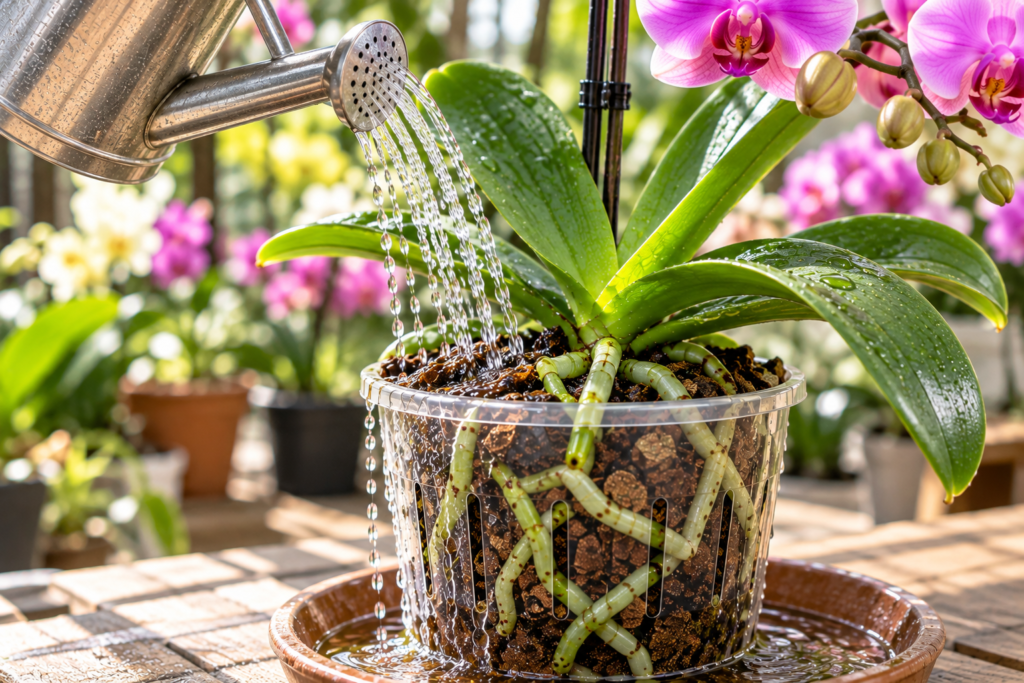
Knowing when to water an orchid is one of the most important skills for keeping it healthy. Water too early, and the roots may remain wet for too long. Wait too long, and the plant may become dehydrated, developing wrinkled leaves or dry roots.
The challenge is that orchids do not always show their watering needs in obvious ways. A dry-looking surface does not necessarily mean the entire pot is dry, and drooping leaves do not always mean an orchid needs more water.
Fortunately, you can learn to recognize several reliable signs by checking the roots, pot weight, growing medium, and overall condition of the plant.
This guide explains how to tell when an orchid needs water, how to recognize signs of overwatering, and how to develop a watering routine that suits your growing conditions.
1. Check the Color of the Roots
For many Phalaenopsis orchids grown in transparent pots, root color is one of the easiest indicators of moisture.
Healthy roots may change appearance depending on whether they are wet or dry.
Green roots
Phalaenopsis roots often appear green when hydrated. If the roots are green and the growing medium is still moist, the orchid may not need watering yet.
However, green roots alone do not guarantee that the entire pot contains enough moisture. Check the medium and pot weight as well.
Silvery or pale roots
When many exposed Phalaenopsis roots dry, their outer surface often becomes silvery gray or pale. This can indicate that watering may be needed, especially if the pot also feels light and the medium has approached dryness.
Do not wait for every root to become completely dry before watering. Consider the overall condition of the root system and growing medium.
Brown or black roots
Brown or black roots are not simply a sign that an orchid needs water. If they are soft, mushy, hollow, or have outer tissue that slips off, they may be damaged or rotting.
Adding more water will not solve a root problem that prevents the plant from absorbing moisture.
For more guidance, read How to Water an Orchid Without Causing Root Rot.
Important: Root color is most useful for orchids whose roots visibly change color with moisture. Other orchid species may have different root appearances, so use additional signs to assess their watering needs.
2. Lift the Pot to Check Its Weight
Pot weight is a practical way to estimate how much moisture remains in the growing medium.
After watering, lift the orchid pot and notice how heavy it feels. Once the medium has dried, lift it again and compare the difference.
A pot that feels noticeably lighter may be approaching the next watering.
This method becomes more reliable with practice because you learn how your particular orchid feels when freshly watered and when approaching dryness.
How to use pot weight
- Lift the pot immediately after watering and draining.
- Remember its approximate weight.
- Check the pot again over the following days.
- Compare the weight with the condition of the roots and medium.
- Water when the combined signs indicate that moisture is needed.
Pot weight is not a precise measurement. A large pot can remain heavy even when the surface has dried, while a small bark-filled pot may become light relatively quickly.
Use this method alongside root inspection rather than relying on it alone.
3. Inspect the Growing Medium
The growing medium provides important clues about whether your orchid needs water.
Many Phalaenopsis orchids grow in bark, sphagnum moss, or a mixture of materials. These media retain different amounts of moisture and dry at different rates.
Orchid bark
Bark generally drains well and allows air to circulate around the roots. As it dries, it may become lighter in color and feel dry to the touch.
However, the top layer may dry before the material deeper inside the pot. Check the medium throughout the pot when possible.
Sphagnum moss
Sphagnum moss can retain substantial moisture. The surface may appear dry while the center remains damp, particularly when the moss is tightly packed or the pot is large.
Avoid watering based only on the appearance of the surface.
Mixed potting media
Orchid mixes containing bark, moss, perlite, or other materials may dry unevenly. Their watering needs depend on the mixture, pot size, airflow, and environment.
A simple moisture check
Look through a transparent pot when possible, inspect the medium carefully, and compare its moisture with the pot’s weight.
If the medium is still noticeably damp and the roots appear hydrated, it may be better to wait. If the medium has approached dryness and the other indicators agree, the orchid may be ready for water.
Learn how these factors affect your routine in How Often Should You Water an Orchid?.
4. Look for Condensation Inside the Pot
Condensation on the inside of a transparent orchid pot can provide another clue about moisture.
If droplets are visible on the inner walls, moisture is present inside the pot. Depending on the growing medium and environment, this may suggest that watering can wait.
However, condensation is not a perfect indicator. It is affected by temperature differences, humidity, airflow, and the pot’s location.
A pot may have no visible condensation while some of the medium remains moist. Similarly, condensation can occur even when the roots are not evenly hydrated.
Use condensation as supporting evidence, not as your only watering test.
5. Observe the Leaves Without Relying on Them Alone
Orchid leaves can help you assess plant health, but their appearance does not always tell you when to water.
Firm, healthy leaves
Firm leaves generally indicate that the plant is maintaining hydration. If the roots and medium also show adequate moisture, immediate watering may not be necessary.
Wrinkled or limp leaves
Wrinkled, limp, or leathery leaves can indicate dehydration. However, these symptoms may also occur when damaged roots cannot absorb enough water.
If the medium is already wet, adding more water may worsen the problem.
Inspect the roots and growing medium before changing your watering routine.
Yellowing leaves
Yellowing leaves can have several causes, including natural aging, root damage, excessive moisture, light problems, and other growing conditions.
Do not automatically assume that yellow leaves mean the orchid needs more water.
For additional guidance, read The Complete Guide to Watering Orchids: When, How, and How Much.
6. Consider Temperature, Humidity, and Airflow
An orchid’s watering needs change as its environment changes.
Warm temperatures, low humidity, increased airflow, and certain growing conditions can cause the medium to dry faster. Cool temperatures and high humidity can slow drying.
This means an orchid that needed water every seven days during one period may need a different interval later.
Check the plant more frequently when the weather changes, but do not assume that hot weather automatically requires daily watering.
Likewise, avoid watering simply because several days have passed if the medium is still too wet.
For more detailed advice, see How to Adjust Orchid Watering in Hot or Humid Weather.
7. Combine the Signs Before Watering
The most reliable way to decide whether an orchid needs water is to consider several indicators together.
Use this simple checklist:
- Roots: Are the visible roots silvery or pale rather than green and hydrated-looking?
- Pot weight: Does the pot feel lighter than it did after watering?
- Growing medium: Has the medium approached the appropriate level of dryness?
- Condensation: Is there little or no condensation, if it is normally visible?
- Environment: Have temperature, humidity, or airflow changed enough to affect drying?
You do not need every indicator to agree perfectly. Instead, learn how they work together for your particular orchid and growing setup.
If the medium remains wet, the pot feels heavy, and the roots appear hydrated, watering may be unnecessary.
If the medium has approached dryness, the pot feels light, and many visible Phalaenopsis roots are silvery, watering is more likely to be appropriate.
8. How to Water When Your Orchid Is Ready
Once you determine that your orchid needs water, the next step is to hydrate the roots without leaving them in stagnant moisture.
For many potted epiphytic orchids, follow this method:
- Water the growing medium evenly and thoroughly.
- Allow excess water to flow freely through the drainage holes.
- Let the pot drain completely.
- Empty any water collected in an outer container or saucer.
- Remove water trapped in the crown or leaf joints of a Phalaenopsis orchid, especially when airflow is limited.
Avoid giving repeated small splashes that wet only part of the root system.
The amount of water and the interval between waterings will depend on the orchid, pot, medium, and environment.
For a full explanation of watering methods and quantities, read The Complete Guide to Watering Orchids: When, How, and How Much.
9. Warning Signs That Your Orchid May Be Overwatered
An orchid that looks dehydrated may not always need more water. Sometimes the roots are damaged and cannot absorb moisture properly.
Watch for these warning signs:
- Roots that are soft, mushy, brown, or black.
- Growing medium that stays wet for an unusually long time.
- An unpleasant smell coming from the pot.
- Leaves that become limp while the medium remains wet.
- A pot that drains poorly or contains compacted, decomposing medium.
These symptoms can have more than one cause, so inspect the plant before deciding what treatment is needed.
If you suspect overwatering, check the roots and medium, improve drainage where necessary, and remove clearly rotten roots if appropriate. Do not leave a badly damaged orchid completely dry for an extended period in an attempt to correct root rot.
Read What to Do When Your Orchid Has Been Overwatered for recovery guidance.
Common Mistakes When Checking Orchid Watering Needs
Following a fixed schedule
Watering every seven days may work in some conditions, but it should not replace checking the plant.
Looking only at the surface
The top of the medium may dry while the center remains moist, especially in larger pots or sphagnum moss.
Assuming limp leaves always mean thirst
Damaged roots can prevent water uptake even when the medium is wet.
Ignoring the potting medium
Different materials retain different amounts of water. Your watering decisions should reflect the medium in which the orchid grows.
Treating all orchid species alike
Phalaenopsis root color is useful for many growers, but other orchid types may require different indicators and moisture conditions.
Frequently Asked Questions
Should orchid roots be green or white when they need water?
For many Phalaenopsis orchids, hydrated roots appear green, while dry roots often appear silvery or pale. Other orchid species may differ, so check the medium and pot weight as well.
Should I wait until all orchid roots turn silver?
No. Root color is only one indicator, and you should not deliberately leave roots dehydrated for an extended period. Consider the medium, pot weight, and overall plant condition.
Can I tell if an orchid needs water by touching the leaves?
Not reliably. Firm leaves may indicate good hydration, while wrinkled or limp leaves can signal a problem. However, damaged roots may prevent water uptake, so inspect the roots and medium before watering more.
Is it better to underwater or overwater an orchid?
Neither is ideal. Prolonged dryness can damage roots and leaves, while persistent saturation can cause root loss. The goal is to provide adequate moisture while maintaining good root aeration.
How often should I check my orchid?
Check it regularly, especially while learning how quickly the pot dries. You may need to inspect more frequently during changes in temperature, humidity, or airflow, but only water when the plant’s conditions indicate that it is needed.
Final Thoughts
Knowing when an orchid needs water becomes easier when you learn to read the plant rather than rely on a calendar.
For many Phalaenopsis orchids, silvery roots, a lighter pot, and a growing medium approaching dryness are useful indicators. Combine these signs and adjust your routine to the orchid’s species, potting medium, and environment.
Water thoroughly when needed, allow excess water to drain, and investigate root health if the plant shows signs of dehydration despite a wet medium.
With practice, you will become more confident in recognizing when your orchid needs water and avoiding the common mistakes that can lead to dehydration or root rot.
Master Orchid Care With The Complete Orchid Care Library
Want to become more confident in watering orchids, identifying root problems, and making better care decisions? The Complete Orchid Care Library brings together practical orchid care ebooks and visual guides to help you understand common orchid problems and care for your plants with greater confidence.
Get The Complete Orchid Care Library Here
Share this article