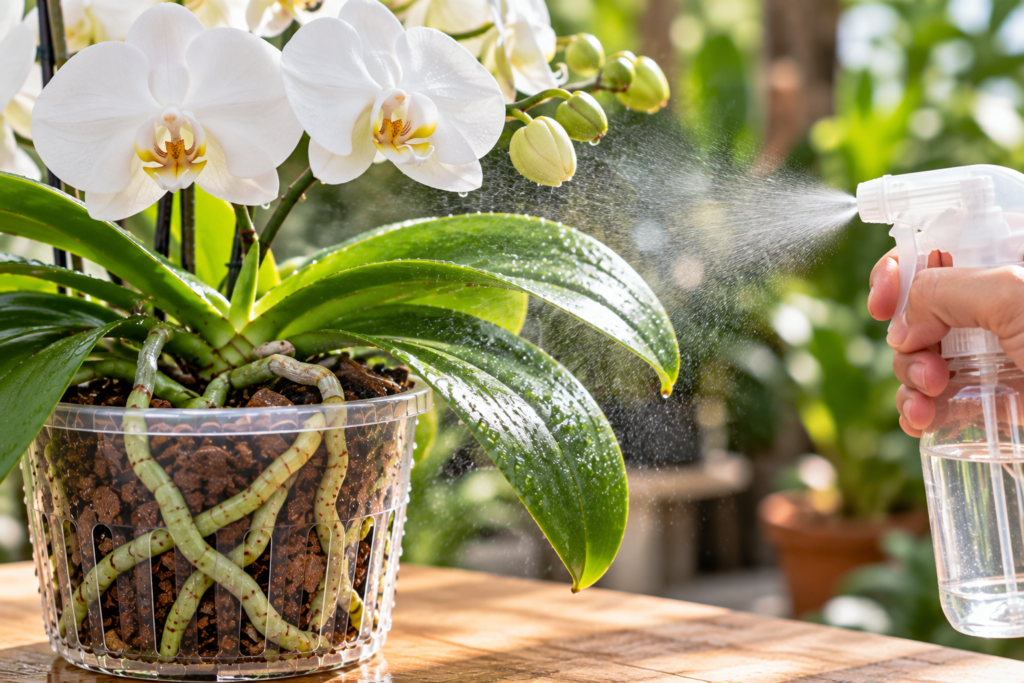
Misting orchids is one of the most debated topics in orchid care. Some growers mist their plants every morning, while others avoid spraying the leaves entirely. So, is misting orchids helpful or harmful?
The answer depends on the type of orchid, where the water lands, how quickly it dries, and the purpose of misting.
Misting can briefly wet exposed orchid roots and cool plant surfaces, but it usually does not provide enough water for a potted orchid or meaningfully increase room humidity. For most Phalaenopsis orchids grown indoors, proper watering and stable humidity are more effective than relying on a spray bottle.
Understanding the difference between misting, watering, and increasing humidity will help you choose the right approach for your growing conditions.
Does Misting Actually Help Orchids?
Misting has limited benefits, but it is not a substitute for proper orchid care.
Many orchids are epiphytes, meaning they naturally grow on trees rather than in soil. Their exposed roots encounter rain, dew, and moisture in the air. These adaptations help them use available moisture, but they do not eliminate the need for adequate hydration.
According to the American Orchid Society’s guidance on humidity and air movement, spraying plants does not significantly raise the humidity of the surrounding air. Any increase is temporary.
Misting may be useful in specific situations, such as briefly wetting exposed roots or cooling plants in hot conditions when droplets can evaporate quickly. However, its benefits are limited when compared with thorough watering and appropriate environmental control.
For a potted orchid, most of the water it needs should come through its roots and growing medium.
Does Misting Increase Humidity Around Orchids?
Only temporarily, and usually not enough to make a meaningful difference indoors.
Humidity refers to the amount of water vapor in the air. Misting deposits liquid droplets on plant surfaces, but those droplets evaporate relatively quickly. This may create a brief local change, yet it does not maintain the consistent humidity that many orchids prefer.
For many commonly grown orchids, a relative humidity range of roughly 40% to 70% is a useful general reference. The ideal level varies by species, temperature, airflow, and growing environment.
If the air around your orchids is too dry, consider these alternatives.
Use a Room Humidifier
A humidifier can increase the moisture content of the surrounding air more consistently than hand misting. A hygrometer helps you measure the actual humidity instead of guessing.
Maintain air circulation as humidity rises. Warm, damp conditions with stagnant air can encourage fungal and bacterial problems.
Group Plants Together
Grouping plants can create a slightly more humid microclimate as moisture evaporates from their growing media and leaves. However, avoid crowding them so tightly that air circulation is restricted.
Use a Humidity Tray Correctly
A shallow tray containing pebbles and water may provide a small local benefit. Keep the orchid pot elevated above the waterline. The roots should not sit in standing water.
For more guidance, see the American Orchid Society’s humidity and air movement recommendations.
Is Misting Orchid Roots Good?
Misting exposed orchid roots can be useful in certain growing setups, but the results depend on how the orchid is cultivated.
Potted Phalaenopsis Orchids
For a Phalaenopsis growing in bark or sphagnum moss, misting the visible roots is not a replacement for watering the entire growing medium.
A few sprays may wet the exposed roots without adequately hydrating the roots inside the pot. Instead, check the moisture level and water thoroughly when the plant needs it.
Learn the signs in How to Tell When an Orchid Needs Water.
Mounted Orchids
Mounted orchids have exposed roots and little or no potting medium to retain moisture. These roots can dry quickly, especially in warm conditions or strong airflow.
Misting may provide temporary moisture, but many mounted orchids need more thorough and frequent watering, depending on their species and environment.
Orchids With Aerial Roots
Aerial roots growing outside the pot are normal for many orchids, particularly Phalaenopsis. They do not automatically need to be misted every day.
Assess the plant as a whole. If the potting medium is dry and the orchid needs water, misting only the aerial roots will not adequately hydrate the entire root system.
Can Misting Orchids Cause Root Rot?
Misting alone is not usually the main cause of root rot. Root rot is more closely associated with roots remaining in unsuitable, persistently wet conditions with insufficient oxygen.
However, misting can contribute to problems when it keeps plant surfaces or the growing area continuously damp without adequate airflow.
Watch for these conditions:
- Water repeatedly collecting in the crown or between leaves.
- Leaves and growing points remaining wet for long periods.
- A potting medium that stays saturated between waterings.
- Poor air circulation around densely grouped plants.
- Cool, damp conditions that slow evaporation.
For Phalaenopsis orchids, take particular care to keep water from collecting in the crown, where the leaves meet. If water gets trapped there, gently remove it with absorbent tissue.
If your orchid develops soft, dark, or mushy roots, inspect the root system and growing medium rather than assuming that misting is the only problem.
Read How to Water an Orchid Without Causing Root Rot for practical prevention steps.
Is It Safe to Mist Orchid Leaves?
Occasional droplets on healthy leaves are not automatically harmful. The concern is repeated or prolonged leaf wetness, especially when air circulation is poor or the plant remains damp overnight.
Some orchids can tolerate wet foliage in suitable conditions. Others are more vulnerable to leaf spots and infections when moisture persists on their surfaces.
If you choose to mist:
- Mist early enough in the day for surfaces to dry.
- Provide gentle air movement around the plant.
- Avoid leaving water trapped in the crown or leaf joints.
- Use clean water to reduce mineral residue on foliage.
- Avoid misting plants that already show signs of leaf disease until you have assessed the cause.
Misting should not be treated as a universal daily requirement. If it creates persistent wetness without solving a real growing problem, it may be unnecessary.
Should You Mist Orchids Every Day?
Not necessarily. Daily misting is not required for every orchid, and a fixed misting routine can distract from more important factors such as root hydration, growing medium, temperature, and humidity.
Consider your growing setup.
Indoors in a typical home: Misting usually does little to change room humidity. Focus on proper watering, suitable light, and stable environmental conditions.
In a warm greenhouse: Misting may be part of a broader humidity or cooling system, provided it is managed carefully and air circulation is adequate.
For mounted orchids: Exposed roots may benefit from frequent moisture, but the plant may need thorough watering rather than occasional sprays alone.
During hot weather: Misting can provide temporary evaporative cooling, but the effect does not last long. Adequate hydration and airflow are more dependable ways to support orchids through heat.
The American Orchid Society’s guidance on heat stress emphasizes the importance of watering needs, humidity, and continuous air movement during hot conditions.
Misting vs. Watering: What Is the Difference?
These methods serve different purposes.
| Method | Main purpose | Main limitation |
|---|---|---|
| Misting | Briefly wets exposed surfaces and roots | Usually does not hydrate the entire root system |
| Top watering | Thoroughly wets the growing medium and roots | Requires adequate drainage and appropriate timing |
| Soaking | Allows the medium to absorb water through the pot | Requires clean water and complete drainage |
| Humidifier | Increases water vapor in the surrounding air | Needs monitoring and adequate air circulation |
For most potted Phalaenopsis orchids, thorough watering when needed is more important than frequent misting.
You can compare the watering methods in Should You Soak Orchids or Water Them From the Top?.
Common Misting Mistakes to Avoid
Mist Instead of Watering
A spray bottle may make the roots look wet without supplying enough water to the roots inside the pot. Check the growing medium and water thoroughly when needed.
Mist Without Checking Humidity
If the room is already humid, additional misting may offer little benefit. Use a hygrometer to understand the conditions around your plants.
Leave Water in the Crown
Water trapped between the leaves of a Phalaenopsis can create problems, especially when it remains there for extended periods. Remove excess water carefully.
Mist Late in the Day in Poorly Ventilated Conditions
When droplets remain on leaves overnight, prolonged wetness can increase disease risk. Mist early enough for the plant to dry, if misting is necessary at all.
Ignore Airflow
Humidity and airflow must be considered together. Increasing moisture without providing sufficient air movement can create conditions favorable to pathogens.
Frequently Asked Questions
Do orchids absorb water through their leaves?
Orchids can absorb some water through their leaves and other above-ground structures, but this is generally a small contribution compared with water uptake through their roots. Misting leaves is not an adequate replacement for watering most potted orchids.
Should I mist orchid flowers?
It is generally best to avoid deliberately wetting orchid flowers. Droplets can leave marks, and prolonged moisture may damage delicate blooms or encourage disease under unsuitable conditions.
Can I mist orchid roots with tap water?
You can mist exposed roots with suitable tap water, but hard water may leave mineral deposits on roots and leaves. Water quality matters, particularly when mineral accumulation is a concern. See What Is the Best Water for Orchids: Tap, Rain, or Distilled?.
Will misting help an orchid with wrinkled leaves?
Not necessarily. Wrinkled leaves may indicate inadequate hydration, but they can also occur when damaged roots cannot absorb water. Inspect the roots and growing medium before changing your watering routine.
Is misting harmful to all orchids?
No. The effects depend on the species and growing conditions. Misting exposed roots can have a role in some setups, but frequent misting is not universally necessary or beneficial.
Final Thoughts
Misting orchids is neither universally helpful nor universally harmful. It can provide temporary moisture to exposed roots and briefly cool plant surfaces, but it does not replace proper watering or reliably increase indoor humidity.
For most potted Phalaenopsis orchids, prioritize checking the roots and growing medium, watering thoroughly when needed, allowing excess water to drain, and maintaining suitable humidity with good air circulation.
Use misting only when it serves a specific purpose in your growing environment. A well-managed growing setup will do more for orchid health than a spray bottle alone.
Master Orchid Care With The Complete Orchid Care Library
Want to become more confident in watering orchids, identifying root problems, and making better care decisions? The Complete Orchid Care Library brings together practical orchid care ebooks and visual guides to help you understand common orchid problems and care for your plants with greater confidence.
Get The Complete Orchid Care Library Here
Share this article