Planning a vacation is easier when you know your orchids will be safe while you are away. The good news is that many healthy, established orchids can tolerate a short absence if you prepare them properly. The challenge is keeping their roots hydrated without leaving the potting medium wet for too long.
The right approach depends on how long you will be away, the type of orchid you grow, your potting medium, and the temperature and humidity in your growing area. Here is how to prepare your orchids for a few days away or a longer vacation.
How Long Can Orchids Go Without Water?
There is no universal number of days that applies to every orchid. Some potted orchids retain moisture for several days, while mounted orchids and plants grown in baskets can dry much faster.
Your orchid’s watering needs depend on several factors:
- Orchid type: Phalaenopsis orchids lack the water-storage pseudobulbs found in many Cattleya and Oncidium orchids.
- Potting medium: Sphagnum moss generally retains more moisture than coarse bark.
- Pot size and material: Small pots and exposed baskets often dry faster than larger plastic pots.
- Weather: Hot, dry conditions accelerate drying, while cool or humid conditions may slow it.
- Plant maturity: Established plants generally tolerate a short interruption better than seedlings or newly repotted plants.
The American Orchid Society recommends watering according to the plant’s drying conditions rather than following a fixed calendar. Its watering guide explains how pot weight, growing medium, humidity, and air movement influence watering frequency.
1. How to Prepare Orchids Before a Short Vacation
For an absence of a few days, most healthy, established potted orchids can often be managed without an elaborate watering system.
Water thoroughly before leaving
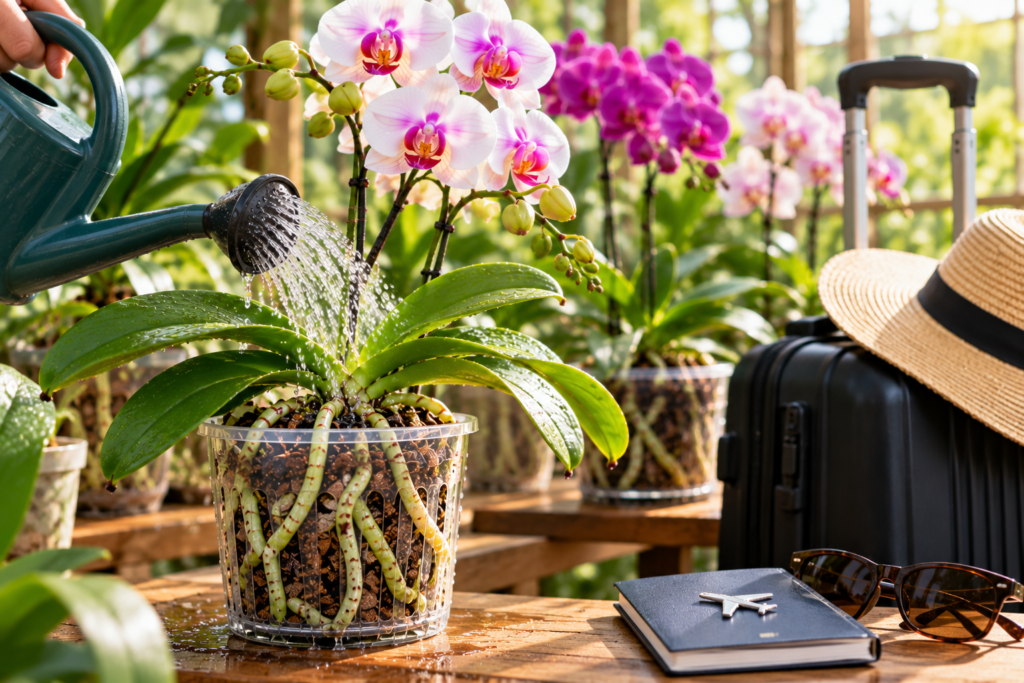
Check each orchid’s potting medium before you go. If it is approaching dryness and the plant needs water, water thoroughly until excess water flows freely from the drainage holes.
Allow the pot to drain completely before returning it to its usual location. Never leave an orchid sitting in a decorative container or saucer filled with standing water.
Do not automatically water a pot that is already wet just because you are leaving. Prolonged wetness can deprive roots of oxygen and contribute to root rot.
Check the growing environment
Move orchids away from intense direct sunlight, hot windows, and other locations where the potting medium may dry unusually quickly. Maintain suitable indirect light and normal growing conditions for the species.
Do not place every orchid in a dark room simply to slow water loss. Reducing excessive heat is useful, but plants still need appropriate light.
Inspect the roots and potting medium
If you grow Phalaenopsis orchids in transparent pots, examine the visible roots. Healthy, hydrated roots are generally firm, while roots that are dry may appear silvery or gray. Brown, mushy roots may indicate decay rather than a simple need for more water.
Check whether the medium is breaking down or staying wet for too long. If an orchid already has damaged roots, solve that problem before leaving rather than relying on extra watering to compensate.
For more guidance, read our articles on healthy orchid roots and how to tell when an orchid needs water.
2. What to Do Before a Vacation of About One Week
A trip of approximately one week may be manageable for many established potted orchids, but conditions matter. A Phalaenopsis in a moisture-retentive medium may behave very differently from a mounted Vanda in a warm, dry environment.
Before leaving:
- Water each orchid that needs watering and allow it to drain completely.
- Group plants according to their watering needs rather than treating every orchid identically.
- Move vulnerable plants away from excessive heat and direct midday sun.
- Ensure that growing areas have suitable ventilation.
- Ask someone to check the plants if you expect unusually hot weather or grow orchids that dry rapidly.
Mounted orchids, small seedlings, newly repotted plants, and orchids without substantial water-storage organs may need more attention than established plants in pots.
Avoid using a blanket rule such as watering every orchid twice before departure. Water according to the condition of each plant and its growing medium.
3. How to Care for Orchids During a Longer Vacation
For an absence longer than about a week, arranging a plant sitter is often the most reliable option, particularly if you have a mixed collection.
The American Orchid Society’s plant-sitter advice discusses temporary drip systems and explains why their suitability depends on the growing medium. A system designed for one growing setup may not work well for another.
Ask someone to check your orchids
A friend, neighbor, or plant-care service can inspect the collection and water individual plants when needed.
Provide simple instructions:
- Check the potting medium before watering.
- Water only when the orchid is ready.
- Water thoroughly and allow excess water to drain.
- Never leave pots standing in water.
- Keep water out of the central crown of Phalaenopsis orchids.
- Contact you if roots appear rotten, plants become unstable, or the growing area becomes excessively hot.
It helps to demonstrate the routine before you leave. A brief written checklist can prevent well-meaning helpers from watering too frequently.
Consider automatic watering carefully
Automatic drip irrigation may be useful for some collections, but it should be tested before departure. A system that supplies water too frequently can keep roots continuously wet, particularly in moisture-retentive media.
Coarse bark, sphagnum moss, mounted orchids, and basket-grown plants do not all respond to the same irrigation method. Do not install an unfamiliar system immediately before a long trip and assume it will work correctly.
If you use automatic watering, check the delivery rate, drainage, and moisture retention well in advance. A trusted person should still be available to inspect the system during an extended absence.
4. Should You Use a Water Tray or Self-Watering Method?
Some vacation watering methods designed for ordinary houseplants can be unsuitable for orchids.
Avoid leaving orchid pots submerged
Standing water around the base of an orchid pot can keep the root zone excessively wet. Most common epiphytic orchids need air around their roots as well as moisture.
A tray of water beneath a pot should not be used in a way that allows the potting medium or roots to remain submerged.
Be cautious with wicking systems
A wick can transfer water from a reservoir into a pot, but the amount delivered depends on the wick, growing medium, pot, and environmental conditions.
If the wick supplies too much water, the medium may remain wet for too long. If it supplies too little, the roots may dry out. Test any system before relying on it, and make sure it suits the particular orchid.
Do not rely on misting alone
Misting briefly wets exposed roots and plant surfaces, but it does not reliably provide the sustained moisture that a drying root zone needs. It is not a substitute for proper watering before departure or an appropriate care plan for a longer trip.
Read our guide to whether misting orchids is helpful or harmful.
5. Adjust Your Vacation Plan to the Weather
Weather can change how much attention your orchids need while you are away.
During hot weather: Pots may dry faster, especially near sunny windows, in small containers, or around mounted orchids. Provide appropriate shade from intense sunlight and arrange additional checks if necessary.
During humid or rainy weather: Growing media may remain wet for longer. Ensure that pots drain freely and that the growing area has suitable air movement. Avoid automatically increasing watering just because the weather is warm.
During unusually dry indoor conditions: Air conditioning and low humidity may accelerate moisture loss in some growing setups. Check vulnerable plants before leaving and arrange a sitter if they cannot safely tolerate the expected interval.
For additional guidance, see how to adjust orchid watering in hot or humid weather.
6. A Simple Vacation Watering Checklist
Use this checklist before leaving home.
- Check every orchid’s potting medium and roots.
- Water plants that need it, then allow complete drainage.
- Remove standing water from saucers and decorative containers.
- Keep plants away from excessive heat and harsh direct sunlight.
- Confirm that ventilation and lighting remain suitable.
- Identify orchids that dry quickly or need more frequent attention.
- Arrange a plant sitter for longer trips or vulnerable plants.
- Test any automatic watering equipment well before departure.
- Leave clear care instructions for whoever will check the collection.
Do not fertilize heavily or repot healthy orchids immediately before leaving unless there is a specific reason to do so. Avoid making major changes to their growing environment at the last minute.
7. What to Do When You Return
When you get home, inspect your orchids before watering them.
Check the pot weight, moisture level, visible roots, and condition of the leaves. If the medium is still wet, wait until the orchid is ready for its next watering. If the roots are dry and the medium has reached the appropriate dryness, water thoroughly and allow excess water to drain.
If leaves are wrinkled or limp, do not immediately assume the plant needs more water. Root damage can prevent an orchid from absorbing moisture even when the medium is wet. Inspect the roots and look for signs of decay.
If you discover soft, brown or black roots, or a potting medium that has broken down and remains wet, review our guide on what to do when an orchid has been overwatered.
Frequently Asked Questions
Can I leave my orchids alone for a week?
Many healthy, established potted orchids can tolerate an absence of around a week if they are prepared appropriately. However, mounted orchids, seedlings, and plants in hot, dry conditions may need more frequent attention.
Should I water my orchid twice before going on vacation?
Not automatically. Water thoroughly when the plant needs it, and let the medium drain completely. Watering an already wet orchid again can increase the risk of root problems.
Is an automatic watering system safe for orchids?
It can be suitable for some growing setups, but it must be tested and adjusted to the orchid and medium. Excessive or continuous watering can cause root damage.
Should I put orchids in the bathroom while I am away?
Not necessarily. A bathroom may offer higher humidity, but light and ventilation may be inadequate. Choose a location that provides suitable light, temperature, and airflow rather than selecting a room based on humidity alone.
What is the safest option for a two-week vacation?
For a mixed collection, a reliable plant sitter is usually the most practical choice. Some established orchids may tolerate the interval with preparation, while others will require watering or inspection during your absence.
Enjoy Your Vacation Without Neglecting Your Orchids
Successful vacation care is about preparation, not simply adding more water before leaving. Understand how quickly each orchid dries, provide suitable growing conditions, and arrange help for plants that cannot safely go without attention.
For short trips, a thorough check and appropriate watering may be enough for many established potted orchids. For longer absences, a trusted plant sitter and a tested watering plan provide greater control over moisture and root health.
Master Orchid Care With The Complete Orchid Care Library
Want to become more confident in watering orchids, identifying root problems, and making better care decisions? The Complete Orchid Care Library brings together practical orchid care ebooks and visual guides to help you understand common orchid problems and care for your plants with greater confidence.
Get The Complete Orchid Care Library Here
Share this article