
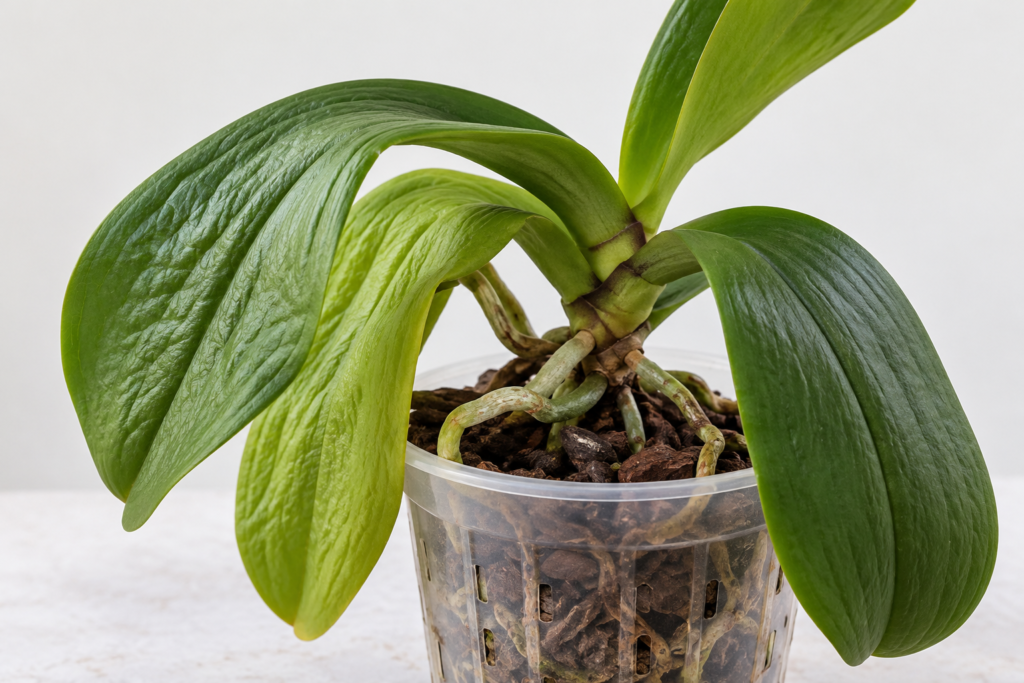
Soft, droopy orchid leaves can be frustrating, especially when you have been watering your plant regularly. Instead of remaining firm and upright, the leaves may become limp, wrinkled, or hang downward.
The most important thing to understand is that droopy orchid leaves do not always mean your plant needs more water. Underwatering can cause dehydration, but damaged roots may also prevent an orchid from absorbing enough moisture even when its potting medium is wet.
In this guide, you will learn how to identify six common causes of soft orchid leaves, inspect the roots, and choose the right solution for your plant.
Quick Answer: Why Are My Orchid Leaves Soft and Droopy?
Orchid leaves may become soft and droopy because of:
- Underwatering and dehydration.
- Root rot caused by excessive moisture and poor aeration.
- Damaged or severely dehydrated roots.
- Potting medium that retains too much moisture.
- Heat stress and excessive water loss.
- Natural aging of older leaves.
Before changing your watering routine, inspect both the roots and the potting medium. This is the most useful first step toward identifying the underlying problem.
For a broader overview of leaf symptoms, see our guide to common orchid leaf problems.
1. Underwatering: When Your Orchid Is Dehydrated
One of the most common reasons orchid leaves become soft and droopy is insufficient water availability.
Orchid roots absorb water from their growing medium and transport it to the rest of the plant. When the roots cannot supply enough moisture, the leaves gradually lose firmness and may develop wrinkles.
Signs of underwatering
Look for these clues:
- The potting medium is very dry.
- Healthy roots appear silvery or pale when dry.
- Leaves feel limp or look wrinkled.
- The growing medium dries out unusually quickly.
Dry-looking roots do not automatically mean that the plant is unhealthy. Many Phalaenopsis roots naturally become silvery between waterings.
To distinguish normal dry roots from damaged ones, read our guide on how to tell whether orchid roots are healthy.
How to fix it
If the roots are firm and functional and the growing medium is dry, water the orchid thoroughly. Allow excess water to drain completely.
Adjust your watering frequency according to the potting medium, pot size, temperature, humidity, and the plant’s needs.
Avoid following a rigid watering schedule without checking the condition of the medium. Some orchids dry out much faster than others.
2. Root Rot: Why Wet Roots Can Cause Droopy Leaves
One of the most confusing orchid problems occurs when the leaves look dehydrated even though the potting medium remains wet.
This can happen when excessive moisture and poor aeration damage the roots. As the roots deteriorate, they lose their ability to absorb and transport water effectively.
The orchid may therefore develop soft, droopy leaves despite frequent watering.
Signs of root rot
Check for several symptoms together:
- Roots feel soft, mushy, or collapsed.
- Root coverings deteriorate or slip away easily.
- The growing medium remains wet for an unusually long time.
- The pot has poor drainage.
- Several leaves become limp or yellow.
Root color alone is not enough to diagnose rot. Some brown roots remain firm and functional, while healthy roots may be cream-colored or yellow when growing inside a dark pot.
For a more detailed diagnosis, read Orchid Root Rot: Signs, Causes, and How to Save Your Plant.
How to fix it
If root rot is suspected, carefully inspect the root system and growing medium.
When repotting is necessary, remove clearly dead or rotten root sections using clean cutting tools. Preserve roots that remain firm and structurally intact.
Repot into a suitable orchid-growing medium with adequate aeration and drainage.
Do not respond to droopy leaves by repeatedly adding water when the medium is already wet. Correcting the root problem is more important than increasing watering frequency.
3. Damaged or Dehydrated Roots
An orchid can have too few functioning roots to support its leaves, even when some remaining roots appear healthy.
Root damage may result from prolonged dryness, excessive moisture, deteriorated potting medium, physical injury, or other unsuitable growing conditions.
When the root system cannot absorb enough water, the leaves may become wrinkled, thin, or floppy.
What to look for
Examine the roots for these characteristics:
- Dry, brittle, or hollow sections.
- Roots that have become severely shriveled.
- Mushy sections or deteriorating outer tissue.
- Very few remaining firm, healthy roots.
If your orchid has wrinkled roots, compare their texture with the moisture condition of the potting medium. Our guide to dry, wrinkled, or shriveled orchid roots explains how to distinguish potentially healthy roots from severely damaged ones.
How to help your orchid recover
Preserve all roots that remain functional. Remove only roots that are clearly dead or severely rotten.
If the potting medium has deteriorated, replace it with a suitable fresh mix. Maintain appropriate growing conditions and give the orchid time to produce new roots.
Severely dehydrated leaves may not regain their original shape completely. Monitor the development of new roots and leaves rather than judging recovery by old leaves alone.
4. Potting Medium That Retains Too Much Moisture
The condition of the potting medium has a direct effect on root health.
Old orchid bark can gradually break down into smaller particles. These particles may reduce airflow and cause the medium to retain moisture longer than expected.
When roots remain excessively wet and receive insufficient oxygen, they can become stressed and deteriorate.
Signs of unsuitable potting medium
- The pot stays wet for too long.
- The medium has broken down into fine particles.
- Water drains slowly from the pot.
- Roots begin to deteriorate.
- Leaves remain limp despite regular watering.
How to fix it
Check the condition of the growing medium and the drainage holes.
Many Phalaenopsis orchids grow well in an appropriately sized, well-aerated bark-based mix. However, the best medium depends on your growing conditions, including temperature, humidity, airflow, and watering habits.
Repot when the medium has deteriorated or root health requires it. Avoid repotting unnecessarily when the roots and growing medium are still healthy.
5. Heat Stress and Excessive Water Loss
High temperatures, strong direct sunlight, and dry air can increase water loss from orchid leaves.
When water escapes from the leaves faster than the roots can replace it, the plant may become limp or droopy.
Heat stress can also occur alongside root problems, making it important to examine the entire plant rather than focusing on one symptom.
Signs of environmental stress
- Leaves become limp during unusually hot weather.
- The orchid receives strong direct sunlight.
- Leaves develop pale, yellow, or brown scorched areas.
- The growing medium dries out much faster than usual.
How to help
Move the orchid away from harsh direct sunlight and provide suitable bright, indirect light.
Maintain temperatures appropriate for your orchid species. Improve airflow without exposing the plant to strong, drying drafts.
Humidity can influence how quickly leaves lose moisture, but increasing humidity alone will not solve dehydration caused by damaged roots.
If the leaves also develop yellow patches, see our guide to why orchid leaves turn yellow.
6. Natural Aging of Older Orchid Leaves
Not every droopy orchid leaf signals a serious problem.
Phalaenopsis orchids periodically shed older leaves as part of their natural growth cycle. An older lower leaf may gradually turn yellow, lose firmness, and eventually fall off.
Signs of natural aging
- Only one older lower leaf is affected.
- Yellowing develops gradually.
- Newer leaves remain firm and healthy.
- The roots show no obvious signs of deterioration.
- The rest of the plant continues growing normally.
If the pattern matches natural aging, allow the leaf to decline naturally. Remove it when it has fully died or can be detached without damaging healthy tissue.
However, if several leaves become soft or droopy at the same time, investigate the roots, moisture levels, and growing conditions.
How to Diagnose Soft and Droopy Orchid Leaves
Use this table to narrow down the possible cause before taking action.
| What you observe | Possible cause | What to check |
|---|---|---|
| Limp leaves and very dry medium | Underwatering | Root firmness and moisture |
| Droopy leaves and wet medium | Root rot or poor aeration | Roots and drainage |
| Wrinkled roots and limp leaves | Dehydration or root damage | Root texture and growing conditions |
| Limp leaves during hot weather | Heat stress | Light, temperature, and airflow |
| One older lower leaf declining | Natural aging may be occurring | Condition of the remaining leaves |
| Droopy leaves despite regular watering | Root dysfunction or unsuitable medium | Root health and moisture retention |
These are diagnostic clues rather than definitive diagnoses. Several problems can occur simultaneously.
For a complete reference, see The Complete Guide to Orchid Roots.
Should You Cut Off Soft Orchid Leaves?
Usually, no.
A leaf that is soft or droopy may still be alive and capable of photosynthesis. Removing it unnecessarily can reduce the plant’s ability to produce energy.
Instead, identify and correct the underlying cause.
Consider removing a leaf only when it is completely dead, severely deteriorated, or affected by a problem that warrants removal. Use clean tools and avoid damaging the stem or surrounding healthy tissue.
If the leaf is also yellowing, read Why Are My Orchid Leaves Turning Yellow? to help distinguish natural aging from other possible causes.
How Long Does It Take for Droopy Orchid Leaves to Recover?
Recovery depends on the severity of the problem and the condition of the root system.
An orchid with healthy roots and mild dehydration may begin to regain firmness after appropriate watering.
A plant with extensive root damage may need weeks or longer to develop enough healthy roots to support new growth.
Existing wrinkles may remain permanently, even after the underlying problem has been corrected. Severely damaged leaves may never return to their original shape.
Look for these signs of progress:
- New roots are developing.
- Existing root damage is no longer spreading.
- New leaves emerge with healthy growth.
- The plant maintains more stable moisture levels.
- No additional leaves become progressively limp.
Avoid applying extra fertilizer to force recovery. Correct root health and growing conditions first.
Frequently Asked Questions
Why are my orchid leaves droopy even after watering?
The roots may be damaged and unable to absorb water effectively. Inspect the roots and growing medium. If the medium is already wet, avoid adding more water until you understand the problem.
Can soft orchid leaves become firm again?
Sometimes. Leaves affected by mild dehydration may regain some firmness after the root system receives adequate moisture. Severely damaged leaves may remain limp or wrinkled.
Should I mist my orchid to fix droopy leaves?
Misting is not a reliable solution for dehydration caused by damaged roots or inadequate water uptake. Focus on root health, appropriate watering, and suitable growing conditions.
Are droopy orchid leaves always caused by underwatering?
No. Overwatering, root rot, damaged roots, heat stress, and natural aging can all contribute to drooping. Check the roots and medium before changing your watering routine.
Why are my orchid roots yellow while the leaves are droopy?
Yellow roots can be healthy, especially when growing inside a dark pot. However, yellow roots that are soft or collapsing may indicate damage. Read Why Are My Orchid Roots Turning Yellow? for more guidance.
Final Thoughts
Soft, droopy orchid leaves are a symptom, not a diagnosis. The best solution depends on whether the plant is dehydrated, suffering from root damage, growing in unsuitable medium, experiencing environmental stress, or naturally losing an older leaf.
Start by inspecting the roots and potting medium. Correct the underlying problem, avoid unnecessary watering or root cutting, and allow the plant time to recover.
For more troubleshooting advice, explore our guides to healthy orchid roots, orchid root rot, and common orchid leaf problems. These related resources can help you recognize symptoms earlier and make more informed orchid-care decisions.