
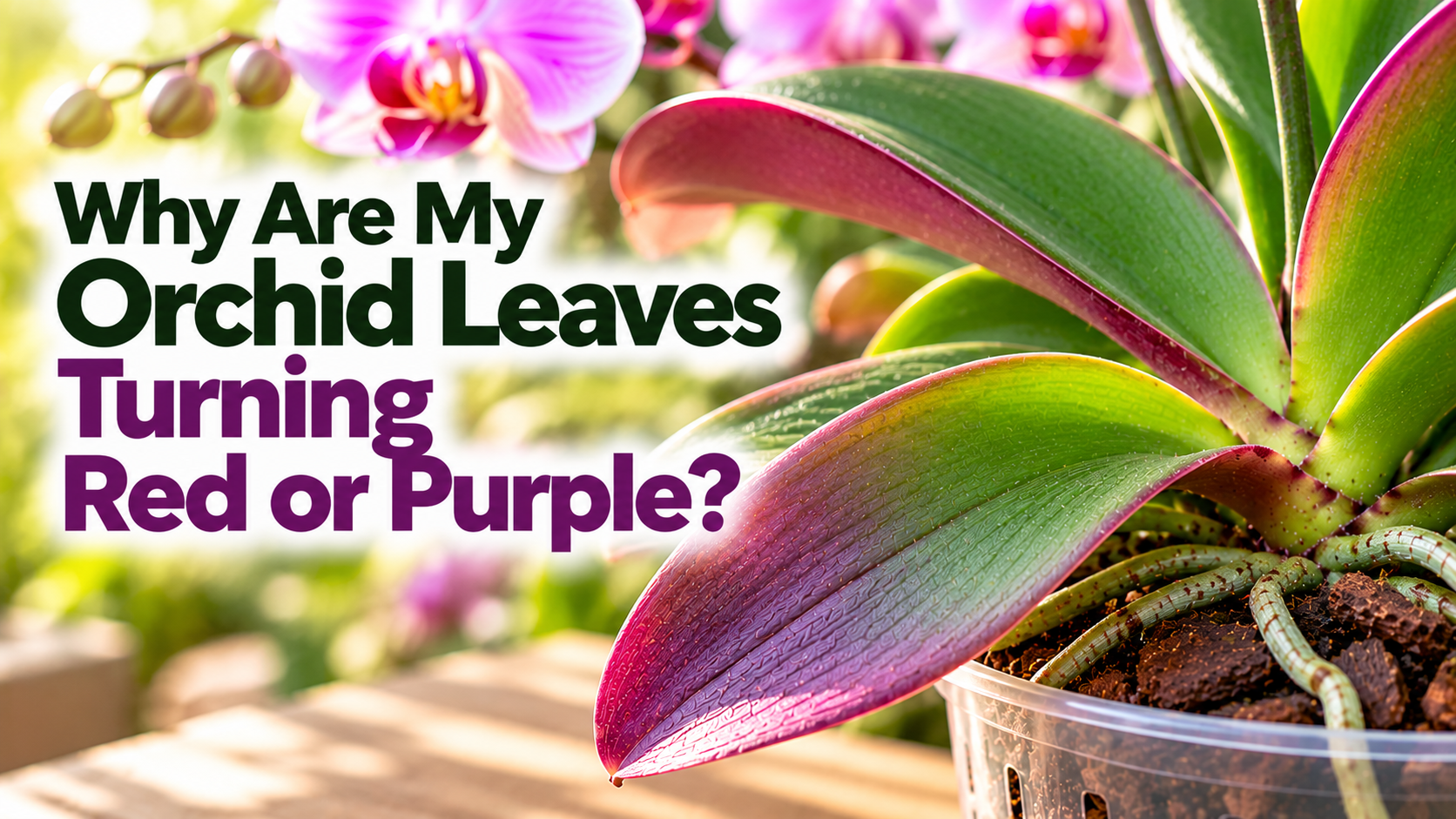
 Seeing red or purple coloration appear on your orchid’s leaves can be surprising, especially when you expect healthy leaves to stay green. Sometimes this color change is a normal response to light or natural pigmentation. In other cases, it can indicate that your orchid is experiencing environmental stress.
The important thing is to look beyond the color itself. The location of the discoloration, the condition of the leaves, the amount of light your orchid receives, and recent changes in its growing environment can help you identify the likely cause.
This guide explains why orchid leaves turn red or purple, how to distinguish normal pigmentation from potential problems, and what to do to keep your plant healthy.
Are Red or Purple Orchid Leaves Normal?
Yes, red or purple leaves can be normal for some orchids.
Certain orchids develop reddish or purple pigments called anthocyanins. These pigments can become more noticeable when plants receive brighter light or experience changes in their growing conditions. Some orchid varieties also naturally produce darker leaf pigmentation than others.
However, a sudden color change in a previously green leaf deserves attention, particularly when it appears alongside yellowing, dry patches, soft tissue, or slowed growth.
If you are unsure whether your plant’s discoloration is normal, start with this broader guide to orchid leaf problems to compare the color change with other symptoms.
1. Too Much Light
One of the most common reasons orchid leaves develop red or purple tones is exposure to strong light.
When an orchid receives more light than it is accustomed to, anthocyanin pigments may accumulate in its leaves. This can create reddish, burgundy, or purple coloration, particularly on the upper surfaces exposed to the strongest light.
Some orchids tolerate brighter conditions and may develop attractive purple pigmentation without suffering damage. However, color changes can also be an early warning that the plant is receiving more light than it can comfortably handle.
Signs that excessive light may be responsible
- Red or purple coloration is strongest on the side facing the window or grow light.
- Leaves feel unusually warm during the brightest part of the day.
- The plant has recently been moved into a brighter location.
- Pale, bleached, yellow, or dry patches begin appearing on exposed leaves.
Severe exposure can lead to sunburn, which causes damaged tissue that may turn pale, brown, or black.
What to do
Move the orchid slightly farther from direct sunlight or filter the light with a sheer curtain. If you use grow lights, review the distance, intensity, and daily exposure time.
Make adjustments gradually rather than moving the orchid abruptly into a very dark location. The goal is to provide suitable light without exposing the leaves to excessive heat or intensity.
If the discoloration is accompanied by pale or scorched patches, read the guide to orchid sunburn and damaged leaves for more specific identification and treatment advice.
2. Natural Anthocyanin Pigmentation
Some orchids naturally develop red, purple, or burgundy tones in their leaves.
Anthocyanins are pigments found in many plants. Depending on the orchid’s genetics and growing conditions, these pigments can create reddish coloration along leaf edges, undersides, veins, or entire leaf surfaces.
This is not necessarily a sign of poor health.
How to recognize natural pigmentation
- The color appears gradually rather than suddenly.
- The leaf remains firm, smooth, and structurally healthy.
- There are no spreading lesions, dry patches, or soft areas.
- New leaves show similar coloration.
- The orchid continues producing roots, leaves, or flowers normally.
If the plant has always displayed reddish or purple tones, its coloration may simply be part of its natural appearance.
Avoid trying to eliminate normal pigmentation by reducing light excessively. Instead, evaluate the plant’s overall condition and growth.
3. Temperature Stress
Changes in temperature can influence pigmentation in some orchids. Cool conditions, especially when combined with bright light, may make red or purple coloration more pronounced.
The effect varies by orchid species and hybrid. Some tolerate cooler nights well, while others are more sensitive to temperature fluctuations.
Signs to look for
- The color change began after a period of cooler nights.
- The orchid sits near a cold window or under an air-conditioning vent.
- The plant experiences large temperature swings between day and night.
- Growth has slowed or other signs of environmental stress have appeared.
Red or purple coloration alone does not prove that an orchid is too cold. Consider the plant’s species, its normal growing conditions, and whether other symptoms are present.
What to do
Keep the orchid within a temperature range appropriate for its type. Protect it from cold drafts, sudden temperature changes, and direct contact with chilled window glass.
Do not assume that warmer conditions are always better. Many orchids benefit from moderate day-night temperature differences, but the ideal range depends on the species.
4. Nutrient Imbalance
Nutrient problems can affect leaf color and overall growth, although red or purple pigmentation alone is not enough to diagnose a deficiency.
Phosphorus is involved in energy transfer and plant metabolism. Under certain conditions, limited phosphorus availability can contribute to reddish or purple coloration. However, similar symptoms can result from genetics, bright light, or temperature stress.
The actual cause may be related to nutrient availability, damaged roots, unsuitable growing media, or an inappropriate fertilizing routine.
What to check
- Has the orchid been fertilized regularly and appropriately?
- Is the growing medium old, decomposed, or accumulating fertilizer salts?
- Are roots healthy enough to absorb water and nutrients?
- Has the plant stopped growing or developed other unusual symptoms?
Do not automatically increase fertilizer because the leaves look purple. Excessive fertilizer can damage roots and create additional problems.
Use a suitable orchid fertilizer according to its label, avoid excessive concentrations, and periodically flush the growing medium with clean water when appropriate for your setup.
If the orchid also has yellowing leaves, compare its symptoms with the guide to why orchid leaves turn yellow before deciding whether nutrition is the likely cause.
5. Water Stress and Root Problems
Watering problems do not typically explain every case of red or purple leaves, but they can contribute to overall plant stress.
When roots are damaged, the orchid may struggle to absorb enough water and nutrients. The leaves may lose firmness, growth may slow, and other discoloration may develop.
Overwatering is particularly dangerous when the potting medium remains wet for too long and the roots begin to deteriorate. Underwatering can also affect the plant’s ability to maintain healthy foliage.
Inspect the roots
For orchids growing in transparent pots, look at the roots before changing your watering routine.
Healthy roots are generally firm. Depending on moisture and the type of orchid, they may appear green, silver, cream, or another normal color. Roots that are brown, mushy, hollow, or badly deteriorated may indicate damage.
Check the growing medium as well. If it remains saturated for extended periods, drainage and aeration may be inadequate.
For a more detailed diagnosis, consult the complete guide to orchid roots.
What to do
Water according to the orchid’s needs, the condition of its roots, the potting medium, and the surrounding environment.
Do not water more frequently simply because the leaves have turned purple. Correct the underlying problem first, and avoid leaving the roots continuously wet.
6. Disease or Damaged Leaf Tissue
Red or purple pigmentation without other symptoms is not usually enough to identify a disease. However, localized discoloration accompanied by lesions or tissue deterioration deserves closer inspection.
Potential warning signs include:
- Spots that enlarge or spread over time.
- Dark, sunken, or water-soaked patches.
- Yellow halos around damaged areas.
- Soft or rapidly deteriorating leaf tissue.
- Discoloration that continues to worsen despite correcting the growing conditions.
These symptoms can have several causes, including physical damage, environmental injury, or infection. Appearance alone may not be enough to distinguish them.
What to do
Keep the orchid under observation and avoid allowing water to remain on its leaves for prolonged periods. If a suspicious lesion is spreading, isolate the plant from other orchids while you investigate the cause.
Use clean tools whenever handling damaged tissue. Avoid applying pesticides or fungicides without a reasonable basis for identifying the problem, and follow product labels carefully.
If the leaf develops dark spots rather than a fairly uniform red or purple tint, compare the symptoms with a dedicated diagnosis of black spots on orchid leaves.
How to Tell Whether Red or Purple Leaves Are a Problem
Use the following comparison to narrow down the likely cause.
| What you observe | Possible explanation | Recommended response |
|---|---|---|
| Uniform reddish or purple tint, firm leaves | Natural pigmentation | Monitor normal growth |
| Color strongest on the light-exposed side | Bright light or light stress | Review light intensity and exposure |
| Color becomes more pronounced after cool nights | Temperature-related pigmentation | Check temperature fluctuations |
| Discoloration with weak growth and other symptoms | Possible nutrient or root problem | Inspect roots and review care |
| Purple coloration with dry, bleached, or scorched patches | Excessive light or heat damage | Reduce exposure and monitor damage |
| Spreading spots, soft tissue, or rapidly worsening lesions | Possible disease or tissue injury | Isolate if appropriate and investigate |
These patterns are clues rather than definitive diagnoses. Several factors can occur together, so consider the full condition of the plant.
Should You Remove Red or Purple Orchid Leaves?
Usually, no.
If the leaf remains firm and healthy, there is generally no reason to remove it simply because its color has changed. The leaf may still be photosynthesizing and supporting the plant.
Removing healthy leaves reduces the plant’s remaining leaf area without necessarily addressing the cause of the discoloration.
Consider removing a leaf only when there is a clear reason, such as extensive dead tissue or a confirmed problem requiring removal. Use a clean, appropriate cutting tool and avoid damaging the stem or nearby healthy tissue.
If the discoloration is caused by excessive light or temperature stress, correcting those conditions is more important than removing the leaf.
How to Prevent Red or Purple Leaf Problems
A consistent care routine can help you distinguish normal pigmentation from stress-related changes.
Provide suitable light. Give your orchid enough light for healthy growth while avoiding excessive direct sun or overly intense grow lights.
Maintain appropriate temperatures. Learn the needs of your orchid type and protect it from sudden environmental changes.
Inspect roots regularly. Root health affects water and nutrient uptake. Check drainage, potting medium condition, and root firmness.
Fertilize carefully. Use a suitable orchid fertilizer at an appropriate concentration. Avoid trying to correct an uncertain diagnosis with extra fertilizer.
Observe new growth. New leaves can help you determine whether the plant is adapting well to its environment. Stable coloration and healthy growth are more reassuring than color alone.
Make one adjustment at a time. If you suspect a care problem, change the most likely factor and monitor the plant rather than changing light, watering, temperature, and fertilizer simultaneously.
Frequently Asked Questions
Are purple orchid leaves a sign of too much sunlight?
Not always. Bright light can increase purple pigmentation in some orchids, but natural genetics can produce similar coloration. Look for additional signs such as bleaching, dry patches, excessive leaf warmth, or a recent change in light exposure.
Can orchid leaves turn red because of cold weather?
Cooler temperatures can influence pigmentation in some orchids, particularly when combined with bright light. However, red leaves alone do not establish that the plant is too cold. Check the species’ temperature requirements and look for other signs of stress.
Will red or purple orchid leaves turn green again?
Sometimes, but not always. Pigmentation may change as growing conditions change, while some naturally pigmented leaves remain reddish or purple. Existing tissue damaged by sunburn may not return to its original appearance.
Should I move my orchid into the shade?
Only if the evidence suggests excessive light. Moving an orchid into deep shade may reduce its ability to grow and flower. Adjust light gradually and aim for conditions appropriate to the orchid’s type.
Do purple leaves mean my orchid will not bloom?
No. Purple coloration by itself does not mean an orchid cannot bloom. Flowering depends on factors such as species, maturity, light, root health, and appropriate growing conditions.
Why are only the undersides of my orchid leaves purple?
Some orchids naturally develop more visible anthocyanin pigmentation on the undersides of their leaves. If the leaves remain firm and the plant grows normally, this may be natural. Sudden changes or accompanying tissue damage warrant further investigation.
Help Your Orchid Stay Healthy
Red or purple orchid leaves can be a normal feature of the plant, a response to brighter light, or a sign that growing conditions need attention. The best diagnosis comes from combining leaf appearance with root health, temperature, light exposure, and recent changes in care.
Rather than reacting to color alone, learn to recognize the patterns that distinguish healthy pigmentation from stress and damage.
For a more systematic approach to diagnosing orchid problems, explore The Complete Orchid Care Library, which includes 2 ebooks and 8 Visual Guide Collections designed to help you understand orchid symptoms and make more informed care decisions.