
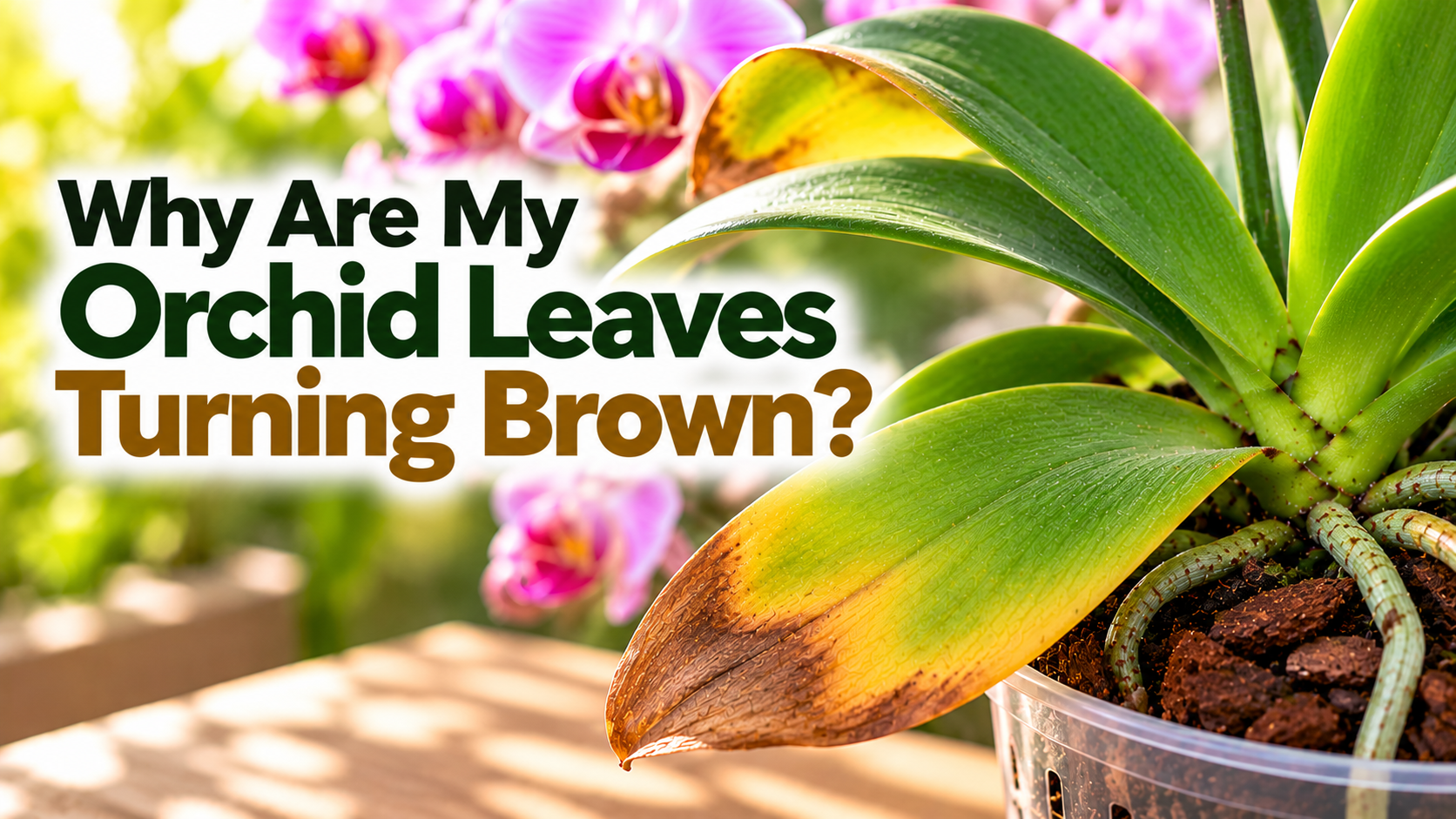
 Brown orchid leaves can be worrying, especially when a previously healthy plant develops brown tips, dry patches, or dark spots. But brown leaves do not always indicate the same problem. The cause may be sunburn, watering stress, damaged roots, fertilizer salt buildup, physical injury, or a disease affecting the leaf tissue.
The most important step is to identify what the brown area looks and feels like, whether it is spreading, and what has changed in the orchid’s growing environment.
A dry brown tip that has remained unchanged for months requires a different response from a dark, wet lesion that is expanding across a leaf.
This guide explains the common causes of brown orchid leaves, how to distinguish them, and how to respond without unnecessarily damaging healthy tissue.
Quick Answer: Why Are My Orchid Leaves Turning Brown?
Orchid leaves may turn brown for several reasons:
- Sunburn: Excessive direct sunlight damages exposed leaf tissue.
- Watering problems: Prolonged moisture problems can damage roots and contribute to leaf deterioration.
- Root damage: Unhealthy roots may struggle to supply the plant with sufficient water.
- Fertilizer salt buildup: Excess salts can damage roots and contribute to brown leaf tips or margins.
- Low humidity or environmental stress: Dry conditions and excessive heat can contribute to moisture stress.
- Physical injury: Bent, bruised, or damaged leaves may develop brown tissue.
- Disease: Some fungal or bacterial problems cause brown or dark lesions that may spread.
- Natural aging: Older leaves may gradually deteriorate as part of the plant’s life cycle, although yellowing often precedes browning.
Do not diagnose the cause by color alone. Examine the texture, location, and progression of the damage, then inspect the roots and growing medium.
1. Identify the Type of Brown Leaf Damage
Before treating your orchid, determine what kind of brown damage you are seeing.
Dry, crispy brown tips
Brown tips that feel dry and papery may be associated with moisture stress, salt accumulation, root problems, or previous environmental damage.
If the brown area is stable and the rest of the leaf remains firm, the damage may be old rather than an active problem.
Large tan or brown patches
Broad patches on exposed leaf surfaces may indicate sunburn, particularly if the orchid was recently moved into stronger light.
Physical injury and other forms of tissue damage can also produce localized brown areas.
Dark, wet, or spreading spots
Dark lesions that enlarge, become soft, or develop a wet appearance are more concerning. They may indicate an active disease or ongoing tissue deterioration.
Keep the plant away from other orchids while investigating potentially contagious damage.
Brown edges accompanied by limp leaves
When brown edges appear alongside wrinkled or drooping leaves, investigate the root system and watering conditions. The plant may be experiencing water stress, but these symptoms alone do not establish the cause.
For a broader overview of leaf discoloration, splitting, drooping, and other symptoms, see The Complete Guide to Orchid Leaf Problems: Symptoms, Causes, and Solutions.
2. Sunburn: A Common Cause of Brown Orchid Leaves
Many commonly grown orchids, including Phalaenopsis, need bright light but can be damaged by excessive direct sunlight.
Sunburn often develops on the parts of the leaves receiving the strongest light. Damaged areas may initially look pale, yellow, or bleached before becoming tan or brown.
Signs of orchid sunburn
- Brown patches are concentrated on exposed leaf surfaces.
- The affected area faces a bright window or direct sunlight.
- The damage appeared after the orchid was moved to a brighter location.
- The damaged tissue becomes dry or papery.
- The remaining leaf tissue may still look healthy.
Sunburn can resemble other types of leaf damage, so consider the location of the affected area and the plant’s recent light exposure.
How to treat sunburn
- Move the orchid away from intense direct sunlight.
- Provide bright, suitable indirect light.
- Introduce changes in light gradually when possible.
- Leave stable, dry damaged tissue in place if it is not deteriorating.
- Monitor the plant for additional damage.
Sunburned tissue generally does not turn green again. The goal is to protect the remaining healthy leaf tissue and prevent further injury.
For a more detailed explanation, read Orchid Sunburn: How to Recognize and Treat Damaged Leaves.
3. Overwatering and Root Damage
Brown leaves are sometimes the visible result of a problem below the potting medium.
Orchid roots require both moisture and oxygen. When the growing medium remains excessively wet, roots may deteriorate and lose their ability to absorb water effectively.
As the root system declines, the orchid may develop limp leaves, yellowing, brown tips, or more general deterioration.
Signs that root problems may be involved
- The growing medium remains wet for an unusually long time.
- Several roots feel soft or mushy.
- Root coverings deteriorate or slip away easily.
- Leaves become limp or wrinkled as well as discolored.
- The plant continues declining despite frequent watering.
Brown roots are not automatically dead. Some roots naturally have brown or tan surfaces, so inspect firmness and structure rather than relying on color alone.
How to respond
Check the roots and growing medium before changing your watering routine.
If the medium has broken down or the roots are deteriorating, repotting into an appropriate, well-aerated orchid medium may be necessary. Remove severely damaged roots with a clean tool when appropriate.
Adjust watering according to the condition of the remaining roots, the pot, and the growing medium. Avoid adding more water simply because the leaves look dehydrated.
For a complete diagnosis of root color, texture, rot, and other root problems, consult The Complete Guide to Orchid Roots: How to Identify Healthy Roots and Fix Common Problems.
4. Underwatering and Moisture Stress
Orchids can also experience water stress when their growing medium dries out too much or too frequently.
If the roots remain functional, insufficient water may cause leaves to lose firmness. Over time, some leaf tips or edges may become dry and brown.
However, dry brown tips do not prove that an orchid needs more water. Similar symptoms can develop when damaged roots cannot absorb moisture effectively.
What to check
- Is the potting medium excessively dry?
- Does the pot become very light between waterings?
- Are the roots firm and intact?
- Are the leaves wrinkled or limp?
- Does the growing medium dry unusually quickly in warm conditions?
What to do
If the medium is dry and the roots are healthy, water the orchid thoroughly and allow excess water to drain.
If the leaves remain limp despite appropriate watering, investigate root damage rather than increasing watering frequency automatically.
Maintain a balance between adequate moisture and good root aeration. Keeping the pot continuously wet is not a reliable solution to dehydration symptoms.
5. Fertilizer Salt Buildup and Brown Leaf Tips
Fertilizer can support orchid growth, but excessive concentrations or accumulated mineral salts can damage roots.
When roots become stressed, the plant may show brown tips or margins. Similar symptoms can also result from watering and environmental problems, so the appearance of a brown tip alone cannot confirm fertilizer injury.
Signs to investigate
- Fertilizer has been applied too frequently or at a high concentration.
- White or crusty mineral deposits are visible around the pot or growing medium.
- Root tips appear damaged.
- Brown leaf tips develop alongside other signs of root stress.
How to prevent further damage
Follow the fertilizer manufacturer’s dilution and application instructions. Avoid increasing the concentration to encourage faster growth.
If salt accumulation is suspected and the roots are healthy enough, suitable watering with low-mineral water may help flush excess salts from the medium. Allow the water to drain freely, and avoid leaving the pot standing in runoff.
If the medium has deteriorated or the roots are damaged, correcting the growing environment may be more important than changing fertilizer alone.
Do not fertilize an orchid with severely damaged roots simply because its leaves are turning brown.
6. Low Humidity, Heat, and Other Environmental Stress
Environmental conditions influence how quickly orchid leaves lose moisture.
High temperatures, very dry air, strong airflow, and intense light can increase moisture loss. If the roots cannot replace that water quickly enough, leaf tissue may become stressed.
Environmental stress can occur alongside other problems, including damaged roots or unsuitable watering.
What to inspect
- Is the orchid exposed to unusually high temperatures?
- Is hot air blowing directly onto the leaves?
- Does the growing area become very dry?
- Does the potting medium dry much faster than usual?
- Has the orchid recently been moved to a different environment?
How to help your orchid
Provide suitable light, temperature, and airflow for the orchid species. Avoid placing the plant where hot or cold air repeatedly strikes the foliage.
If humidity needs to be increased, maintain good airflow and avoid leaving water trapped in the crown or between the leaves.
Do not compensate for dry air by keeping the roots permanently saturated. The aim is to support moisture availability without depriving roots of oxygen.
7. Black or Dark Brown Spots: Could It Be Disease?
Brown spots can develop from sunburn, physical injury, or other localized damage. However, dark spots that expand or become wet and soft may indicate an active disease.
Some fungal and bacterial problems affect orchid leaves, and their symptoms can overlap. A photograph or a single visual symptom may not be enough to identify a specific pathogen.
Signs that need closer attention
- Spots increase in size over time.
- New lesions appear on the same leaf or nearby leaves.
- The affected tissue becomes soft or wet.
- Dark discoloration spreads rapidly.
- The damage is accompanied by other signs of plant decline.
What should you do?
If disease is suspected, separate the orchid from nearby plants while investigating.
Avoid splashing water between plants, keep tools clean, and provide suitable airflow. Do not apply fungicides or other chemicals indiscriminately; the correct treatment depends on the underlying cause.
If lesions are spreading quickly or the tissue is becoming soft and wet, seek a reliable diagnosis promptly.
For additional guidance, see Black Spots on Orchid Leaves: Causes and What to Do.
8. Natural Aging and Physical Damage
Not every brown area indicates a serious health problem.
Natural aging
An older lower leaf may gradually yellow and deteriorate as the orchid sheds it naturally. If only one old leaf is affected and the rest of the plant remains healthy, natural aging may be responsible.
However, several leaves deteriorating at once or rapid discoloration across the plant deserves further investigation.
Physical damage
Leaves can become bruised, bent, scratched, or torn during handling. Damaged tissue may later become brown, even when the roots and growing conditions are healthy.
How to respond
Observe whether the damage remains localized and stable.
If the brown area is dry and unchanged, and the rest of the plant is healthy, monitoring may be sufficient. Avoid removing a whole leaf solely because it contains a small brown patch.
If the affected area begins expanding, becomes soft, or develops additional symptoms, reassess the possible cause.
9. Should You Cut Off Brown Orchid Leaves?
Not necessarily. The decision depends on how much of the leaf is affected and whether the damage is stable or actively deteriorating.
When you can leave the leaf alone
- The brown area is dry and stable.
- Only the tip or edge is affected.
- The remaining tissue is healthy.
- The damage is consistent with old sunburn or physical injury.
Healthy green tissue continues to support photosynthesis. Removing an entire leaf unnecessarily reduces the plant’s remaining foliage.
When removal may be appropriate
If a substantial section of tissue is severely deteriorating or a diagnosed disease requires removal, cutting away affected material may be necessary.
Use a clean cutting tool, avoid cutting into healthy tissue unnecessarily, and take care not to damage the crown or stem.
Do not pull a damaged leaf off forcibly while it remains firmly attached.
10. How to Diagnose Brown Orchid Leaves Step by Step
Use this process to narrow down the likely cause before treating the plant.
Step 1: Examine the pattern
Is the damage limited to a tip, concentrated on the sun-facing side, or appearing as scattered dark spots?
The pattern can provide useful clues about the source of the damage.
Step 2: Check the texture
Determine whether the affected tissue is dry and papery or wet and soft. Dry, stable damage may have a different cause from an expanding, wet lesion.
Step 3: Inspect the roots
Look for firm, intact roots and check whether the medium is staying wet too long or drying excessively quickly.
Step 4: Review recent care changes
Consider recent changes in sunlight, watering, fertilizer, temperature, and potting medium.
Step 5: Check for additional symptoms
Wrinkled leaves, yellowing, sticky residue, pests, or multiple spreading lesions may help narrow down the possibilities.
Step 6: Correct the most likely cause
Adjust the relevant growing condition rather than changing everything at once. Avoid unnecessary pruning, additional fertilizer, or extra watering without a clear reason.
Step 7: Monitor the damage
Photograph the affected area and compare it over time. Stable old damage may remain visible, while new discoloration or expanding lesions suggest that the problem needs further attention.
11. How to Prevent Brown Orchid Leaves
Although some leaf damage is unavoidable, appropriate care can reduce many common causes.
Provide suitable light. Most Phalaenopsis orchids grow well in bright, indirect light. Protect them from intense direct sunlight.
Water according to the growing conditions. Consider root health, medium, pot size, temperature, and drying rate instead of relying on a rigid schedule.
Maintain healthy roots. Use suitable orchid medium and replace it when it deteriorates. Ensure excess water can drain freely.
Use fertilizer carefully. Follow dilution instructions and avoid excessive concentrations or unnecessary applications.
Keep conditions stable. Protect orchids from extreme temperatures and sudden environmental changes when possible.
Inspect leaves regularly. Check for new spots, brown tips, pests, and changes in leaf texture.
Keep tools clean. Clean tools and sensible hygiene reduce the risk of transferring pests or disease between plants.
Frequently Asked Questions
Why are my orchid leaf tips turning brown?
Brown tips may result from moisture stress, root damage, fertilizer salt buildup, environmental conditions, or other forms of tissue injury. Check the roots, growing medium, and fertilizer routine before deciding on a treatment.
Should I cut off the brown tips of orchid leaves?
Not always. If the brown tissue is dry and stable, you can usually leave it in place. If trimming is necessary for a clear reason, use a clean tool and avoid cutting healthy tissue unnecessarily.
Can brown orchid leaves turn green again?
Brown tissue caused by permanent damage generally does not turn green again. Focus on preventing further damage and supporting healthy roots and new growth.
Can overwatering cause brown orchid leaves?
Yes. Excessive moisture can damage roots and interfere with water absorption, contributing to leaf deterioration. Inspect the roots and medium before increasing watering.
Are brown spots always a sign of disease?
No. Sunburn, physical injury, and environmental damage can also produce brown spots. Expanding, wet, or soft lesions are more concerning and warrant closer investigation.
Why are my orchid leaves brown and wrinkled?
This combination can indicate water stress, root damage, or a combination of problems. Check whether the roots are healthy and whether the medium is too dry or remaining wet for too long.
How long does it take for an orchid to recover from brown leaves?
Recovery depends on the cause and severity. Existing brown tissue usually remains damaged. The more useful signs of recovery are stable remaining leaves, healthy roots, no new damage, and continued growth under suitable conditions.
Make Better Orchid Care Decisions With Practical Guidance
Brown orchid leaves can result from several different problems, and the right response depends on what is causing the damage. Learning to distinguish sunburn, moisture stress, root damage, and potentially spreading lesions can help you avoid unnecessary treatments and protect healthy growth.
The Complete Orchid Care Library includes 2 ebooks and 8 Visual Guide Collections to help you understand orchid symptoms, assess growing conditions, and make more confident care decisions with practical visual references.
Build your orchid care knowledge and learn how to approach common problems with a clearer diagnostic process.