
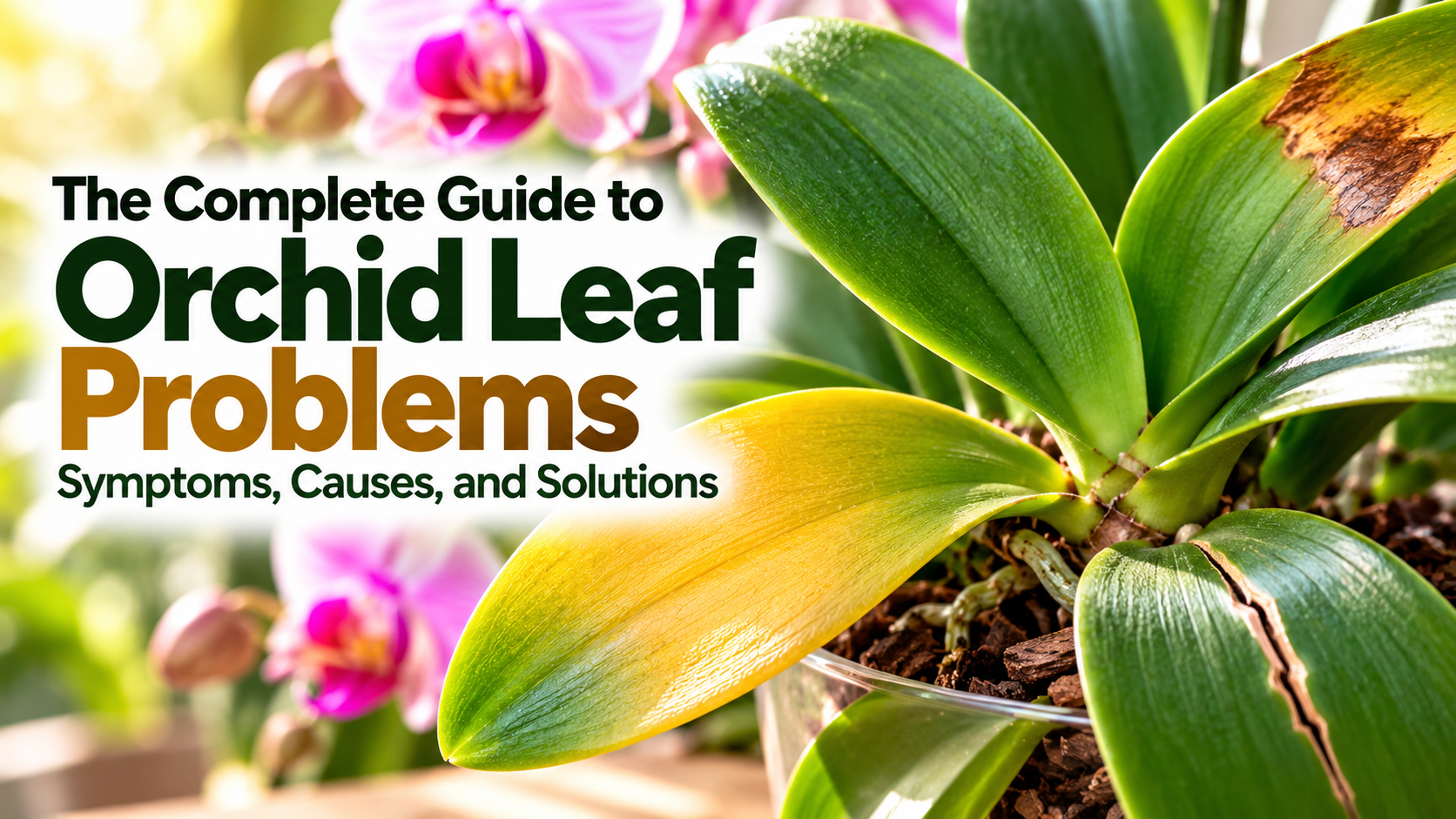
 Orchid leaves can reveal a great deal about your plant’s health. Changes in color, texture, firmness, or surface appearance may indicate normal aging, watering problems, root damage, excessive sunlight, pests, or disease.
However, not every unusual leaf is a sign that your orchid is dying. A yellow lower leaf may be part of the plant’s natural life cycle, while soft, wrinkled leaves may indicate that damaged roots can no longer absorb enough water. Brown patches may result from sunburn, physical injury, or infection.
The key is to examine the symptoms carefully and consider the plant’s growing conditions before taking action.
This complete guide explains how to identify common orchid leaf problems, understand their possible causes, and choose practical solutions without unnecessarily damaging healthy leaves.
Quick Guide to Common Orchid Leaf Problems
Use this table to narrow down the possible cause of your orchid’s symptoms.
| Leaf symptom | Possible causes | What to check first |
|---|---|---|
| Yellow leaves | Natural aging, watering problems, root damage, excessive light | Which leaves are yellowing and how quickly |
| Wrinkled or limp leaves | Dehydration, root loss, damaged roots | Root condition and moisture in the potting medium |
| Brown leaves or patches | Sunburn, physical damage, infection | Location, texture, and pattern of the damage |
| Red or purple leaves | Pigment response to strong light, genetics, environmental stress | Cultivar characteristics and recent light exposure |
| Splitting or cracking | Mechanical injury, fluctuations in growth conditions, dehydration | Whether the split is old, dry, or still spreading |
| Soft, droopy leaves | Loss of water balance, root problems, heat stress | Root firmness and growing conditions |
| Sunburned leaves | Excessive direct sunlight or sudden light exposure | Whether damaged areas face the light source |
| Falling leaves | Natural aging, stress, root problems, disease | Whether one old leaf or several leaves are affected |
| Black spots | Fungal or bacterial disease, injury, other localized damage | Whether spots are spreading or becoming soft |
| Sticky or shiny leaves | Natural nectar, honeydew from pests, residue | Leaf undersides, leaf joints, and flower stems |
These symptoms can overlap. A single symptom rarely identifies the cause with certainty, so always examine the whole plant before deciding on a treatment.
1. Why Are My Orchid Leaves Turning Yellow?
Yellow orchid leaves are among the most common concerns for orchid growers. The meaning depends on which leaf is affected, how quickly the color changes, and whether other symptoms are present.
Common causes
Natural leaf aging: Many Phalaenopsis orchids periodically lose their oldest lower leaves. If one bottom leaf gradually turns yellow while the remaining leaves stay firm and healthy, natural aging may be responsible.
Watering problems: Persistently wet potting medium can deprive roots of oxygen and encourage root decay. Inadequate watering can also contribute to stress, particularly when roots are already damaged.
Root damage: An orchid with extensive root loss may struggle to absorb enough water and nutrients. Yellowing can occur alongside wrinkled leaves, poor growth, or root deterioration.
Excessive light: Strong direct sunlight can damage leaves, sometimes producing pale or yellow areas before they become brown.
What to do
- Determine whether the yellowing affects one older lower leaf or several leaves.
- Inspect the roots and potting medium for signs of decay, dryness, or poor aeration.
- Review the plant’s light exposure and watering routine.
- Avoid adding fertilizer simply because a leaf has turned yellow.
- Allow a naturally aging leaf to finish yellowing rather than pulling it off prematurely.
Read the dedicated guide: Why Are My Orchid Leaves Turning Yellow?
2. Orchid Leaves Wrinkled or Limp: Underwatering or Root Damage?
Wrinkled, folded, or limp leaves often indicate that an orchid is not maintaining enough water in its tissues. However, this does not automatically mean the plant needs more water.
Orchid roots absorb water from the growing medium and surrounding environment. If the roots are dead, rotten, or severely damaged, the plant may become dehydrated even when its pot remains wet.
How to distinguish the possible causes
Underwatering: The potting medium may be very dry, and healthy roots may appear silvery or pale when dry. If the roots remain firm and functional, appropriate watering may help the plant recover.
Root rot: Roots may appear brown or black, feel mushy, or lose their outer tissue. The medium may remain wet for too long, and the leaves can become limp despite frequent watering.
Environmental stress: Excessive heat, low humidity, or rapid changes in growing conditions can increase water loss.
What to do
- Check the roots before increasing watering frequency.
- If the roots are healthy but dry, water thoroughly and allow excess water to drain.
- If substantial root damage is present, correct the underlying problem rather than repeatedly soaking the plant.
- Maintain suitable airflow and avoid leaving the orchid standing in water.
- Be patient. Severely wrinkled leaves may not regain their original appearance, even after root function improves.
Read the dedicated guide: Orchid Leaves Wrinkled or Limp: Underwatering or Root Damage?
3. Why Are My Orchid Leaves Turning Brown?
Brown areas may appear as dry tips, scorched patches, irregular spots, or sections of damaged tissue. The appearance and location of the damage can help narrow down the cause.
Common causes
Sunburn: Excessive direct sunlight can produce pale, yellow, tan, or brown patches, especially on exposed surfaces.
Physical damage: Leaves may become bruised, scratched, or torn during handling. Damaged tissue can eventually turn brown.
Root and watering problems: Severe stress associated with unhealthy roots can contribute to leaf deterioration, although brown leaves alone do not establish a watering problem.
Disease: Some fungal or bacterial problems cause brown lesions. These may expand, develop distinct borders, or become soft and wet.
Environmental or chemical injury: Temperature extremes, inappropriate chemical applications, and fertilizer salt accumulation can damage leaf tissue.
What to do
First, examine whether the affected tissue is dry and stable or wet and spreading. Correct any obvious environmental problem, keep the foliage dry when disease is suspected, and avoid wetting other plants with drainage or splashes from the affected orchid.
Do not cut away large sections of a leaf simply because they have turned brown. If the damage is localized and stable, monitoring may be safer than removing the leaf.
Read the dedicated guide: Why Are My Orchid Leaves Turning Brown?
4. Why Are My Orchid Leaves Turning Red or Purple?
Red or purple coloration can be normal in some orchids. Anthocyanin pigments may develop in response to genetics, bright light, or other environmental conditions.
The important question is whether the color is a stable characteristic or a new change accompanied by damage.
Possible explanations
- Natural pigmentation: Some orchid varieties naturally develop reddish or purple coloring on their leaves.
- Strong light exposure: Bright light can intensify red or purple pigments in certain orchids.
- Environmental stress: A sudden change in light or growing conditions may alter leaf coloration.
- Other leaf problems: Red or purple discoloration accompanied by bleaching, dry patches, or deteriorating tissue deserves closer inspection.
What to do
Compare the affected leaves with the plant’s previous appearance and, if possible, with healthy plants of the same variety. Review recent changes in light exposure.
If the orchid has been exposed to intense direct sunlight, gradually move it to a more appropriate location. Avoid moving it abruptly into deep shade unless immediate protection from severe sun exposure is needed.
Red or purple leaves do not automatically mean the plant is unhealthy, and color alone is not a reliable reason to change fertilizer.
Read the dedicated guide: Why Are My Orchid Leaves Turning Red or Purple?
5. Why Are My Orchid Leaves Splitting or Cracking?
Orchid leaves may develop lengthwise splits, transverse cracks, or tears along their edges. These injuries can look alarming, but a split leaf does not necessarily mean the entire plant is in danger.
Common causes
Mechanical injury: A leaf may split after being bent, squeezed, moved, or caught against a nearby object.
Uneven growth: Changes in growth conditions can contribute to leaves developing with physical imperfections. However, splitting alone cannot establish the cause.
Dehydration or fluctuating conditions: Significant changes in water availability and growing conditions may be associated with leaf damage, although not every split is caused by dehydration.
What to do
- Check whether the split is dry and stable or actively deteriorating.
- Keep the plant in stable growing conditions.
- Avoid pulling or bending the damaged leaf.
- Do not cut off an otherwise healthy leaf solely because it has a split.
- Monitor for discoloration, soft tissue, or spreading damage around the injury.
A split leaf can continue functioning. The goal is to prevent further injury and identify any underlying problem rather than attempting to make the leaf look perfect.
Read the dedicated guide: Why Are My Orchid Leaves Splitting or Cracking?
6. Why Are My Orchid Leaves Soft and Droopy?
Firm orchid leaves usually indicate that the plant is maintaining adequate water balance. When leaves become soft, floppy, or unusually droopy, it is worth investigating the roots and growing environment.
Possible causes
- Dehydration caused by insufficient water availability.
- Root loss or decay that limits water absorption.
- Excessive heat and rapid moisture loss.
- A combination of poor root health and unsuitable watering conditions.
A drooping leaf is a symptom, not a diagnosis. Adding water without checking the roots can make matters worse if the growing medium is already saturated.
What to do
Inspect the root system, paying attention to firmness, color, and whether the roots have retained their outer tissue. Check how quickly the growing medium dries between waterings.
If roots are healthy and the medium is dry, appropriate watering may resolve the underlying moisture shortage. If roots are deteriorating, address the root problem and improve drainage and aeration.
Avoid expecting an older, severely damaged leaf to become perfectly firm again. New, healthy growth is often a better indication of recovery.
Read the dedicated guide: Why Are My Orchid Leaves Soft and Droopy?
7. Orchid Sunburn: How to Recognize and Treat Damaged Leaves
Orchids need light to grow, but many commonly grown varieties, including Phalaenopsis, can suffer when exposed to strong direct sunlight for too long.
Sunburn often appears on the parts of the leaves receiving the most intense light.
Signs of sunburn
- Pale or bleached patches.
- Yellow areas that later become tan or brown.
- Dry, papery tissue in severely affected areas.
- Damage concentrated on the sun-facing side of the plant.
Sunburn can resemble other types of leaf damage, so consider the location of the injury and whether the plant was recently moved into stronger light.
How to treat sunburned leaves
- Move the orchid away from intense direct sunlight.
- Provide bright, suitable indirect light.
- Keep the plant’s temperature and watering routine stable.
- Leave damaged but firm tissue in place if it is not spreading or becoming diseased.
- Monitor the affected area for secondary deterioration.
Sunburned tissue generally does not return to its original green color. Recovery means protecting the remaining healthy tissue and supporting new growth.
Avoid immediately placing the orchid in darkness. It still needs appropriate light for photosynthesis and recovery.
Read the dedicated guide: Orchid Sunburn: How to Recognize and Treat Damaged Leaves
8. Why Is My Orchid Losing Leaves? Normal Aging or a Warning Sign?
Leaf loss can be a normal part of an orchid’s growth cycle, but it can also indicate serious stress.
The most useful clues are the age of the leaf, the speed of the change, and whether other leaves or roots are affected.
When leaf loss may be normal
Many Phalaenopsis orchids gradually shed their oldest lower leaves as new growth develops. If one old leaf yellows slowly and the remaining leaves stay firm, the plant may simply be renewing its foliage.
When leaf loss is concerning
Investigate further if:
- Several leaves turn yellow or fall within a short period.
- Leaves become soft, mushy, or unusually dark.
- The crown or stem base shows signs of decay.
- Roots are deteriorating or the medium remains excessively wet.
- The plant declines rapidly after a major environmental change.
What to do
Do not assume that every falling leaf requires treatment. Inspect the crown, roots, and growing medium, then review recent changes in watering, temperature, and light.
If the crown or stem base becomes soft or develops spreading dark tissue, act promptly to isolate the plant and investigate possible rot.
Read the dedicated guide: Why Is My Orchid Losing Leaves? Normal Aging or a Warning Sign?
9. Black Spots on Orchid Leaves: Causes and What to Do
Black spots on orchid leaves deserve careful attention because several different problems can produce dark lesions.
Possible causes include fungal or bacterial disease, physical injury, tissue death, and other environmental damage.
How to assess black spots
Look for changes in the spots over time:
- Are they stable or expanding?
- Are the affected areas dry or wet?
- Is the tissue firm or soft?
- Are new spots appearing on other leaves?
- Is the damage concentrated in one area or spreading across the plant?
These observations can help determine how urgently the plant needs attention, but they may not identify a specific pathogen.
What to do
If the spots are spreading or appear wet and deteriorating, separate the orchid from other plants while you investigate.
Avoid splashing water between plants, keep tools clean, and improve airflow without exposing the orchid to harsh drafts. If removing diseased tissue is necessary, use an appropriate sterile cutting tool and avoid cutting into healthy tissue unnecessarily.
Do not apply fungicides or other chemicals indiscriminately. Different causes require different treatments, and a product intended for one problem may not help another.
Read the dedicated guide: Black Spots on Orchid Leaves: Causes and What to Do
10. Why Are My Orchid Leaves Sticky, Shiny, or Covered in Residue?
Sticky orchid leaves can result from more than one source. Some orchids produce natural nectar, while sap-feeding insects can leave behind a sugary substance known as honeydew.
Mineral deposits, fertilizer residue, and other substances can also leave a shiny or crusty coating.
How to investigate
Check for pests: Inspect the undersides of leaves, leaf joints, flower stems, and areas near new growth. Look for scale insects, mealybugs, aphids, or other small insects.
Consider natural secretions: Some orchids produce droplets of nectar without having a pest infestation.
Look for residue: A dried mineral or fertilizer deposit may have a different appearance from fresh sticky droplets.
What to do
Gently inspect and clean the affected area with a suitable method for the plant. If insects are present, identify them and use a targeted treatment appropriate for the pest and orchid.
Isolate a plant with a suspected pest infestation until you understand the extent of the problem. Check nearby plants as well.
Avoid assuming that sticky leaves always indicate insects, and do not use harsh household cleaners on orchid foliage.
Read the dedicated guide: Why Are My Orchid Leaves Sticky, Shiny, or Covered in Residue?
How to Diagnose an Orchid Leaf Problem Step by Step
When several symptoms look similar, a consistent inspection process can help you avoid unnecessary treatments.
Step 1: Identify which leaves are affected
Determine whether the problem affects old lower leaves, young leaves, or most of the plant. A single aging lower leaf has a different significance from rapid deterioration across multiple leaves.
Step 2: Examine the texture
Feel the leaf gently and observe whether it is firm, wrinkled, floppy, dry, mushy, or sticky. Texture often provides more useful information than color alone.
Step 3: Inspect the roots
Healthy-looking leaves depend on functional roots. Check whether roots are firm and intact or whether they appear mushy, hollow, severely shriveled, or damaged.
For a more detailed diagnosis, read The Complete Guide to Orchid Roots: How to Identify Healthy Roots and Fix Common Problems.
Step 4: Review the growing conditions
Consider the plant’s recent watering, light exposure, temperature, airflow, humidity, and potting medium.
Ask yourself whether anything changed shortly before the symptoms appeared.
Step 5: Look for pests and spreading lesions
Inspect leaf undersides and leaf joints. If spots are expanding or tissue is deteriorating, consider disease or ongoing injury rather than assuming a simple watering problem.
Step 6: Correct the most likely underlying cause
Make targeted changes instead of changing everything at once. Avoid adding fertilizer, increasing watering, cutting leaves, and moving the plant to a new location simultaneously unless an immediate hazard requires action.
Step 7: Monitor new growth
Photograph the affected leaves and compare them over time. Existing damage may remain visible even after the underlying problem is corrected, so the condition of new growth is an important measure of recovery.
How to Prevent Common Orchid Leaf Problems
Good growing conditions cannot prevent every leaf problem, but they can reduce many avoidable sources of stress.
Provide appropriate light. Most Phalaenopsis orchids do well in bright, indirect light. Introduce stronger light gradually and protect foliage from intense direct sunlight.
Water according to root and medium conditions. Avoid rigid watering schedules that ignore temperature, pot size, potting medium, and drying speed. Water thoroughly when appropriate and allow excess water to drain.
Maintain a healthy root system. Use a suitable potting medium that provides sufficient aeration and drainage. Repot when the medium has deteriorated or the roots need attention.
Keep conditions reasonably stable. Sudden changes in light, temperature, and moisture can stress an orchid. Adjust conditions gradually when possible.
Inspect leaves regularly. Early detection of pests, expanding spots, or unusual discoloration makes problems easier to investigate.
Keep tools clean. Clean tools and sensible hygiene practices reduce the risk of transferring pests or disease between plants.
Avoid unnecessary treatments. Yellow leaves, red pigmentation, and splitting can have different causes. Diagnose before applying pesticides, fungicides, or fertilizer changes.
Frequently Asked Questions About Orchid Leaf Problems
Should I cut off yellow orchid leaves?
Not necessarily. If an older lower leaf is gradually yellowing as part of natural aging, it can usually remain until it detaches easily. Remove leaves when there is a clear reason, such as severely deteriorating tissue, and use clean tools when cutting is necessary.
Can an orchid recover from wrinkled leaves?
Yes, if the underlying problem is corrected and enough healthy roots remain or new roots develop. Severely wrinkled leaves may not regain their original appearance, so watch for healthy new growth.
Why are my orchid leaves yellow even though I water regularly?
Regular watering does not guarantee healthy roots. If the medium stays wet too long, roots can deteriorate and lose their ability to absorb water. Check the roots and drainage before increasing watering frequency.
Should I remove an orchid leaf with black spots?
That depends on the cause and extent of the damage. A stable, dry mark may not require removal. Spreading, wet, or deteriorating lesions warrant closer investigation and may require removal of affected tissue.
Are red or purple orchid leaves unhealthy?
Not always. Red or purple pigments can be natural or associated with light exposure. Investigate further if the color change is sudden or accompanied by bleaching, dry patches, or declining growth.
Why are my orchid leaves sticky?
Possible causes include natural nectar, insect honeydew, and residue. Inspect the leaf undersides and joints for pests before deciding on treatment.
How long does it take for damaged orchid leaves to recover?
The time varies with the cause and severity. Damaged tissue often remains discolored or scarred permanently. Improvement is better judged by the absence of new damage, healthy root activity, and the development of healthy new leaves.
Build Your Orchid Care Knowledge Beyond Leaf Symptoms
Understanding orchid leaves is an important part of successful orchid growing, but leaves rarely tell the whole story on their own. Root health, watering, potting medium, light, and growing conditions all influence how an orchid develops.
The Complete Orchid Care Library brings together 2 ebooks and 8 Visual Guide Collections to help you understand orchid symptoms, make more confident care decisions, and troubleshoot common growing problems with practical visual references.
Instead of guessing when a leaf changes color or texture, build a clearer understanding of what to inspect, which conditions to correct, and when intervention is actually necessary.