
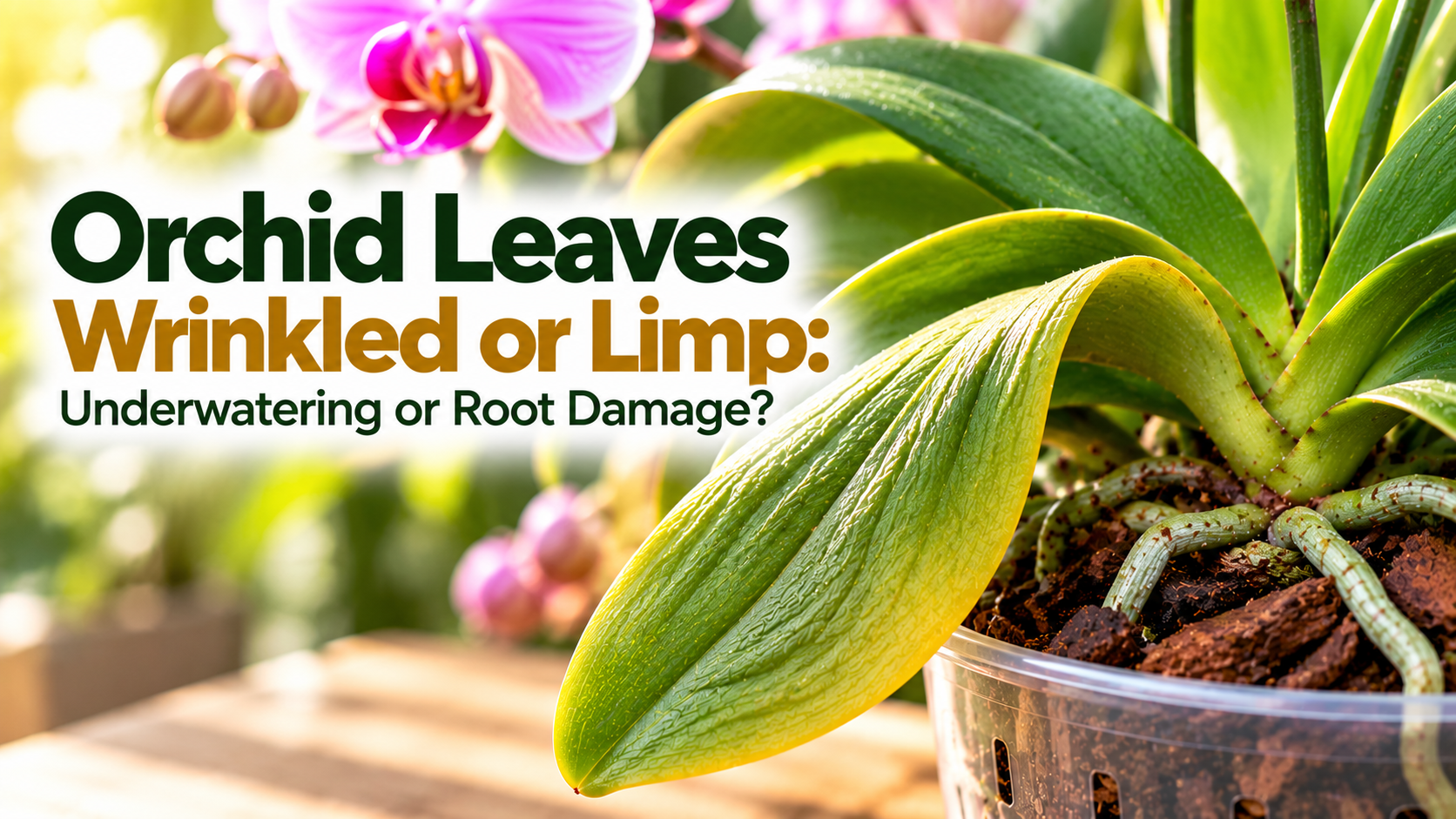
 Wrinkled, limp, or floppy orchid leaves can be frustrating, especially when you water your plant regularly but the leaves still look dehydrated.
The problem is that wrinkled orchid leaves do not always mean your orchid needs more water. Sometimes the potting medium is too dry. In other cases, the roots have deteriorated and can no longer absorb enough water to keep the leaves firm.
Understanding the difference is essential. Adding more water to an orchid with damaged roots can make the problem worse, while leaving a genuinely dehydrated orchid without water can cause further stress.
Wrinkled and limp leaves are also part of a wider range of symptoms covered in our complete guide to orchid leaf problems. This article focuses specifically on how to distinguish underwatering from root damage and what to do about each condition.
Quick Answer: Why Are My Orchid Leaves Wrinkled or Limp?
Orchid leaves become wrinkled or limp when the plant loses more water than it can replace. Several conditions can cause this problem:
- Underwatering: The growing medium dries out too much or too frequently.
- Root rot: Excessive moisture and poor aeration damage the roots, reducing water absorption.
- Severe root dehydration: Roots dry out and lose their ability to function effectively.
- Environmental stress: High temperatures, low humidity, or rapid moisture loss increase the plant’s water demand.
- Extensive root loss: Too few healthy roots remain to support the leaves.
The most useful first step is to inspect both the roots and the potting medium. Leaf appearance alone cannot reliably distinguish underwatering from root damage.
1. What Do Wrinkled Orchid Leaves Look Like?
Healthy Phalaenopsis orchid leaves are generally firm, smooth, and thick enough to hold their shape. When the plant struggles to maintain its water balance, the leaves may gradually lose their firmness.
Common symptoms include:
- Longitudinal wrinkles running along the leaf.
- Leaves that feel softer or thinner than usual.
- Drooping leaves that no longer hold their normal position.
- Leaves that bend downward or appear floppy.
- A generally dehydrated appearance despite regular care.
Some orchids naturally have slightly different leaf shapes or textures. What matters most is a noticeable change from the plant’s usual condition.
If your orchid develops yellowing along with wrinkles or limpness, do not assume that the plant simply needs more water. Our guide to orchid leaves turning yellow explains how natural aging, root problems, and environmental stress can produce similar symptoms.
2. Underwatering: When Your Orchid Really Needs More Water
Underwatering occurs when an orchid cannot obtain enough moisture from its growing environment.
Although many orchids prefer their roots to receive plenty of air, they still need access to water. If the potting medium dries out excessively, the roots may be unable to supply enough moisture to the leaves.
Signs of underwatering
Look for several clues rather than relying on one symptom:
- The potting medium is very dry.
- The pot feels lighter than usual.
- Healthy roots appear silvery or pale rather than green when dry.
- The leaves are becoming thinner, wrinkled, or less firm.
- The orchid has been exposed to warm temperatures or conditions that accelerate drying.
A dry-looking root is not necessarily a dead root. Many healthy Phalaenopsis roots become silvery when dry and turn greener after watering.
How to help an underwatered orchid
Step 1: Check the growing medium.
Determine whether the bark, moss, or other medium is dry throughout the pot rather than just at the surface.
Step 2: Inspect the roots.
Look for roots that remain firm and intact. Healthy roots may be green, silvery, or cream-colored depending on moisture and other conditions.
Step 3: Water thoroughly when appropriate.
If the roots are healthy and the medium is dry, water the orchid thoroughly and allow excess water to drain away.
Step 4: Adjust your watering routine.
Consider the pot size, growing medium, temperature, airflow, and how quickly the roots dry. Do not rely on a rigid calendar.
Step 5: Monitor the leaves.
The orchid may gradually improve as its water balance stabilizes. Severely wrinkled leaves may not return to their original appearance.
If the leaves remain limp after appropriate watering, investigate root damage rather than repeatedly soaking the plant.
3. Root Damage: When Watering Cannot Solve the Problem
One of the most confusing situations for orchid growers is an orchid with wrinkled leaves and a wet pot.
You may assume that the plant needs even more water. However, the opposite may be true.
Orchid roots need both moisture and oxygen. When the potting medium remains excessively wet, roots may become damaged and lose their ability to absorb water efficiently.
As the root system deteriorates, the leaves can become dehydrated even though the growing medium contains plenty of moisture.
Signs of root damage
Examine the visible roots for the following characteristics:
Mushy roots: Healthy roots are generally firm. Roots that feel soft, mushy, or collapsed may be deteriorating.
Damaged outer tissue: Severely damaged roots may lose their outer covering, leaving a thin inner strand.
Hollow or shriveled roots: Some roots may be dead or unable to function effectively.
Persistent wetness: The growing medium stays wet for an unusually long time, especially when old bark has broken down.
Multiple declining leaves: Several leaves may become limp, wrinkled, or yellow as the plant’s ability to absorb water decreases.
Root color varies naturally, so do not remove roots simply because they look brown or pale. Firmness, structure, and the condition of the outer tissue are more informative.
How to respond to root damage
- Carefully inspect the roots and growing medium.
- Determine whether the medium has deteriorated or retains excessive moisture.
- If repotting is necessary, use an appropriate orchid medium with suitable aeration and drainage.
- Remove severely damaged roots with a clean cutting tool when appropriate.
- Adjust watering to the condition of the remaining roots and the new medium.
- Keep the plant in suitable growing conditions while new roots develop.
Do not automatically cut every brown root. Some roots can remain firm and functional despite having a brown exterior.
For a more comprehensive diagnosis, see The Complete Guide to Orchid Roots: How to Identify Healthy Roots and Fix Common Problems.
4. Underwatering vs. Root Damage: How to Tell the Difference
The following comparison can help you decide what to investigate first.
| Observation | Underwatering more likely | Root damage more likely |
|---|---|---|
| Potting medium | Very dry | Often stays wet too long, although other patterns are possible |
| Root texture | Roots generally remain firm | Some roots may be mushy, hollow, or deteriorating |
| Root appearance | Healthy roots may look silvery when dry | Damaged roots may have deteriorated outer tissue |
| Leaf condition | Wrinkled or limp | Wrinkled or limp, sometimes with yellowing |
| Response to watering | May improve as water balance recovers | May remain limp because damaged roots cannot absorb enough water |
| Likely first action | Water appropriately if roots are healthy | Investigate and correct the root problem |
These are clues, not absolute rules. An orchid can experience underwatering and root damage at the same time.
For example, a plant may have lost most of its roots because of previous root rot. Even after the remaining medium dries out, the reduced root system may struggle to supply enough water.
The correct response depends on the condition of the roots, not simply whether the pot feels wet or dry.
5. Can Low Humidity or High Temperatures Cause Limp Orchid Leaves?
Yes. Environmental conditions can affect how quickly an orchid loses water.
High temperatures, low humidity, strong airflow, and intense light can increase moisture loss. If the roots cannot replace that water quickly enough, the leaves may become less firm.
However, environmental stress should not be assumed to be the cause until root health and watering have been considered.
What to check
- Is the orchid exposed to intense direct sunlight?
- Is it located near hot air from an appliance?
- Does the growing area become unusually warm?
- Does the medium dry out very quickly?
- Is the plant receiving enough appropriate light without overheating?
How to improve the conditions
Provide suitable light and airflow while avoiding excessive heat. Maintain a reasonable level of humidity for the orchid species, and ensure the roots can access water without remaining continuously saturated.
Do not compensate for hot conditions by keeping the roots permanently wet. The goal is to balance moisture availability with sufficient aeration.
6. Why Are My Orchid Leaves Still Wrinkled After Watering?
If you have watered your orchid but its leaves remain wrinkled, there are several possible explanations.
The roots are damaged
This is one of the most important possibilities to investigate. Roots that have deteriorated may not absorb enough water even when the medium is moist.
The plant has lost too many roots
An orchid with a severely reduced root system may need time to produce new roots before it can maintain its leaves effectively. If the root system is badly damaged, our guide on growing new roots on an orchid with root damage explains how root recovery can be approached.
The leaves have suffered lasting damage
Leaves that have been severely dehydrated may not regain their original shape completely, even after conditions improve.
The underlying conditions have not been corrected
Repeated watering will not resolve problems caused by deteriorated potting medium, poor drainage, or an unsuitable growing environment.
What should you do?
Inspect the roots again and review the condition of the growing medium. If the roots are healthy and the plant was genuinely dry, allow time for recovery after appropriate watering.
If the roots are deteriorating, correct that problem first. Avoid repeatedly soaking the plant or adding fertilizer in an attempt to force the leaves to recover.
7. Should You Remove Wrinkled Orchid Leaves?
Usually, no.
Wrinkled or limp leaves can still carry out photosynthesis and provide energy to the plant. Removing them unnecessarily reduces the remaining healthy foliage.
Leave the leaves in place if they are still attached and have no other serious signs of deterioration.
Consider removal only when there is a clear reason, such as severely deteriorating tissue or a diagnosed problem that requires removing affected material. Use a clean tool and avoid damaging the crown or stem.
A wrinkled leaf is a symptom to investigate, not an automatic reason to prune.
8. How Long Does It Take for Wrinkled Orchid Leaves to Recover?
Recovery depends on the cause, the severity of dehydration, and the condition of the root system.
An orchid that was simply too dry may begin to improve after appropriate watering, although visible changes are not always immediate.
A plant with extensive root damage may take considerably longer because it needs to restore functional roots before it can maintain its water balance.
Severely wrinkled leaves may remain creased or limp even after the plant’s condition improves.
Instead of judging recovery by one leaf alone, monitor:
- Whether new leaves remain firm.
- Whether root tips show healthy growth.
- Whether existing symptoms stop progressing.
- Whether the plant maintains a stable condition.
- Whether new damage develops.
Healthy new growth is often a more useful sign of recovery than expecting an old damaged leaf to become perfectly smooth again.
9. How to Prevent Wrinkled and Limp Orchid Leaves
Good orchid care involves maintaining a balance between moisture and root health.
Water according to the plant’s needs
Consider the medium, pot, root condition, temperature, and drying rate. Avoid both prolonged saturation and excessive drying.
Use suitable potting medium
Orchids need an environment that provides adequate moisture while allowing air to reach their roots. Replace deteriorated medium when necessary.
Maintain healthy roots
Inspect roots periodically, especially when the leaves begin to change. Catching root problems early can prevent more extensive decline.
Provide suitable light and temperature
Bright, appropriate light supports growth, but excessive heat and intense direct sunlight can increase water stress.
Avoid unnecessary fertilizer
Fertilizer cannot compensate for damaged roots or poor watering practices. Use a suitable orchid fertilizer according to its instructions.
Monitor changes over time
Photograph the leaves and roots when symptoms first appear. Comparing their condition over time can help you identify whether the plant is improving or continuing to decline.
Frequently Asked Questions
Do wrinkled orchid leaves always mean underwatering?
No. Wrinkled leaves indicate that the plant may be struggling to maintain its water balance. Underwatering is one possible cause, but damaged roots can produce similar symptoms.
Should I water an orchid with limp leaves?
Check the roots and growing medium first. If the medium is dry and the roots are healthy, appropriate watering may help. If the medium is wet and the roots are damaged, more water may worsen the problem.
Can an orchid survive with only a few healthy roots?
It may survive if the remaining roots can support the plant and conditions allow new roots to develop. Recovery depends on the extent of the damage, the condition of the crown, and the care provided.
Why are my orchid leaves wrinkled while the roots look green?
Green roots do not guarantee that the entire root system is healthy. Inspect their firmness and structure, and check whether enough functional roots remain. Also consider environmental stress and recent watering.
Will wrinkled orchid leaves become smooth again?
Sometimes leaves regain some firmness after the underlying problem is corrected. However, severe dehydration can cause lasting creases or damage, so complete recovery of an old leaf is not guaranteed.
Should I fertilize an orchid with wrinkled leaves?
Do not increase fertilizer simply because the leaves are wrinkled. First investigate root health, watering, and environmental conditions. Fertilizer cannot repair dead roots.
Help Your Orchid Recover With Better Diagnosis
Wrinkled and limp orchid leaves can be caused by underwatering, root damage, or environmental stress. The most effective approach is to examine the roots and growing medium before deciding what to change.
The Complete Orchid Care Library includes 2 ebooks and 8 Visual Guide Collections to help you understand orchid symptoms, assess growing conditions, and make more confident care decisions.
Build a clearer understanding of what your orchid is telling you and learn how to approach common care problems with practical visual references.