
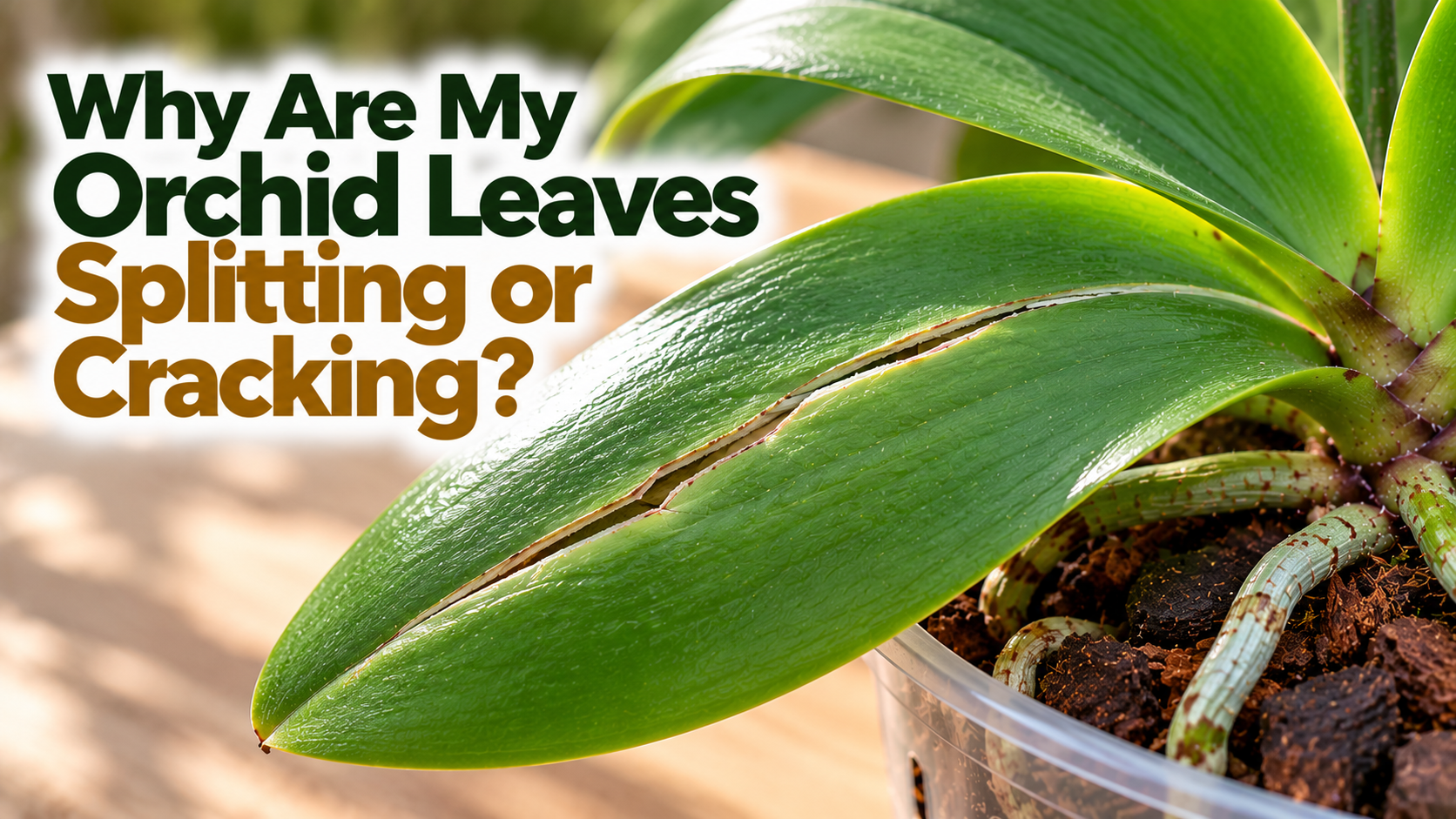
 Discovering a split or crack in an orchid leaf can be worrying, especially when the rest of the plant appears healthy. The damage may run down the center of the leaf, spread outward from the tip, or appear as a jagged tear across the surface.
Fortunately, a split leaf does not automatically mean your orchid is seriously ill. Orchid leaves can crack because of physical damage, changes in water availability, or stress during growth. The important step is identifying the likely cause and preventing additional damage.
This guide explains why orchid leaves split or crack, how to assess the damage, and what you can do to keep new leaves growing properly.
Are Splitting Orchid Leaves a Sign of a Problem?
Not always. A single split in an otherwise healthy orchid may result from accidental handling or mechanical stress. If the plant continues producing firm leaves and healthy roots, the damage may have little effect on its overall health.
However, repeated splitting, several damaged leaves, or cracks accompanied by wrinkling and limp foliage deserve closer attention.
The location and appearance of the split can provide useful clues. A clean tear may suggest physical damage, while a leaf that cracks as it grows may indicate that its development or growing conditions deserve investigation.
For a broader assessment of leaf symptoms, see our complete guide to orchid leaf problems.
1. Inconsistent Watering
One possible contributor to splitting leaves is inconsistent water availability.
Orchid leaves depend on adequate water to maintain their firmness and flexibility. If a plant experiences prolonged dryness followed by a sudden change in water availability, its tissues may experience stress. This can be particularly concerning when the roots are unhealthy or the growing medium dries out too much between waterings.
Watering inconsistency should not be assumed to be the cause of every split. Physical damage and normal growth variation can produce similar symptoms.
Signs to look for
- Leaves appear wrinkled or less firm than usual.
- The plant has experienced repeated periods of excessive dryness.
- Roots are dry, damaged, or unable to absorb water effectively.
- New leaves develop irregularities or splits during growth.
What to do
Establish a consistent watering routine based on your orchid’s needs, the potting medium, temperature, humidity, and root condition.
For most commonly grown Phalaenopsis orchids, water thoroughly when the growing medium approaches the appropriate drying point rather than following a rigid calendar. Allow excess water to drain freely, and avoid keeping the roots continuously saturated.
If the leaves are also wrinkled or limp, read our guide to orchid leaves that are wrinkled or limp to help distinguish dehydration from root-related water uptake problems.
2. Physical Damage
Physical damage is a common explanation for a leaf that suddenly develops a split.
Orchid leaves can tear when bent too far, squeezed against a nearby object, caught during transport, or handled roughly during repotting. A leaf may also crack when it is pressed against a hard edge or repeatedly moved by a fan or passing people.
How to recognize physical damage
- The split appeared after moving or handling the plant.
- There is one obvious tear rather than several developing cracks.
- The surrounding leaf tissue remains green and firm.
- The rest of the orchid looks healthy.
What to do
Move the orchid away from objects that press against its leaves. When repositioning the plant, support the leaf gently instead of pulling it by the tip.
Avoid repeatedly bending a damaged leaf to inspect the crack. This can extend the tear and damage more tissue.
If the split is stable and the leaf remains healthy, it usually does not need to be removed.
3. Damage During Leaf Growth
Sometimes an orchid leaf develops a split while it is still emerging or expanding.
Young leaves are delicate. If a developing leaf encounters physical resistance, becomes trapped between nearby leaves, or experiences unfavorable growing conditions, it may emerge with a crease, tear, or irregular shape.
A split that appears along the length of a leaf may become more noticeable as the leaf expands.
What to check
- Did the split appear while the leaf was still growing?
- Is the newest leaf affected while older leaves remain intact?
- Is the growing tip crowded or obstructed?
- Has the plant experienced major changes in light, temperature, or watering?
What to do
Give emerging leaves enough room to unfold naturally. Avoid pulling them open or trying to straighten them by force.
Maintain reasonably stable growing conditions and monitor the next leaf. If subsequent leaves develop normally, the problem may have been temporary or related to the individual leaf’s development.
If multiple new leaves repeatedly emerge damaged, review the entire growing environment rather than treating each split as an isolated injury.
4. Root Damage and Poor Water Uptake
An orchid can have adequate water around its roots but still struggle to absorb it if the root system is damaged.
Root rot, severely dehydrated roots, or deteriorated potting medium can interfere with water uptake. This may cause leaves to become limp, wrinkled, or less resilient, making existing damage more noticeable and potentially increasing vulnerability to further cracking.
A split leaf alone does not establish that root damage is present. Look for supporting evidence before changing your care routine.
Inspect the roots
If your orchid is growing in a transparent pot, examine the roots and growing medium.
Healthy roots are generally firm, although their colors vary with moisture and orchid type. Roots that are mushy, hollow, or badly deteriorated may indicate a problem.
Also check whether the medium stays wet for too long, has broken down, or drains poorly.
What to do
Address any confirmed root problem first. Improve drainage and aeration when necessary, and repot only when the condition of the roots or growing medium justifies it.
Avoid increasing watering simply because the leaves look damaged. If roots are rotting, additional water can make the underlying problem worse.
For detailed diagnosis and treatment, consult our complete guide to orchid roots.
5. Sudden Environmental Changes
Orchids generally benefit from stable growing conditions. Abrupt changes in temperature, light exposure, humidity, or airflow can stress a plant, particularly when several changes occur at once.
Environmental stress may not directly cause every leaf split, but it can contribute to poor leaf development or reveal an existing problem.
Conditions worth reviewing
Temperature fluctuations: Large changes between warm days and cold nights may stress sensitive orchids.
Excessive light and heat: Strong direct sunlight can damage leaf tissue and create dry or scorched areas.
Very dry air: Low humidity combined with inadequate root hydration may contribute to leaf stress.
Abrupt changes in care: Moving an orchid suddenly from a humid environment to a hot, dry location can make it harder for the plant to adjust.
What to do
Keep the orchid in a location that suits its species and provides appropriate light, temperature, and airflow.
Make environmental changes gradually where possible. Avoid placing the plant directly in front of strong air-conditioning vents, heaters, or intense afternoon sunlight.
6. Nutrient Problems
Nutrient deficiencies can interfere with normal plant growth, but a split leaf by itself is not a reliable sign of a specific deficiency.
If new leaves repeatedly develop abnormally, examine the orchid’s overall growth, roots, growing medium, and fertilizing routine before concluding that it needs additional nutrients.
Excessive fertilizer can also damage roots and worsen water uptake problems.
What to do
Use a fertilizer formulated for orchids and follow the product’s directions. Avoid increasing fertilizer concentration in an attempt to repair a cracked leaf.
If the plant has healthy roots, receives suitable light, and is growing normally, there may be no reason to change its feeding routine solely because one leaf has split.
Should You Cut a Split Orchid Leaf?
Usually, no. A split leaf can continue functioning even though its appearance has changed.
Removing it unnecessarily reduces the leaf area available for photosynthesis. If the damage is limited and the surrounding tissue remains healthy, leaving the leaf in place is generally the better option.
Consider these situations:
- Small, stable split: Leave the leaf intact and monitor it.
- Large tear with healthy surrounding tissue: Avoid further handling and protect the leaf from repeated movement.
- Dead or extensively damaged tissue: Assess whether removal is justified rather than cutting automatically.
- Spreading discoloration or soft, deteriorating tissue: Investigate the cause because the problem may involve more than a mechanical tear.
If trimming is necessary, use a clean cutting tool and avoid damaging the stem or nearby healthy tissue. Do not apply household glue or other improvised sealants to the wound.
Will a Split Orchid Leaf Heal?
A split leaf generally does not fuse back together or return to its original shape. The damaged area may dry along the edges, while the remaining healthy tissue continues functioning.
The main objective is to prevent the split from becoming larger and support healthy new growth.
Monitor the leaf over time. If it remains firm and the crack does not spread, the plant may continue growing normally. New leaves may emerge without the same damage once the underlying cause has been addressed.
How to Prevent Orchid Leaves From Splitting
Although not every split can be prevented, a few habits can reduce the risk of repeated damage.
Handle leaves gently. Support them when moving the pot, cleaning the plant, or repotting.
Keep watering appropriate and consistent. Avoid prolonged dehydration and prevent the roots from remaining waterlogged.
Maintain healthy roots. Check root condition and replace deteriorated growing medium when appropriate.
Give new leaves room to grow. Avoid crowding the plant against walls, shelves, or other objects.
Avoid sudden environmental changes. Adjust light, temperature, and humidity gradually when possible.
Monitor new growth. If repeated splitting occurs, record when it begins and review recent changes in the plant’s environment and care.
Frequently Asked Questions
Why is my orchid leaf splitting down the middle?
A lengthwise split may result from physical stress, damage during leaf development, or other growing conditions that affect the leaf. Check whether the leaf was bent or obstructed and whether new leaves are developing normally.
Can underwatering cause orchid leaves to crack?
Inconsistent water availability may contribute to leaf stress, particularly when roots are damaged or the plant becomes severely dehydrated. However, underwatering is not the only possible explanation for a crack.
Should I tape a split orchid leaf together?
Usually, no. Tape can place pressure on the leaf or damage its surface when removed. A stable split is generally best left alone while the plant continues growing.
Can a split leaf still support flowering?
Yes. A leaf with a limited split can continue photosynthesizing. Flowering depends on the orchid’s overall health, maturity, growing conditions, and species rather than the appearance of one leaf alone.
Why do my orchid’s new leaves keep splitting?
Repeated damage to new leaves deserves closer investigation. Check for physical obstruction, handling damage, inconsistent watering, root problems, and abrupt changes in growing conditions. Persistent abnormalities may require a broader assessment of the plant.
Should I repot an orchid because one leaf has split?
Not necessarily. One split leaf is not, by itself, a reason to repot. Consider repotting when the growing medium has deteriorated, drainage is inadequate, or root inspection reveals a problem.
Help Your Orchid Grow Healthier Leaves
A split orchid leaf is often a cosmetic problem rather than an emergency. Physical damage, leaf development, inconsistent water availability, and root problems are all possible factors, but the correct explanation depends on the symptoms and growing conditions.
Focus on protecting the damaged leaf, checking root health, and observing how the next leaves develop. Repeated splitting is a reason to investigate your care routine, while a single stable crack in an otherwise healthy plant usually requires little intervention.
For a more systematic way to identify orchid symptoms and choose appropriate care responses, explore The Complete Orchid Care Library, featuring 2 ebooks and 8 Visual Guide Collections.