
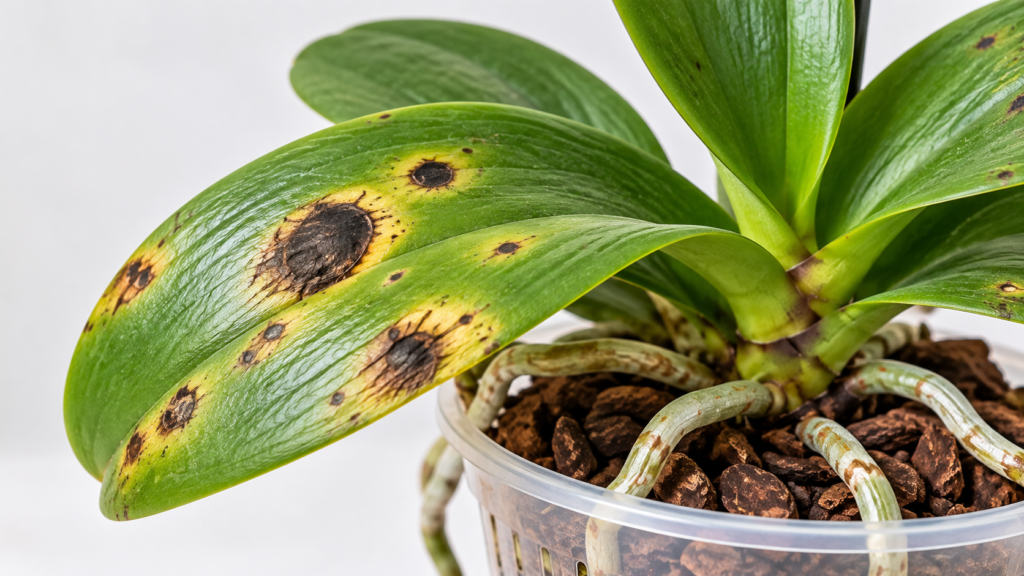
Black spots on orchid leaves can be alarming, especially when they appear on an otherwise healthy plant. Some spots result from sunburn or environmental stress, while others may indicate a fungal or bacterial infection that can spread quickly.
The most important step is to examine the spots carefully before deciding how to treat them. Black spots that are dry and stable are different from lesions that are soft, wet, and expanding.
This guide explains the common causes of black spots on orchid leaves, how to recognize warning signs, and what you can do to protect your plant.
What Causes Black Spots on Orchid Leaves?
Black spots may develop for several reasons:
- Fungal leaf spot diseases.
- Bacterial leaf spot or soft rot.
- Black rot.
- Sunburn or other environmental damage.
- Cold injury or chemical damage.
- Other plant health problems that produce dark lesions.
Spot color alone cannot identify the cause. Their texture, shape, location, and rate of progression are more useful clues.
For a broader overview of leaf symptoms, see our guide to common orchid leaf problems.
1. Fungal Leaf Spot
Fungal leaf spot diseases can cause small brown or black lesions that gradually enlarge. Some spots have a yellow margin, while others develop tan or reddish-brown centers.
As the infection progresses, individual spots may merge into larger areas of damaged tissue.
Signs of fungal leaf spot
- Small, roughly circular brown or black spots.
- Spots that gradually increase in size or number.
- Yellow or discolored areas surrounding some lesions.
- Multiple affected leaves in advanced cases.
- Lesions that become dry or necrotic as they age.
The appearance varies according to the fungus involved and the orchid species. Not every dark spot is fungal.
What to do
- Isolate the affected orchid from nearby plants while you investigate the problem.
- Keep leaves dry and avoid splashing water between plants.
- Improve airflow and reduce prolonged leaf wetness.
- Remove severely affected tissue when appropriate, using sterile cutting tools.
- If the disease continues to spread, consult a reliable orchid disease reference or plant health professional to identify the likely pathogen.
Fungal leaf spots are often encouraged by prolonged moisture on foliage and poor air circulation. Correcting these conditions helps reduce the risk of further infection.
For additional identification guidance, consult the University of Maryland Extension’s guide to fungal leaf spots.
2. Bacterial Leaf Spot
Bacterial infections can also produce brown or black spots on orchid leaves. These lesions may initially appear water-soaked, soft, or translucent before becoming darker.
Some bacterial diseases spread rapidly under warm, humid conditions, particularly when water splashes from an infected plant onto healthy foliage.
Warning signs
- Soft, water-soaked lesions.
- Dark spots surrounded by yellow or pale green tissue.
- Lesions that expand noticeably over a short period.
- Wet or collapsing leaf tissue.
- An unpleasant odor in cases involving soft rot.
These symptoms are especially concerning when the affected area is expanding or the tissue becomes mushy.
What to do
Separate the orchid from other plants immediately if a bacterial infection is suspected.
Avoid misting the leaves and prevent water from splashing between plants. Keep the foliage dry and provide appropriate airflow.
If removal of infected tissue is necessary, use sterile tools and avoid transferring contaminated material to healthy plants. Dispose of infected tissue safely.
Do not assume a fungicide will control bacterial disease. Fungal and bacterial infections require different management approaches, and the correct treatment depends on the cause.
The American Orchid Society’s leaf problems guide explains several patterns associated with fungal and bacterial lesions.
3. Black Rot: A Serious Orchid Disease
Black rot is a potentially destructive disease caused by water molds, including Pythium and Phytophthora. It can affect orchid leaves, new growth, pseudobulbs, and roots.
Unlike a small, stable blemish, black rot can progress rapidly and threaten the entire plant if it reaches the crown or growing point.
Signs of black rot
- Dark brown to black lesions that enlarge rapidly.
- Soft or water-soaked tissue.
- Yellowish margins around some infected areas.
- Rapid deterioration of new growth.
- Spread toward the crown, rhizome, or roots.
A lesion that becomes soft and expands quickly should be treated as a warning sign rather than monitored casually.
What to do
Immediately isolate the orchid and prevent water from reaching nearby plants.
Inspect the affected areas and seek species-appropriate disease management guidance. Severely infected tissue may need to be removed with sterile tools, but cutting must be done carefully to avoid spreading contamination.
Use only products labeled for the intended disease and orchid-growing situation. Follow the label instructions and local regulations.
For detailed disease information, see the American Orchid Society’s guide to black rot.
4. Sunburn or Excessive Light
Sunburn can cause orchid leaves to develop pale, bleached, tan, or brown patches that may eventually turn dark.
This often happens when an orchid is suddenly exposed to stronger sunlight, such as after being moved outdoors or placed beside a hot window.
How to recognize sunburn
- Damage occurs on the most exposed part of a leaf.
- The affected area is often bleached or tan before turning brown.
- The tissue becomes dry or papery.
- The damaged area remains relatively stable after light exposure is corrected.
- The plant was recently moved to a brighter location.
Severe sunburn is irreversible, although preventing further exposure can protect the remaining healthy tissue.
What to do
Move the orchid into suitable bright, indirect light and acclimate it gradually if brighter conditions are needed.
Do not remove a leaf simply because it has a dry sunburn patch. If most of the leaf remains healthy, it can still contribute to photosynthesis.
Read our related guide: Orchid Sunburn: How to Recognize and Treat Damaged Leaves.
5. Cold Injury or Chemical Damage
Black or dark patches can sometimes develop after exposure to unsuitable temperatures or chemicals.
Cold injury may occur after sudden chilling, exposure to cold drafts, or contact with a very cold window. Chemical injury may follow inappropriate pesticide applications, leaf-shine products, cleaning products, or spray drift.
Signs to look for
- Damage appeared after a sudden environmental change.
- Dark patches remain limited to exposed areas.
- The tissue is dry rather than actively spreading.
- The orchid was recently sprayed or exposed to an unfamiliar product.
- Similar lesions are absent from newer leaves.
These clues can help distinguish environmental injury from infection, although they cannot confirm the cause by themselves.
What to do
Move the orchid into a stable environment suitable for its species.
Stop using any suspected irritating product and avoid applying additional treatments until the cause is clearer.
Monitor the damaged tissue. Old injury may remain visible even after conditions improve, so focus on whether new spots develop or existing lesions continue expanding.
6. Why Are the Tips of My Orchid Leaves Turning Black?
Black leaf tips do not always have the same cause as black spots elsewhere on the leaf.
The American Orchid Society notes that blackened tips can result from accumulated salts, often associated with fertilizer or hard water.
Other possible contributors include root stress and environmental damage.
What to check
- Whether only the tips or margins are affected.
- Whether fertilizer has been applied too heavily.
- Whether the water contains high levels of dissolved minerals.
- Whether roots remain healthy and the growing medium drains properly.
If salt accumulation is suspected, flushing the medium with suitable low-mineral water may help, provided the pot drains freely and the roots are not already compromised.
Avoid increasing fertilizer to correct dark leaf tips. More fertilizer can worsen salt accumulation.
For more help identifying symptoms, consult the American Orchid Society’s leaf problems troubleshooter.
How to Diagnose Black Spots on Orchid Leaves
Use the following table to compare the symptoms you observe.
| Appearance | Possible cause | Recommended first step |
|---|---|---|
| Small spots that gradually enlarge | Fungal leaf spot | Isolate and reduce prolonged leaf wetness |
| Wet, soft spots with yellow margins | Possible bacterial infection | Isolate immediately and keep foliage dry |
| Black lesions that expand rapidly | Possible black rot | Isolate and seek prompt disease guidance |
| Dry, bleached patches that turn brown | Sunburn | Reduce excessive direct sunlight |
| Dark areas following cold or chemical exposure | Environmental or chemical injury | Correct the exposure and monitor |
| Blackened leaf tips | Salt accumulation or other stress | Review water quality, fertilizer, and roots |
These patterns are diagnostic clues, not definitive identification. Different diseases and environmental problems can look similar, especially in photographs.
If the spots are rapidly spreading, soft, or wet, do not wait for a perfect diagnosis before isolating the plant.
Should You Cut Off Black Spots on Orchid Leaves?
Not every black spot needs to be cut away.
If the damage is dry, stable, and limited, the leaf may still be functional. Removing healthy tissue unnecessarily can reduce the orchid’s ability to produce energy.
If an infection is suspected and the affected tissue is spreading, removal may be necessary. Use sterile cutting tools and avoid cutting through healthy areas in a way that could spread contamination.
For severe or fast-moving disease, follow guidance specific to the suspected pathogen. Do not apply home remedies indiscriminately, particularly around the crown or roots.
How to Prevent Black Spots on Orchid Leaves
Good growing practices can reduce the risk of many leaf problems.
Keep foliage from staying wet for too long
Water early enough for leaves to dry under normal growing conditions. Avoid leaving water trapped in the crown of a Phalaenopsis orchid.
Improve airflow
Space plants so air can circulate between leaves. Avoid conditions that keep foliage wet for prolonged periods.
Use clean tools and pots
Sterilize cutting tools between plants and keep growing containers clean. Contaminated tools and reused materials can contribute to disease spread.
Avoid sudden light changes
Acclimate orchids gradually when moving them into brighter conditions. Protect leaves from intense direct sunlight and excessive heat.
Inspect new plants
Check newly purchased orchids for unusual lesions, discoloration, or signs of rot. Keep new plants separate when practical while monitoring their condition.
Water according to the orchid’s needs
Avoid both prolonged saturation and severe dehydration. The appropriate watering routine depends on the orchid species, growing medium, pot, temperature, and humidity.
Frequently Asked Questions
Are black spots on orchid leaves always a disease?
No. Black spots can result from fungal or bacterial infections, sunburn, cold injury, chemical damage, or other environmental problems. The texture and progression of the spots help narrow down the possibilities.
Can an orchid recover from black spots?
Yes, if the underlying problem is corrected and sufficient healthy tissue remains. However, damaged tissue usually does not return to its original appearance. Recovery is better judged by the absence of new lesions and the development of healthy growth.
Should I isolate an orchid with black spots?
Isolation is a sensible precaution when spots are unexplained, spreading, wet, or potentially infectious. It helps reduce the chance of transferring pathogens to nearby orchids while you investigate.
Can I use hydrogen peroxide on black spots?
Do not apply hydrogen peroxide indiscriminately. Its suitability depends on the suspected problem, concentration, and application method, and it can damage plant tissue. Identify the likely cause and follow reliable, species-appropriate guidance before treating the plant.
Can cinnamon cure black spots on orchid leaves?
Cinnamon is not a reliable universal treatment for orchid leaf spots. It cannot be assumed to control every fungal or bacterial disease, and dry powders may damage exposed plant tissue. Prioritize isolation, sanitation, and appropriate environmental corrections.
Final Thoughts
Black spots on orchid leaves can range from harmless environmental damage to rapidly spreading disease.
Dry, stable patches after strong sunlight or cold exposure may indicate physical injury. Soft, wet, or rapidly expanding lesions are more concerning and may indicate a fungal or bacterial problem.
Start by isolating suspicious plants, keeping foliage dry, improving airflow, and examining how the spots change over time. Avoid applying random treatments before identifying the likely cause.
For more troubleshooting guidance, explore our articles on common orchid leaf problems, orchid sunburn, and orchid root rot.