
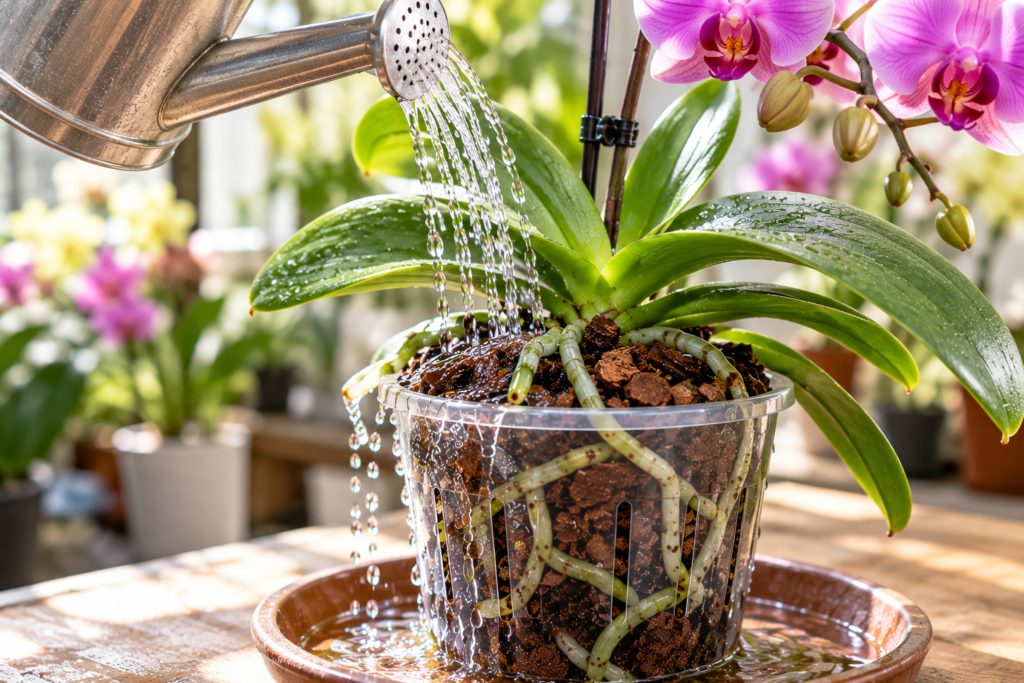
One of the most common questions orchid growers ask is how often they should water their plants. Should you water an orchid every week, every few days, or only when the roots look dry?
The answer depends on several factors, including the type of orchid, potting medium, pot size, temperature, humidity, and root condition. A watering schedule that works for one orchid may leave another too wet or too dry.
For many indoor Phalaenopsis orchids, watering approximately every 7–10 days can be a useful starting point. However, this is only a general guideline. The most reliable approach is to learn how quickly your orchid’s growing medium dries and recognize when the plant needs water.
In this guide, you will learn how often to water different orchids, which factors affect watering frequency, and how to build a routine that supports healthy roots and leaves.
How Often Should You Water an Orchid?
Most orchids do not follow a strict watering schedule. Their needs change with the growing environment, the type of potting medium, and the plant’s condition.
For a typical indoor Phalaenopsis orchid growing in bark, checking the plant every few days and watering when the medium approaches dryness is a practical approach. Depending on the conditions, watering may be needed approximately every 7–10 days, but some orchids dry out faster while others retain moisture longer.
The following ranges are general starting points rather than fixed rules.
| Growing conditions | Possible watering frequency |
|---|---|
| Phalaenopsis in bark | Often around every 7–10 days |
| Orchid in coarse bark in warm conditions | May need more frequent watering |
| Orchid in moisture-retentive sphagnum moss | Often needs less frequent watering |
| Orchid in a cool, humid room | May dry more slowly |
| Orchid in a warm, dry, well-ventilated space | May dry more quickly |
These examples are most useful when combined with regular checks of the medium and roots. Do not water simply because the expected number of days has passed.
For a broader overview of watering methods, water quality, and root health, read The Complete Guide to Watering Orchids: When, How, and How Much.
Why There Is No Universal Orchid Watering Schedule
Two orchids of the same type can require different watering frequencies when they grow in different conditions.
Understanding the following factors will help you decide when to water.
1. Type of Orchid
Different orchid species have different moisture requirements.
Phalaenopsis orchids generally prefer a growing medium that approaches dryness between waterings without remaining dry for an excessive period. Other orchids may prefer more consistent moisture, while some need a more pronounced drying period.
Before adopting a watering routine, identify your orchid whenever possible. Do not assume that every orchid follows the same schedule.
2. Potting Medium
The potting medium has a major influence on how quickly an orchid dries.
Orchid bark usually provides good airflow and drains readily. It can dry relatively quickly, especially in warm conditions.
Sphagnum moss retains more moisture and may remain damp longer than coarse bark. Watering too frequently in tightly packed moss can keep roots excessively wet.
Mixed orchid media vary depending on the proportions of bark, moss, perlite, and other materials.
As the medium ages and decomposes, it may retain more water and provide less airflow. An orchid that once needed frequent watering may eventually need a different routine or repotting.
3. Pot Size and Material
Small pots generally dry faster than large pots because they contain less growing medium.
Plastic pots tend to retain moisture longer than porous terracotta pots under otherwise similar conditions. Transparent plastic pots also allow growers to observe visible roots and moisture inside the container.
Choose a pot that accommodates the root system without leaving excessive unused space. Make sure it has adequate drainage.
4. Temperature and Humidity
Warm temperatures can increase water use and speed up evaporation. Low humidity and strong airflow can also cause the growing medium to dry faster.
Cooler temperatures and high humidity may slow drying, increasing the risk of keeping roots wet for too long if you continue using the same schedule.
During seasonal changes, pay closer attention to your orchid’s drying time rather than assuming its usual routine will always work.
For practical advice on changing your routine with the weather, see How to Adjust Orchid Watering in Hot or Humid Weather.
5. Root Health
Healthy roots absorb water and support the plant’s hydration. An orchid with substantial root damage may be unable to absorb water effectively, even when its growing medium is wet.
This can create a confusing situation: the leaves may look dehydrated while the pot remains damp.
If your orchid has wrinkled leaves, soft foliage, or roots that look brown and mushy, inspect the root system before increasing watering frequency.
Learn more about recognizing root problems in How to Water an Orchid Without Causing Root Rot.
How to Tell When Your Orchid Needs Water
Checking the plant is more reliable than following a calendar. Several signs can help you decide whether it is time to water.
Check the Roots
For many Phalaenopsis orchids growing in transparent pots, root color is a useful indicator.
- Green roots: Often indicate that the roots are hydrated.
- Silvery or pale roots: Often indicate that the roots have dried and may need water.
- Brown, black, soft, or mushy roots: May indicate root damage and should be investigated.
Root color varies among orchid species, so this method is most useful for orchids whose roots visibly change color with moisture.
Check the Pot Weight
Lift the pot after watering and notice how heavy it feels. Check it again as the medium dries.
A pot that feels considerably lighter may be approaching the next watering. Over time, you can learn the difference between a freshly watered pot and one that is ready for water.
Check the Growing Medium
Look at the bark or other medium inside the pot, not just the surface.
The top layer may dry before the center. Conversely, a pot with coarse bark may drain quickly and contain relatively little retained moisture.
For a more detailed method, read How to Tell When an Orchid Needs Water.
Do Not Rely on One Sign Alone
Root color, pot weight, and medium moisture work best when considered together. Wrinkled leaves are not automatically a sign that an orchid needs more water. Root damage can prevent water uptake even when the medium is wet.
Always consider the overall condition of the plant before changing your watering routine.
How Much Water Should You Give an Orchid?
Watering frequency and watering volume are related, but they are not the same.
When a potted epiphytic orchid needs water, a common approach is to wet the growing medium thoroughly and allow excess water to drain completely.
Avoid giving repeated small splashes that wet only part of the root system. In many bark-grown orchids, thorough watering is more effective than adding a little water every day.
Follow these steps:
- Check that the orchid actually needs water.
- Pour water evenly over the growing medium.
- Allow water to run through the drainage holes.
- Let the pot drain fully.
- Empty any outer container or saucer before returning the orchid to its growing position.
There is no single volume of water that works for every orchid pot. The goal is to hydrate the root zone without leaving it waterlogged.
For more details, read How to Water an Orchid Without Causing Root Rot.
Can You Water an Orchid Too Often Even With Drainage Holes?
Yes. Drainage holes are important, but they do not guarantee that an orchid’s roots will dry appropriately between waterings.
A potting medium that retains too much moisture, a container that is too large, or poor airflow can keep the root zone wet for too long. Watering again before the medium has dried sufficiently can increase the risk of root damage.
Watch for these warning signs:
- The medium remains wet for an unusually long time.
- Roots become soft, brown, or mushy.
- The pot develops an unpleasant smell.
- Leaves begin yellowing or losing firmness while the medium remains wet.
These signs do not prove that overwatering is the only problem, but they indicate that the root system and growing conditions need attention.
Read Can You Overwater an Orchid Even With Drainage Holes? to understand why drainage alone may not prevent root problems.
Should You Water Orchids More Often in Hot Weather?
Orchids may need water more frequently during hot weather because higher temperatures and increased evaporation can cause the growing medium to dry faster.
However, hot weather does not automatically mean that every orchid needs daily watering. A plant growing in sphagnum moss may remain moist much longer than one growing in coarse bark.
During hot periods:
- Check the pot and medium more frequently.
- Observe whether the roots are drying faster than usual.
- Avoid leaving orchids in intense direct sunlight that can overheat the plant and pot.
- Maintain appropriate airflow without exposing the orchid to damaging conditions.
- Adjust watering according to actual moisture levels.
In humid weather, drying may slow even when temperatures are high. Check the medium rather than assuming that heat alone determines watering needs.
Should You Water an Orchid Less Often After Flowering?
Not necessarily. The end of flowering does not automatically mean that an orchid needs substantially less water.
Watering needs depend on the orchid’s type, root health, growing medium, temperature, humidity, and growth activity.
Continue monitoring the roots and medium after the flowers fade. If the orchid is actively growing new roots or leaves, its water requirements may remain similar or increase under suitable conditions.
Avoid making major watering changes based only on whether the plant is flowering.
What If You Have Been Watering Your Orchid Too Often?
If you suspect overwatering, do not simply switch to an arbitrary long drying period. First, determine whether the growing medium is staying wet for too long and whether the roots are healthy.
Check the following:
- Is the medium compacted or decomposing?
- Does the pot drain freely?
- Are the roots firm or soft and mushy?
- Is the pot much larger than the root system requires?
- Has the room become cooler or more humid?
If the medium is healthy and the roots are firm, allowing the pot to approach the appropriate dryness before watering again may be enough.
If the roots are rotting or the medium has broken down, you may need to remove damaged roots and repot the orchid into a suitable fresh medium.
For recovery instructions, read What to Do When Your Orchid Has Been Overwatered.
A Simple Routine for Deciding When to Water
Instead of following a rigid weekly schedule, establish a regular inspection routine.
Step 1: Inspect your orchid. Look at the roots, leaves, and growing medium.
Step 2: Check moisture. Assess the pot’s weight and the condition of the medium.
Step 3: Consider the environment. Think about recent changes in temperature, humidity, light, and airflow.
Step 4: Water when needed. If the medium has reached the appropriate level of dryness for your orchid, water thoroughly.
Step 5: Drain completely. Never leave the orchid standing in excess water.
Step 6: Learn its pattern. Record approximately how long the pot takes to dry under your current conditions.
After several watering cycles, you should have a better understanding of your orchid’s needs. Continue adjusting as the weather, medium, and plant condition change.
Frequently Asked Questions
Is watering an orchid once a week enough?
It may be enough for some indoor Phalaenopsis orchids, particularly those growing in bark under moderate conditions. Others may need water sooner or later. Check the roots and medium before deciding.
Can I water my orchid every three days?
Some orchids in warm, dry conditions may need frequent watering, but watering every three days can be excessive for plants in moisture-retentive media. Base the decision on the plant’s actual moisture requirements.
Should orchid roots dry completely between waterings?
Many epiphytic orchids benefit from the growing medium approaching dryness between waterings, but this does not mean leaving the roots dehydrated for extended periods. The appropriate drying level depends on the orchid species and growing setup.
Do orchids need less water in winter?
Often, cooler conditions slow drying, so watering may be needed less frequently. However, indoor heating, airflow, and lighting can change the pattern. Check the medium rather than automatically reducing watering by a fixed amount.
Is misting enough to water an orchid?
No. Misting may temporarily wet leaves and aerial roots, but it does not reliably hydrate the entire root system and growing medium. When the orchid needs water, water the medium appropriately.
What is the best time of day to water an orchid?
Morning is often convenient because it gives splashed water time to dry. More important than the exact hour is watering when needed, allowing the pot to drain, and avoiding water trapped in the crown or leaf joints.
Final Thoughts
The best answer to “How often should you water an orchid?” is to water according to the plant’s needs rather than following a universal schedule.
For many indoor Phalaenopsis orchids, approximately 7–10 days can be a starting point, but potting medium, temperature, humidity, pot size, and root health all influence the correct frequency.
Check the roots, assess the medium, and learn how quickly your orchid dries in its growing environment. Water thoroughly when needed, allow excess water to drain, and investigate root problems if the plant continues to decline.
With regular observation, you can develop a watering routine that supports healthy roots and steady growth without keeping the orchid constantly wet or allowing it to become excessively dry.
Master Orchid Care With The Complete Orchid Care Library
Want to become more confident in watering orchids, identifying root problems, and making better care decisions? The Complete Orchid Care Library brings together practical orchid care ebooks and visual guides to help you understand common orchid problems and care for your plants with greater confidence.
Get The Complete Orchid Care Library Here
Share this article