
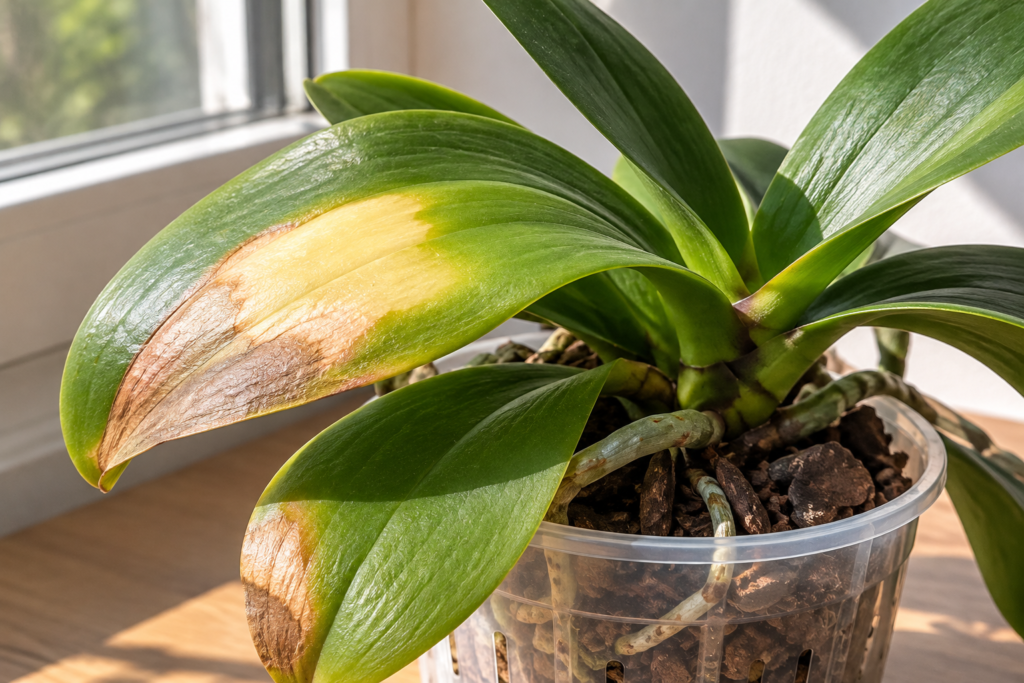
Orchid sunburn occurs when a plant receives more intense light and heat than its leaves can tolerate. The damage may begin as pale yellow or bleached patches and later turn tan, brown, or black. In severe cases, the affected tissue becomes dry and papery.
Sunburn is especially common when an orchid is moved suddenly from a shaded indoor location to direct sunlight, placed beside a hot window, or exposed to stronger seasonal sunlight without enough time to adjust.
The good news is that you can often prevent further damage by correcting the lighting conditions early. However, leaf tissue that has been severely sunburned cannot return to its original healthy state.
This guide explains how to recognize orchid sunburn, distinguish it from other leaf problems, and help your plant recover.
What Does Orchid Sunburn Look Like?
Sunburn can change the color and texture of orchid leaves as the damage progresses. The exact appearance depends on the orchid species, the intensity of the light, and how long the plant has been exposed.
Common signs include:
- Pale yellow or bleached patches on exposed leaves.
- White, cream, or tan areas where leaf color has faded.
- Brown or blackened sections in more severe cases.
- Dry, papery tissue in the affected areas.
- Damage concentrated on the side facing the strongest sunlight.
Sunburn often develops on the most exposed part of a leaf, particularly where direct sunlight strikes the surface intensely.
The location of the damage is an important clue. If the affected patch corresponds to a sunny window or the side of the plant facing outdoors, excessive light may be responsible.
However, brown or black patches do not automatically mean sunburn. Physical injury, disease, and other environmental problems can produce similar symptoms.
For a broader diagnosis, see The Complete Guide to Orchid Leaf Problems: Symptoms, Causes, and Solutions.
1. Why Do Orchid Leaves Get Sunburned?
Most commonly grown orchids need light for photosynthesis, but their tolerance varies by species.
Phalaenopsis orchids generally prefer bright, indirect light rather than prolonged exposure to intense direct sunlight. Other orchid types, including some Cattleya and Vanda varieties, can tolerate brighter conditions when properly acclimated.
Several situations can cause sunburn.
Sudden exposure to stronger sunlight
An orchid that has grown indoors under filtered light may suffer damage when moved directly into outdoor sunlight.
Even if the plant eventually could tolerate brighter conditions, it may not be acclimated to that intensity yet.
Strong sunlight through a window
Sunlight entering through glass can heat exposed leaves, especially near a window that receives intense afternoon sun.
The surrounding room may feel comfortable while the leaf surface becomes excessively hot.
Seasonal changes in sunlight
The angle and intensity of sunlight change throughout the year. A location that provides gentle light in one season may expose an orchid to much stronger direct sunlight in another.
Excessive heat and poor airflow
High leaf temperatures can increase the risk of damage, particularly when strong light combines with limited air movement.
For additional information about overheating, read the American Orchid Society’s guide to orchid heat stress.
2. How to Tell Orchid Sunburn From Other Leaf Problems
Before treating a damaged leaf, consider the color, texture, location, and progression of the affected area.
| Symptom | Possible explanation | What to check |
|---|---|---|
| Pale or bleached patch on an exposed leaf | Sunburn | Recent changes in light exposure |
| Dry tan or brown patch facing a sunny window | Sunburn or physical injury | Location and recent handling |
| Dark, wet, or expanding lesion | Possible disease or active tissue deterioration | Whether the damage is spreading |
| Brown tips or leaf margins | Moisture stress, salt accumulation, root problems, or other damage | Roots, growing medium, and fertilizer use |
| Yellowing of several leaves | Various causes, including watering or root problems | Root health and the pattern of yellowing |
| Limp or wrinkled leaves | Dehydration, root dysfunction, or heat stress | Root firmness and medium moisture |
The pattern of damage is often more informative than color alone.
If the brown area is dry and stable, the injury may be old sunburn. If the area is soft, wet, or spreading, investigate other causes instead of assuming that sunlight is responsible.
Our guide to Why Are My Orchid Leaves Turning Brown? explains additional causes of brown leaf tissue.
3. What to Do Immediately When You Notice Sunburn
The first priority is to prevent further damage without placing the orchid under unnecessary stress.
Step 1: Move the orchid out of intense direct sunlight
Relocate the plant to a position with suitable bright, indirect light.
For a Phalaenopsis orchid, this might mean moving it away from a hot, sun-facing window or placing a sheer curtain between the plant and direct sunlight.
Do not automatically move the orchid into complete darkness. It still needs appropriate light for photosynthesis and continued growth.
Step 2: Check the leaf temperature and airflow
If the leaves feel unusually warm, improve air circulation and reduce excessive direct exposure.
Avoid placing the plant in a strong drying draft. The goal is to maintain a stable, suitable growing environment.
Step 3: Check the roots and potting medium
Sunburn primarily damages exposed leaf tissue, but heat and environmental stress can occur alongside root problems.
Check whether the roots remain firm and whether the growing medium is appropriately moist.
Do not water excessively just because the leaves look damaged. Water according to the condition of the roots and medium.
If the leaves are also soft or droopy, read Why Are My Orchid Leaves Soft and Droopy?.
Step 4: Monitor the damaged area
Take a photograph of the affected leaf so you can compare its appearance over the following days.
Stable, dry sunburn scars may remain visible without indicating that the damage is continuing. New discoloration, spreading dark tissue, or soft lesions deserve closer investigation.
4. Can Sunburned Orchid Leaves Recover?
The answer depends on how much tissue has been damaged.
Early light stress may cause yellowing before the leaf tissue has been irreversibly damaged. Correcting the light conditions at this stage may prevent more serious injury.
Once tissue becomes bleached, sunken, or extensively brown and necrotic, it generally cannot regain its original green color.
Recovery therefore means protecting the remaining healthy tissue and allowing the plant to continue growing.
What recovery looks like
- The damaged patch stops expanding.
- The remaining leaf tissue stays firm.
- No additional leaves develop similar damage.
- New leaves grow under suitable light conditions.
- The plant maintains healthy roots and continues normal growth.
Do not expect the old leaf to become completely green again. A permanent scar can remain on an otherwise healthy orchid.
5. Should You Cut Off a Sunburned Orchid Leaf?
Not necessarily.
A leaf with a small, dry sunburn patch can often remain on the plant. The healthy green portion can still contribute to photosynthesis.
Removing an otherwise functional leaf may reduce the plant’s ability to produce energy.
Consider removing a leaf only when it is extensively dead, severely deteriorating, or affected by a suspected disease that requires removal. Use clean, sterile cutting tools and avoid injuring the stem or crown.
If the damaged tissue becomes wet, soft, or progressively dark, reassess whether the problem is actually sunburn or whether another issue is developing.
Do not cut away healthy tissue simply to make the plant look more attractive.
6. How Much Sunlight Do Orchids Need?
There is no single light level that suits every orchid species.
Phalaenopsis orchids generally perform best in bright, filtered light. Other orchids may need higher light levels to grow and flower well.
Instead of relying only on a fixed number of hours, observe the plant and consider the intensity of the light, its duration, the temperature, and the species.
Useful practices include:
- Provide bright, indirect light for Phalaenopsis orchids.
- Use appropriate shading when direct sunlight is too intense.
- Keep leaves away from excessively hot window glass.
- Observe the plant as seasonal sunlight changes.
- Adjust light gradually rather than making sudden, extreme changes.
Leaf color can provide clues, but it is not a perfect light meter. A pale or yellowing leaf may have several causes, so consider the whole plant before changing its environment.
7. How to Prevent Orchid Sunburn
Prevention is easier than treating damaged leaves.
Acclimate orchids gradually
When moving an orchid into brighter conditions, increase exposure in stages rather than placing it directly into strong sunlight.
Observe the plant during the adjustment period and reduce exposure if bleaching or scorching develops.
Use filtered light
A sheer curtain or suitable shade can reduce excessive direct sunlight while allowing useful light to reach the leaves.
Outdoor orchids may need additional shade during the hottest part of the day.
Watch for seasonal changes
Check whether the sun’s angle changes the amount of direct light reaching your orchid. A previously safe windowsill can become too intense at certain times of the year.
Maintain airflow
Good airflow helps dissipate heat around leaves. It does not make excessive direct sunlight safe, but it can support more stable growing conditions.
Match light to the orchid species
Research the needs of your particular orchid rather than assuming that every variety prefers the same exposure.
For example, a Phalaenopsis orchid generally needs more protection from intense direct sunlight than some high-light orchid varieties.
Frequently Asked Questions
Can an orchid die from sunburn?
Severe sunburn can cause extensive leaf damage and may contribute to the decline of a plant. Most cases of limited leaf damage are less serious if the growing conditions are corrected promptly and the remaining roots and leaves are healthy.
Will a sunburned orchid leaf turn green again?
Severely bleached or necrotic tissue generally cannot recover its original color. Early yellowing caused by excessive light may improve if the tissue has not been irreversibly damaged.
Should I water an orchid after sunburn?
Water only when the plant’s roots and potting medium indicate that watering is needed. Sunburn does not automatically mean the orchid is dehydrated, and excess water can create additional root problems.
Can orchid sunburn look like a disease?
Yes. Brown, black, or pale patches can result from several different causes. Consider whether the damage is concentrated on sun-exposed areas, whether it appeared after a change in light, and whether the tissue is dry or spreading.
Is morning sunlight safe for orchids?
Gentle morning sunlight may be suitable for some orchids, depending on the species, location, season, and intensity. Introduce direct light gradually and observe the plant rather than assuming that every morning exposure is safe.
Final Thoughts
Orchid sunburn develops when the intensity of light and heat exceeds what the plant can tolerate. The first signs may be pale or yellow patches, followed by bleached, tan, brown, or blackened tissue.
The most effective response is to reduce excessive exposure, provide suitable indirect light, and maintain stable growing conditions. Leave minor, stable scars in place when the leaf remains functional, and monitor any tissue that becomes soft or begins spreading.
Most importantly, acclimate orchids gradually whenever you change their growing location. With appropriate light and attentive observation, you can prevent further sunburn and support healthy new growth.
For more troubleshooting advice, explore our guides to common orchid leaf problems, brown orchid leaves, and soft and droopy orchid leaves.