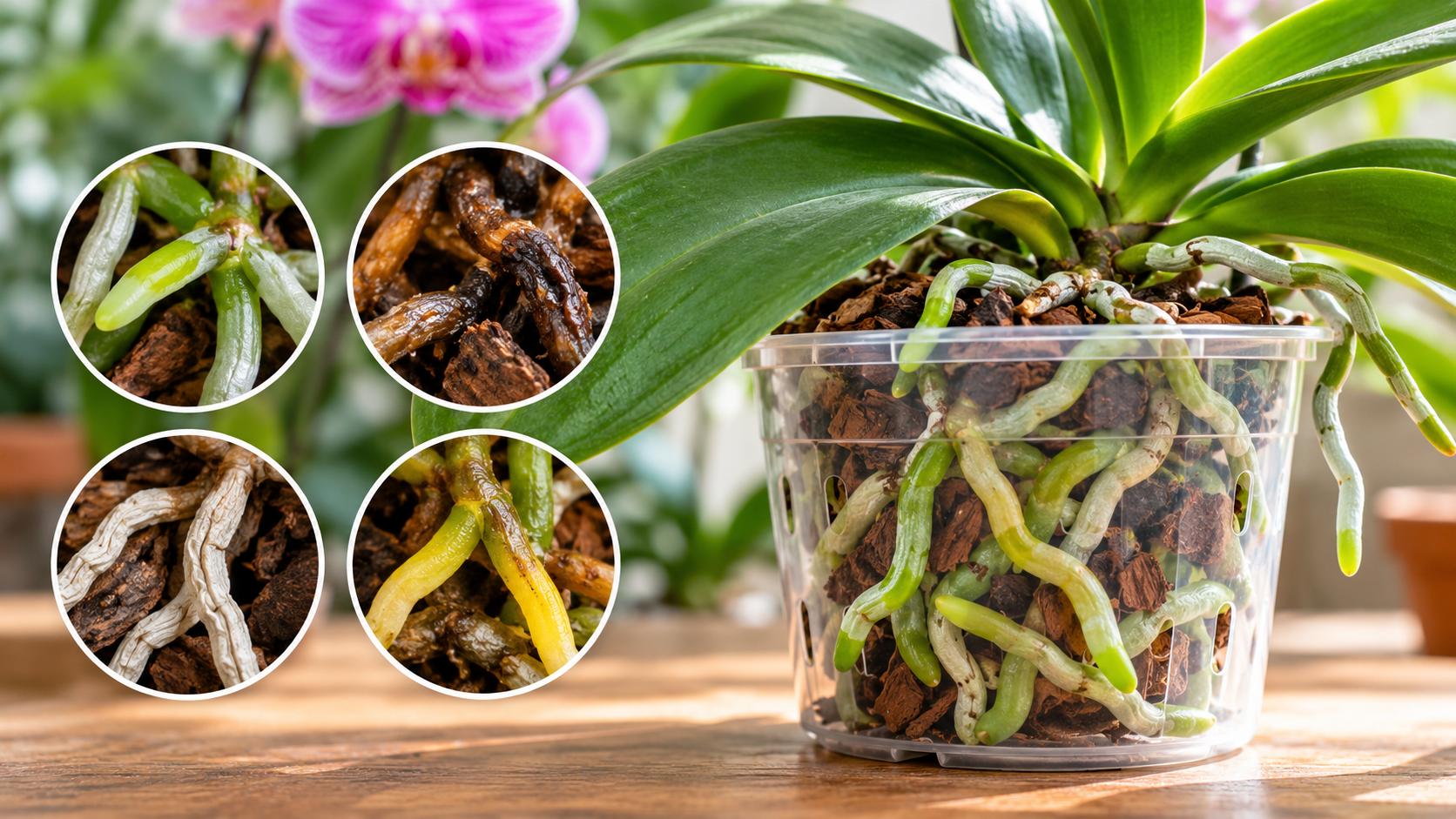
Orchid roots are one of the most important indicators of plant health. They absorb water and nutrients, help anchor the plant, and, in many orchid species, contribute to photosynthesis. When roots are healthy, an orchid is better equipped to produce new leaves, develop flower spikes, and recover from environmental stress.
However, orchid roots can be confusing for beginners. Green roots may turn silver after drying. Healthy roots may grow outside the pot. Some roots naturally appear yellow or brown, while damaged roots can look similar to healthy ones at first glance.
The most important lesson is this: never diagnose an orchid root problem by color alone. Root texture, firmness, moisture, growing conditions, and the overall condition of the plant provide a more reliable picture.
This complete guide explains how orchid roots work, how to identify healthy roots, what common root changes mean, and how to respond when something goes wrong. You will also find links to detailed guides covering individual root problems.
Whether you grow Phalaenopsis orchids on a windowsill, Cattleya orchids in a greenhouse, or other orchid varieties in different growing environments, understanding their roots will help you make better care decisions.
Understanding Orchid Roots
Before treating a root problem, it helps to understand how orchid roots function and why they can look different from the roots of ordinary houseplants.
The velamen: A special outer layer
Many popular orchids, including Phalaenopsis, Vanda, and Cattleya, are epiphytes. In nature, they commonly grow attached to trees or other surfaces rather than buried in soil.
Their roots are adapted to this environment. Many have an outer layer called the velamen, which consists of multiple layers of cells that are generally dead at maturity.
The velamen helps roots absorb water quickly, retain moisture temporarily, and protect the living tissues beneath it.
When dry, the velamen often appears silver, white, or pale. When wet, it can become translucent, allowing the green tissues underneath to show through.
This explains why a healthy Phalaenopsis root may look silver before watering and green afterward.
However, not every orchid root follows this exact color pattern. Root appearance varies with species, age, growing conditions, and exposure to light.
How orchid roots absorb water and nutrients
Orchid roots absorb water and dissolved nutrients from their surroundings. Depending on the species and growing method, those resources may come from potting media, rainwater, irrigation, or moisture collected on exposed roots.
Healthy roots also need oxygen. Root tissues use oxygen for cellular respiration, which supports normal growth and function.
When an orchid’s root zone remains excessively wet and poorly aerated for extended periods, the roots can become stressed and damaged. Once the tissues deteriorate, the plant may struggle to absorb water even when its potting medium is wet.
This is why adding more water does not always help an orchid with limp leaves. If its roots are damaged, the plant may be unable to use the water available to it.
Why aerial roots are normal
Many epiphytic orchids produce roots that extend beyond their pots. These are commonly called aerial roots.
In their natural habitats, orchids may grow along tree trunks and branches, where roots spread through the air and attach to suitable surfaces. Aerial roots are therefore a normal part of their growth.
These roots can absorb moisture when conditions allow. They may also help the plant attach to its growing surface.
You do not need to force every aerial root into the potting medium. Healthy roots growing outside the container are not automatically a sign of poor care.
For more information, read Why Are My Orchid Roots Growing Outside the Pot?.
Different orchid species have different roots
Root characteristics vary among orchid genera.
Phalaenopsis commonly produces thick, rounded roots covered with velamen. Vanda orchids often develop substantial exposed roots, especially when grown in baskets or with minimal potting medium. Cattleya orchids produce roots associated with their rhizomes and pseudobulbs.
Some terrestrial orchids have root systems adapted to soil-like substrates and may not display the same characteristics as common epiphytic orchids.
Before diagnosing a root problem, consider the orchid’s identity and natural growth habit. A characteristic that is normal for one orchid may be unusual for another.
How to Identify Healthy Orchid Roots
Healthy roots generally remain structurally intact and firm. Their exact color is less important than their texture, condition, and ability to support the plant.
1. Check root firmness
Healthy orchid roots generally feel firm rather than mushy or hollow.
If you need to inspect a root, handle it gently. Avoid squeezing it repeatedly or pulling on it to test its strength.
Roots that have deteriorated may feel soft, collapse under light pressure, or have an outer covering that slips away from the central strand.
Dead roots may also become papery, brittle, or hollow.
Do not assume that every root that feels slightly flexible is unhealthy. The important distinction is whether the root remains structurally intact or shows clear signs of deterioration.
2. Look at the root surface
A healthy root usually has an intact outer covering.
Depending on the species and growing conditions, the surface may look smooth, rounded, pale, green, or slightly tan. Aerial roots may have a different appearance from roots growing inside a pot.
By contrast, severely damaged roots may have missing outer tissue, collapsed sections, or exposed central strands.
If the root surface looks unusual, compare it with other roots on the same plant rather than relying on a single visual feature.
3. Observe active root tips
New root tips are a useful sign of active growth.
They may appear green, reddish, purple, or another color depending on the orchid. Actively growing tips are often smooth and pointed, with a distinct developing end.
Protect these tips from unnecessary handling, fertilizer concentrations that are too strong, and physical damage.
A plant producing new roots is showing encouraging signs of growth. However, new root development does not necessarily mean every older root is healthy.
4. Evaluate the entire root system
A healthy orchid does not need to have a pot completely filled with roots.
Some orchids naturally produce extensive root systems, while others have fewer roots depending on their species, age, and growth stage.
Look for a reasonable balance between the roots, leaves, and overall plant size. A plant with several functioning roots may grow well, while a plant that has lost most of its roots may struggle even if a few healthy roots remain.
5. Consider the leaves and new growth
Roots should never be assessed in isolation.
Firm leaves, steady growth, and a healthy growing point can provide reassuring evidence that the plant is functioning well. Limp leaves, stalled growth, or widespread root deterioration may indicate that the plant is under stress.
However, symptoms do not always appear simultaneously. An orchid may retain firm leaves for a while after root damage begins. Older leaves may also yellow naturally as part of normal development.
Use the roots, leaves, growing medium, and environmental conditions together to make a diagnosis.
For a detailed checklist and visual indicators, see How to Tell If Your Orchid Roots Are Healthy.
What Orchid Root Colors Mean
Root color can provide clues about moisture and root condition, but it is not a reliable diagnosis on its own.
Green roots
Green roots are common in hydrated Phalaenopsis orchids, particularly when the roots receive light.
When the velamen becomes wet and translucent, the green tissues underneath become more visible.
Firm green roots with intact surfaces are generally reassuring. Nevertheless, a green root can still be damaged, so check its texture and surrounding conditions.
Silver or white roots
Silver or silvery-white roots are common in Phalaenopsis orchids between waterings.
This appearance often indicates that the velamen is dry, not that the root is dead.
If the roots are firm and intact, there is generally no reason to panic. Assess the potting medium and the orchid’s watering needs before deciding whether to water.
White roots can also develop inside opaque pots where they receive little light. This may be entirely normal.
Yellow roots
Yellow or cream-colored roots may be healthy, especially when they grow inside a pot without light exposure.
The distinction is between a firm, intact yellow root and one that is soft, collapsing, or decomposing.
Yellowing alone is not a reason to cut a root. Look for additional signs of deterioration before taking action.
Brown roots
Brown roots may be stained by potting media, minerals, or organic material. Some roots also become darker with age.
A firm brown root may remain functional, whereas a soft brown root with deteriorating tissue may be damaged.
Inspect the root carefully before pruning. Cutting healthy roots because of their color alone can reduce the plant’s ability to absorb water and nutrients.
Black or very dark roots
Very dark roots deserve closer inspection, particularly when the potting medium remains wet for long periods.
If a dark root is mushy, hollow, foul-smelling, or losing its outer covering, it may be severely damaged or rotting.
However, color alone is not enough to confirm root rot. Surface staining and other harmless discoloration can occur.
For a more detailed explanation of these color changes, read What Do Green, Silver, White, and Brown Orchid Roots Mean?.
Common Causes of Orchid Root Problems
Root problems rarely have just one possible cause. Watering practices, potting medium, drainage, temperature, light, and fertilizer can interact to affect root health.
Overwatering and poor aeration
Overwatering is not simply a matter of watering too many times per week. It also depends on how long the roots remain wet and how much oxygen is available around them.
A dense or decomposed potting medium may retain more moisture than expected. An oversized pot may dry slowly. Cool conditions can also reduce the rate at which the medium loses moisture.
If the root zone remains excessively wet and poorly aerated, root tissues may become stressed and eventually deteriorate.
The solution is not to follow a universal watering schedule. Instead, consider the orchid species, medium, pot material, temperature, humidity, and rate of drying.
Underwatering and prolonged dryness
Insufficient water can also stress orchid roots.
If roots repeatedly become too dry for the species and growing conditions, they may lose moisture, shrivel, or become less functional.
However, a dry-looking root is not necessarily unhealthy. Silver roots are normal in many Phalaenopsis orchids between waterings.
Before increasing watering frequency, determine whether the roots are firm, whether the medium is dry, and whether the plant still has a functioning root system.
Decomposing potting medium
Organic potting materials such as bark gradually break down.
As the material decomposes, fine particles may accumulate between larger pieces, reducing airflow and changing how water moves through the pot.
A watering routine that worked when the medium was fresh may become unsuitable as it deteriorates.
Repotting may be appropriate when the medium has broken down substantially, drainage is poor, or the roots are being damaged by the conditions inside the pot.
Incorrect pot size
A pot that is too large for the root system may contain more medium than the orchid can effectively use. Depending on the medium and environment, this can increase drying time and contribute to unfavorable root conditions.
A pot that is too small can also become unsuitable when the root system has outgrown the available space or the plant cannot remain stable.
Choose a pot based on the root system, the orchid’s growth habit, the growing medium, and your environment. A larger pot is not automatically better.
Temperature and environmental stress
Temperature influences water use, root activity, and how quickly the growing medium dries.
Cool conditions can slow drying and water use. Excessive heat, strong direct sunlight, or dry airflow can increase water loss and stress exposed roots.
Different orchid genera have different temperature and humidity preferences. The growing environment should match the needs of the particular plant.
Fertilizer and water quality
Excessive fertilizer concentration can damage roots, especially when salts accumulate in the medium.
Water quality may also matter. Mineral content, alkalinity, and dissolved salts can influence the root environment over time.
Use a fertilizer appropriate for the orchid and growing method. Avoid concentrated fertilizer applications to plants with damaged roots.
When drainage is adequate, periodic flushing with suitable water may help remove accumulated salts. The exact approach depends on the water quality, medium, and cultivation method.
Physical damage
Roots can be damaged during repotting, transport, cleaning, or repeated handling. Young growing tips are especially vulnerable.
Handle roots carefully and avoid repotting unnecessarily. If damage occurs, maintain appropriate conditions and monitor the remaining root system.
How to Diagnose Unhealthy Orchid Roots
When roots look unusual, follow a consistent process rather than immediately cutting them or changing the watering routine.
Step 1: Identify the orchid
Determine the genus or species if possible. Consider whether the plant is epiphytic or terrestrial and what its normal root appearance should be.
Step 2: Check the texture
Are the roots firm and intact, or are they soft, hollow, brittle, or collapsing?
Texture is often more useful than color alone.
Step 3: Examine the growing medium
Check whether the medium is drying too quickly, staying wet for too long, or breaking down.
Look at drainage, pot size, and the conditions in which the orchid is growing.
Step 4: Inspect the rest of the plant
Consider the leaves, growing point, pseudobulbs where present, and recent growth.
Determine whether the problem affects only a few roots or whether the entire plant is declining.
Step 5: Look for patterns
A single brown root may be harmless. Multiple roots becoming soft and dark while the medium remains wet suggest a different problem.
Similarly, a few dry-looking roots may be normal, while extensive root loss combined with wrinkled leaves requires closer investigation.
Step 6: Correct the likely cause
If the roots are healthy, avoid unnecessary intervention.
If the medium is unsuitable, improve the root environment. If roots are clearly dead or severely decayed, remove nonviable tissue when necessary and correct the conditions that contributed to the damage.
Step 7: Monitor the plant
Observe changes in root growth, leaf condition, and moisture levels. Avoid repeatedly removing the orchid from its pot just to check for progress.
How to Fix Common Orchid Root Problems
The correct treatment depends on the condition of the roots and the cause of the problem.
Brown roots
First, determine whether the brown coloration is staining or actual tissue deterioration.
Firm roots with intact surfaces may be worth preserving. If the roots are soft, collapsing, or losing their outer tissue, investigate the growing medium, drainage, and watering conditions.
Do not cut roots solely because they are brown.
Read the detailed guide: Why Are My Orchid Roots Turning Brown?.
Root rot
Root rot requires attention to both the damaged roots and the environment that allowed deterioration to develop.
If the roots are severely affected, remove the orchid carefully from its pot and inspect the root system. Remove loose medium and use a clean, sharp tool to cut away roots that are clearly dead or severely decayed.
Preserve firm, viable roots even when their color is not ideal.
If the medium has decomposed or drainage is poor, repot using fresh medium suited to the orchid and its growing conditions.
After repotting, adjust watering according to the new medium and the condition of the remaining roots. Do not keep the medium constantly saturated in an attempt to stimulate recovery.
Fungicides are not automatically necessary for every case of root deterioration. If you use a treatment, select one appropriate for the suspected problem and follow the product label.
Read: Orchid Root Rot: Signs, Causes, and How to Save Your Plant.
Dry, wrinkled, or shriveled roots
Wrinkled roots may indicate prolonged dryness, but they may also be damaged and unable to absorb water properly.
Inspect the root texture and the moisture conditions around the plant. Determine whether the medium is drying too quickly, remaining excessively wet, or becoming difficult to rewet.
If the roots are alive and the medium is genuinely too dry, appropriate watering may help. If the roots are rotting or nonfunctional, adding more water may make the problem worse.
Read: Why Are My Orchid Roots Dry, Wrinkled, or Shriveled?.
Yellow roots
Yellow roots may be healthy when they develop without light exposure.
If the roots remain firm and intact, there is usually no need to cut them. If yellowing occurs alongside softness, deterioration, or an unpleasant smell, investigate the root environment.
Read: Why Are My Orchid Roots Turning Yellow?.
Aerial roots growing outside the pot
Healthy aerial roots generally do not need to be cut or forced into the medium.
If you are repotting, you may position a root inside the pot if it bends naturally and doing so suits the orchid’s growth habit. Never force a stiff root into the medium if it is likely to break.
Read: Why Are My Orchid Roots Growing Outside the Pot?.
Dead roots
Remove roots that are clearly dead or severely decayed when necessary. Preserve roots that remain firm and structurally intact, even if their color is unusual.
Use clean tools and avoid removing more tissue than necessary.
Read: Should You Cut Dead Orchid Roots? How to Identify Them.
How to Encourage New Root Growth
An orchid with damaged roots needs suitable growing conditions before it can recover. No single technique guarantees new roots, and recovery time varies by species, growing conditions, and the amount of damage.
Correct the underlying problem first
If the roots deteriorated because the medium was poorly aerated, correct the medium and drainage.
If the plant has been allowed to dry excessively, adjust the watering approach to suit the species and growing conditions.
If fertilizer salts may have contributed to the damage, avoid further concentrated feeding and assess water quality and the medium.
Root growth is unlikely to improve consistently if the underlying problem remains.
Choose an appropriate pot and medium
The pot should accommodate the remaining roots without surrounding them with an unnecessarily large volume of wet medium.
Select a medium suitable for the orchid and the environment in which it grows. A warm, ventilated space may require a different setup from a cool, humid growing area.
The objective is to provide both adequate moisture and oxygen.
Provide suitable light and temperature
Appropriate light supports plant growth, but excessive direct sunlight can overheat the orchid and increase water loss.
Maintain temperatures suitable for the species. Avoid extreme environmental changes while the plant is recovering.
Good airflow can help reduce stagnant, excessively wet conditions, but very strong, dry airflow can increase dehydration.
Avoid excessive fertilizer
Fertilizer supports growth when used appropriately, but it cannot repair dead roots or compensate for poor growing conditions.
Damaged roots may be particularly vulnerable to excessive fertilizer concentration. Focus first on root function, moisture management, and the growing environment.
Be patient
New roots may develop from the base of the plant or other growth points depending on the orchid’s structure.
Some orchids produce new roots more readily during active growth. Others grow slowly when seasonal conditions are less favorable.
Monitor new root tips, leaves, and overall plant condition. Avoid repeatedly unpotting the orchid to check for progress.
For a step-by-step discussion, read How to Grow New Roots on an Orchid With Root Damage.
What if new roots are not appearing?
A lack of visible new roots does not automatically mean that the orchid is dying. Root development varies with species, season, maturity, and growth stage.
However, persistent lack of growth accompanied by declining leaves or damaged roots may indicate unsuitable conditions.
Review light, temperature, medium condition, watering, and fertilizer practices. Make targeted adjustments instead of changing everything at once.
Read: Why Are My Orchid Roots Not Growing?.
How to Prevent Future Root Problems
Preventing root problems is generally easier than trying to restore an orchid that has lost most of its functioning roots.
Water according to the plant and environment
Do not water solely because a certain number of days has passed.
Consider the orchid species, potting medium, pot material, temperature, humidity, and the rate at which the medium dries.
When watering is appropriate, provide enough water to moisten the medium as intended for that growing method, while ensuring suitable drainage.
Monitor the potting medium
Organic media gradually decompose. Check their condition periodically and repot when they no longer provide suitable drainage and aeration.
Do not repot unnecessarily, because handling can damage roots and growing tips.
Choose the right pot
Select a pot that fits the root system and provides appropriate drainage for the medium and environment.
Transparent pots can make it easier to observe roots, but they are not essential for every orchid. Pot material and ventilation also affect how quickly the medium dries.
Use fertilizer carefully
Follow appropriate dilution and application guidance. Avoid excessively concentrated solutions and consider the quality of the water used for irrigation.
A plant with damaged roots does not necessarily benefit from stronger feeding.
Maintain suitable environmental conditions
Provide the light, temperature, humidity, and airflow required by the orchid species.
Avoid prolonged conditions that leave the root zone excessively wet or expose roots to extreme dehydration.
Observe changes early
Check the roots and growing medium periodically. Look for changes in texture, moisture retention, and growth rather than reacting to every color change.
Early diagnosis can help you correct unsuitable conditions before more extensive damage develops.
Frequently Asked Questions About Orchid Roots
Should healthy orchid roots always be green?
No. Many Phalaenopsis roots turn green when wet and silver when dry. Other healthy roots may be cream-colored, yellowish, tan, or brownish. Assess firmness and tissue condition as well as color.
Are silver orchid roots a sign of dehydration?
Not necessarily. Silver roots are often normal dry roots with velamen that has not been wetted recently. Check the medium, root texture, and overall plant condition before increasing watering.
Can an orchid survive with only a few healthy roots?
Yes. Some orchids can recover with a limited number of viable roots. Recovery depends on the remaining root system, the condition of the growing point, the species, and the suitability of the growing environment.
Should I cut every brown orchid root?
No. Some brown roots are stained or naturally darker. Preserve roots that remain firm and intact. Remove roots that are clearly dead or severely decayed when necessary.
Why are my orchid roots growing outside the pot?
Many epiphytic orchids naturally produce aerial roots. These roots can help absorb moisture and nutrients. Their presence alone does not mean that the orchid needs repotting.
Why are my orchid roots wrinkled even though the potting medium is wet?
The roots may be damaged and unable to absorb water effectively. Inspect their texture and the condition of the medium. Adding more water without diagnosing the cause may worsen the problem.
Can fertilizer encourage new orchid roots?
Appropriate fertilizer can support growth, but it cannot repair dead roots or correct poor drainage. Excessive concentrations may damage roots. First provide suitable moisture, aeration, light, and temperature.
How long does it take for new orchid roots to grow?
There is no universal timeline. Growth depends on species, temperature, light, season, plant health, and the extent of root damage. Look for gradual signs of active growth rather than expecting a fixed recovery period.
Is repotting always necessary when orchid roots look unhealthy?
No. If the roots are healthy and the medium remains suitable, repotting may be unnecessary. Repot when the medium has deteriorated, drainage is unsuitable, the pot no longer meets the plant’s needs, or root damage requires inspection and correction.
Conclusion: Focus on Root Health, Not Root Color Alone
Orchid roots reveal important information about a plant’s condition, but their appearance must be interpreted in context.
Green, silver, white, yellow, and brown roots can all occur in different circumstances. Firmness, tissue integrity, moisture conditions, and the overall health of the orchid provide a more reliable basis for diagnosis than color alone.
When problems arise, identify the likely cause before changing your care routine. Preserve healthy roots, remove clearly dead or severely decayed tissue when appropriate, and provide growing conditions suited to the orchid.
With careful observation and consistent care, you can recognize root problems earlier and give your orchid a better opportunity to recover.
Want to grow healthier orchids and solve common orchid care problems with greater confidence?
The Complete Orchid Care Library brings together 10 practical resources in one complete collection:
- 2 Ebooks covering essential orchid care and reblooming techniques
- 8 Visual Guide Collections featuring diagnostic charts, care posters, decision guides, tutorials, and visual references
Whether you’re troubleshooting unhealthy roots, dealing with leaf problems, or trying to encourage your orchids to bloom again, these resources help you make more informed care decisions.
Ready to become a more confident orchid grower?
Explore The Complete Orchid Care Library and keep practical orchid care guidance at your fingertips.