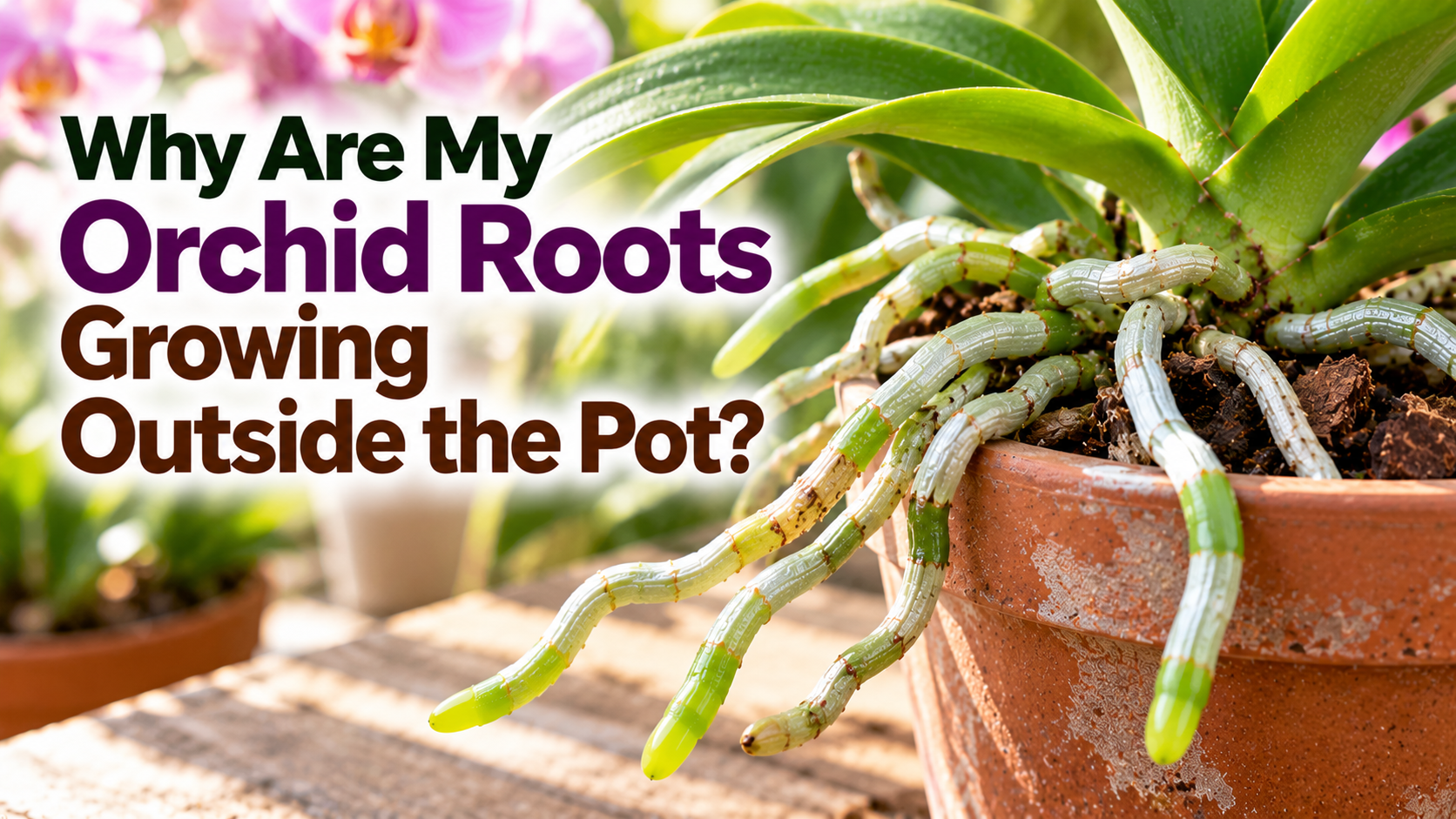
 If you notice orchid roots growing over the rim of the pot, spreading across the surface of the growing medium, or reaching into the air, you may wonder whether something is wrong with your plant.
In most cases, orchid roots growing outside the pot are completely normal. Many popular orchids, especially Phalaenopsis orchids, naturally produce aerial roots that grow beyond the container. These roots help the plant interact with its environment and absorb moisture when conditions are suitable.
However, roots growing outside the pot can sometimes indicate that the plant needs more space, the growing medium has deteriorated, or the current growing conditions should be reviewed.
The important thing is to understand why the roots are growing outward and whether the rest of the plant is healthy.
This guide explains why orchid roots grow outside their pots, whether you should put them back inside, and how to care for them without causing unnecessary damage.
For a broader understanding of root growth and health, visit our Complete Guide to Orchid Roots.
Why Do Orchid Roots Grow Outside the Pot?
Orchids do not all grow like ordinary houseplants. Many popular varieties are epiphytes, meaning they naturally grow attached to trees or other surfaces rather than in soil.
Their roots are adapted to an environment where they can encounter moisture, air, and changing humidity levels. When grown in a pot, an orchid may still produce roots that extend beyond the container.
These are commonly called aerial roots.
Aerial roots may grow upward, sideways, over the pot rim, or along nearby surfaces. Their direction depends on the orchid’s growth pattern and surrounding conditions.
Roots growing outside the pot are not automatically a sign of poor care. If the roots are firm and the plant is growing well, they may simply be part of normal development.
6 Reasons Orchid Roots Grow Outside the Pot
1. Natural Aerial Root Growth
The most common explanation is that the orchid is producing aerial roots as part of its normal growth.
Phalaenopsis orchids frequently develop roots that extend beyond the potting medium. These roots may grow horizontally, upward, or outward rather than remaining inside the container.
Aerial roots often have a silvery or pale surface when dry and may appear greener when wet.
What to do: If the roots are firm and healthy, leave them alone. You do not need to cut them or force them into the pot.
2. The Orchid Has Outgrown Its Pot
An orchid may produce a large root system that gradually extends beyond the available space.
Roots can spread over the surface of the medium, cross the pot rim, or grow through drainage holes. This does not always mean that repotting is immediately necessary.
The more useful question is whether the remaining space and growing medium can still support the plant.
What to do: Check whether the orchid is becoming unstable, the medium is breaking down, or most of the root system has become crowded outside the container. If the plant has genuinely outgrown its pot, consider moving it to a slightly larger container that provides appropriate drainage.
Avoid choosing an excessively large pot, as too much unused medium may stay wet for longer than expected.
3. The Growing Medium Has Deteriorated
Orchid bark and other organic potting materials gradually decompose. As the medium breaks down, its structure and drainage properties can change.
The orchid may continue producing roots outside the pot while older roots inside the medium become less healthy.
Roots growing outward do not prove that the medium is deteriorated, so inspect the medium itself.
Look for bark that has crumbled into fine particles, compacted material, poor drainage, or a pot that remains wet unusually long.
What to do: If the medium has decomposed or no longer drains properly, repot the orchid into a fresh mix suited to its type and growing environment.
For more guidance, read Orchid Root Rot: Signs, Causes, and How to Save Your Plant.
4. The Roots Are Searching for Suitable Growing Conditions
Roots respond to moisture, airflow, physical space, and other environmental conditions. A root may grow toward an available area where conditions are suitable for continued development.
However, it is difficult to determine a single cause from root direction alone. Roots growing outside the pot do not necessarily mean the orchid is searching for water or that something is wrong.
What to do: Observe the overall root system and plant condition. If the orchid has firm roots, stable leaves, and healthy new growth, there may be no reason to change anything.
If the plant also shows signs of stress, inspect watering, drainage, light, and the condition of the growing medium.
5. The Pot Does Not Provide Enough Room for Root Growth
A small pot may limit the space available for an expanding root system. Some roots will naturally grow over the rim or through drainage holes.
This can happen even when the orchid is otherwise healthy.
What to do: Consider repotting if the root system has genuinely outgrown the container or the plant has become difficult to support. Choose a pot that accommodates the roots without leaving excessive unused growing medium.
Do not repot simply because one or two roots extend outside the pot.
6. Growing Conditions Encourage Active Root Production
When an orchid receives suitable light, moisture, temperature, and nutrition, it may produce new roots during active growth.
Some of these roots may develop outside the container. Their position is not necessarily a problem.
What to do: Maintain appropriate growing conditions and monitor new root growth. Firm roots with healthy growing tips are generally a positive sign.
Avoid increasing fertilizer solely because the plant is producing aerial roots.
Are Orchid Roots Growing Outside the Pot Healthy?
They can be. The best way to assess aerial roots is to look at their texture, structure, and growth.
| Root appearance | What it may indicate | What to do |
|---|---|---|
| Firm, silvery roots | Often normal dry aerial roots | Leave them in place |
| Green roots with growing tips | Active root growth is likely | Maintain suitable care |
| Firm, pale yellow or cream roots | May be normal coloration | Check texture rather than color alone |
| Dry, severely shriveled roots | Possible dehydration or root damage | Assess moisture and root condition |
| Brown, soft, or mushy roots | Possible root rot | Inspect drainage and growing medium |
| Roots emerging through drainage holes | Root growth beyond the available space | Assess the pot and medium before repotting |
Root color varies by orchid type and moisture level. Firmness and structural condition are more informative than color alone.
If you are unsure whether your roots are healthy, read How to Tell If Your Orchid Roots Are Healthy.
Should You Cut Orchid Roots Growing Outside the Pot?
No. Do not cut healthy aerial roots simply because they are outside the pot.
These roots can contribute to the orchid’s water and nutrient absorption. Removing them unnecessarily reduces the plant’s functioning root system.
Before cutting any root, check whether it is firm and intact or clearly dead and deteriorating.
- Firm and healthy: Leave it alone.
- Pale or silvery but firm: Usually normal for many Phalaenopsis aerial roots.
- Slightly wrinkled but still firm: Assess the growing conditions before deciding what to do.
- Soft, hollow, or severely rotted: Consider removing the damaged tissue with a clean cutting tool.
Do not cut roots simply to make the plant look tidy.
For a detailed explanation of root removal, see Should You Cut Dead Orchid Roots? How to Identify Them.
Should You Put Aerial Roots Back Inside the Pot?
You generally do not need to force aerial roots into the potting medium.
Roots that have grown in the air may be less flexible than roots that have developed inside moist media. Forcing them into the pot can crack, bend, or break them.
If an aerial root is naturally flexible and can be accommodated during repotting without damage, you may gently position it. However, there is no need to bury every aerial root.
Many orchids grow successfully with roots both inside and outside the container.
The goal is to maintain healthy roots, not to achieve a particular appearance.
How to Care for Orchid Roots Growing Outside the Pot
Aerial roots often need little special treatment, but a few practices can help you protect them.
Step 1: Avoid Unnecessary Handling
Aerial roots can be damaged when bent, pulled, or forced into the pot. Let them grow naturally unless there is a clear reason to reposition the plant.
Step 2: Maintain Suitable Humidity and Airflow
Aerial roots are exposed to the surrounding environment and may dry faster than roots inside the potting medium.
Provide growing conditions suitable for your orchid type. Avoid creating persistently wet conditions or allowing water to collect in places where it cannot drain.
Step 3: Water According to the Orchid’s Needs
Do not assume that every aerial root needs to be sprayed or soaked every day.
Water the orchid according to its type, potting medium, environment, and moisture needs. Some growers lightly mist aerial roots in dry environments, but misting should not replace appropriate watering and should not leave water trapped in sensitive plant areas.
Step 4: Check the Roots Periodically
Look for new root tips, firm tissue, and normal growth. Investigate roots that become soft, hollow, or severely deteriorated.
Do not cut a root simply because it changes from green to silvery as it dries.
Step 5: Repot When Necessary
Repot when the medium has deteriorated, drainage has become poor, or the orchid’s root system no longer fits the container appropriately.
Use fresh, suitable orchid media and a pot that allows excess water to drain freely.
When Should You Repot an Orchid With Many Aerial Roots?
A large number of aerial roots alone does not mean the orchid must be repotted.
Consider repotting when several signs appear together:
- The potting medium has broken down or become compacted.
- The pot no longer supports the plant securely.
- The root system has substantially outgrown the container.
- Water drains poorly or the medium remains wet too long.
- Roots inside the pot are deteriorating.
If the medium is still in good condition and the orchid is growing well, you may be able to leave it in the same pot.
When repotting, select a container that fits the root system reasonably well. Avoid cutting healthy roots merely to make the plant fit a smaller pot.
Frequently Asked Questions
Is it normal for orchid roots to grow upward?
Yes. Aerial roots may grow upward, sideways, or outward depending on the orchid’s growth pattern and surrounding conditions. Their direction alone does not indicate a problem.
Do aerial roots mean my orchid needs more water?
Not necessarily. Aerial roots are a normal feature of many orchids. Their presence does not prove that the plant is underwatered. Check the moisture level of the growing medium, root condition, and overall plant health before changing your watering routine.
Can I bury aerial roots when repotting?
You can gently position flexible roots inside the pot if they fit naturally, but you should not force them. Roots that have developed in the air may break when bent sharply. It is acceptable for some healthy roots to remain outside the pot.
Why are my orchid’s aerial roots dry and wrinkled?
Aerial roots may dry faster because they are exposed to the surrounding air. Severe shriveling may also indicate dehydration or damaged root tissue. Assess firmness and the plant’s growing conditions before deciding how to respond.
Read Why Are My Orchid Roots Dry, Wrinkled, or Shriveled? for more information.
Should I cut aerial roots that turn brown?
Not automatically. Brown roots can sometimes remain firm and functional. Check their texture and structure. Remove roots only when they are clearly dead or rotting.
Final Thoughts
Orchid roots growing outside the pot are usually a normal part of growth, particularly in epiphytic orchids such as Phalaenopsis. Aerial roots can remain healthy outside the container and do not need to be cut or forced into the pot.
Focus on root firmness, the condition of the growing medium, drainage, and the overall health of the plant. Repot only when there is a practical reason, such as decomposed media or a root system that has outgrown its container.
By allowing healthy aerial roots to grow naturally, you can avoid unnecessary damage and support your orchid’s long-term health.
For a complete overview of orchid root problems and care, return to our Complete Guide to Orchid Roots.
Grow Your Orchid Care Knowledge
Aerial roots are just one part of understanding how orchids grow. Knowing how to recognize healthy roots, identify root damage, and evaluate growing conditions can help you care for your plants with greater confidence.
The Complete Orchid Care Library includes 2 ebooks and 8 visual guide collections, bringing together diagnostic charts, practical care guides, and visual references for everyday orchid growing.
Build your knowledge and make more informed decisions as your orchid grows.