
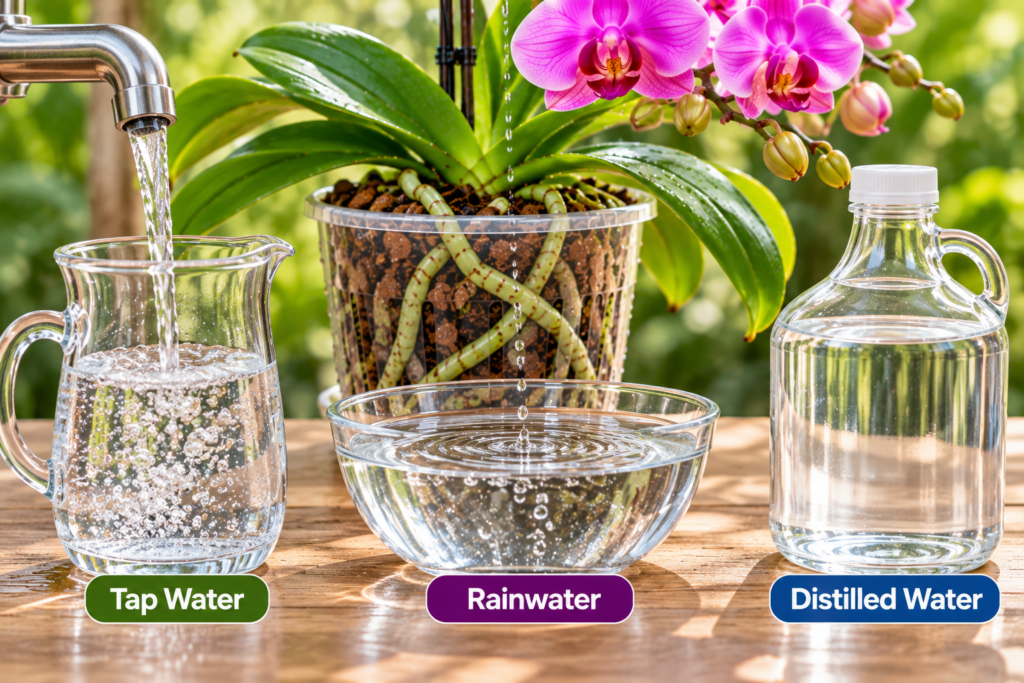
Choosing the right water for orchids can make a difference to root health, leaf condition, and long-term growth. Some growers use tap water without problems, while others prefer collected rainwater or purified water because their local water contains high levels of dissolved minerals.
So, which is best for orchids: tap water, rainwater, or distilled water?
The answer depends on your local water quality, the orchid species you grow, and how you fertilize your plants. Many common orchids can grow successfully with suitable tap water, but water with excessive minerals or sodium can cause problems over time.
This guide compares the three main water sources, explains their advantages and disadvantages, and helps you choose an option that suits your orchids.
Why Water Quality Matters for Orchids
Orchids need water for photosynthesis, nutrient transport, cell function, and healthy root growth. However, water is not always just water. It can contain dissolved minerals, salts, treatment chemicals, and other substances that affect plant health.
Many popular orchids, including Phalaenopsis, grow naturally as epiphytes. Their roots are exposed to rain and airflow rather than surrounded by ordinary garden soil. In pots, their roots depend on a growing medium that provides moisture while maintaining adequate air circulation.
When water contains excessive dissolved minerals, salts can accumulate in the potting medium, especially when fertilizer is added regularly. Over time, this buildup may damage sensitive root tips and interfere with healthy growth.
Water quality is therefore worth considering alongside watering frequency, potting medium, drainage, and fertilizer practices.
For a complete overview of these factors, read The Complete Guide to Watering Orchids: When, How, and How Much.
1. Is Tap Water Safe for Orchids?
For many home growers, tap water is the easiest and most affordable option. The American Orchid Society notes that most orchid genera can tolerate suitable household tap water.
However, tap water quality varies considerably between locations. Some supplies contain relatively low levels of dissolved minerals, while others are hard or have higher concentrations of dissolved salts.
Advantages of tap water
- Convenient and readily available.
- Usually inexpensive.
- Can be suitable for many common orchids.
- Provides some naturally occurring minerals, depending on the source.
Potential disadvantages
- Hard water can leave mineral deposits on pots and growing media.
- Excessive dissolved salts may damage sensitive roots.
- Water chemistry can vary by municipality or well source.
- Salt-based water softeners can introduce sodium that is harmful to plants.
How to tell whether your tap water may be a problem
Look for persistent white or chalky deposits around the pot, on the growing medium, or near exposed roots. These deposits can indicate mineral accumulation, although fertilizer residues may also contribute.
If you suspect that your water is too hard, check a local water-quality report or use a suitable test to assess its mineral content. Total dissolved solids (TDS) can provide useful information, although the reading does not identify which minerals or salts are present.
Important: Water from a salt-based household softener should generally be avoided for orchids because the treatment can increase sodium levels. A softened-water supply is not the same as naturally soft tap water.
If your tap water is suitable and your orchids are growing well, there may be no reason to change it.
2. Is Rainwater the Best Water for Orchids?
Clean rainwater is often an excellent choice for orchids because it generally contains relatively few dissolved minerals compared with hard tap water.
In nature, many epiphytic orchids receive water from rain, fog, and condensation. Collecting clean rainwater can provide a practical source of low-mineral water for home growing.
Advantages of rainwater
- Often contains fewer dissolved minerals than hard tap water.
- Can reduce the buildup of mineral deposits in the growing medium.
- Is inexpensive when collected safely.
- Can be useful for orchids sensitive to mineral accumulation.
Potential disadvantages
- Availability depends on rainfall and storage capacity.
- Collected water may become contaminated.
- Roofs, gutters, storage tanks, and containers can introduce dirt or pollutants.
- Water quality may vary between collection locations and weather conditions.
How to collect rainwater safely
Use a clean collection container and store the water in a covered vessel to reduce contamination and mosquito breeding. Avoid collecting water from surfaces that may contain chemical residues, heavy pollution, bird droppings, or other contaminants.
If you live in an urban or industrial area, consider the condition of the collection surface and local environmental conditions before using stored rainwater on your plants.
Rainwater is a strong option when it is clean and readily available, but it is not automatically safe simply because it comes from the sky.
3. Can You Use Distilled Water for Orchids?
Distilled water is produced by evaporating water and then condensing the vapor. This process removes most dissolved minerals and many other impurities.
Because it contains very few dissolved minerals, distilled water can be useful when tap water is unsuitable or when growing orchids that are particularly sensitive to mineral accumulation.
Advantages of distilled water
- Contains very low levels of dissolved minerals.
- Helps reduce mineral deposits from the water itself.
- Provides a consistent water source when local tap water quality varies.
- Can be useful for sensitive orchids when paired with suitable nutrition.
Potential disadvantages
- Usually costs more than tap water.
- Requires regular purchasing or a distillation system.
- Provides virtually no calcium, magnesium, or other minerals.
- Requires attention to fertilizer and nutrient management during long-term use.
Distilled water is not inherently harmful to orchids. The important consideration is that it contains very few minerals, so the plant must obtain essential nutrients through an appropriate fertilizer program or other suitable sources.
If you use distilled water regularly, choose a fertilizer suitable for low-mineral water and follow its directions. Avoid adding nutrients indiscriminately, as excessive fertilizer can also damage orchid roots.
Distilled water is a useful option, but it is not automatically necessary for every orchid grower.
4. Tap Water vs. Rainwater vs. Distilled Water
The best option depends on water quality, availability, cost, and your orchid collection.
| Factor | Tap water | Rainwater | Distilled water |
|---|---|---|---|
| Availability | Usually convenient | Depends on rainfall and collection | Depends on supply or equipment |
| Mineral content | Varies by location | Often relatively low | Very low |
| Cost | Usually low | Low if collected safely | Usually higher |
| Risk of mineral buildup | Higher with hard water | Often lower | Very low from the water itself |
| Nutrient contribution | May supply some minerals | Usually limited and variable | Virtually none |
| Main concern | Hardness, salts, sodium-softened water | Contamination during collection or storage | Cost and need for appropriate nutrition |
No single source is best for every situation. Suitable tap water can work well for many orchids, while clean rainwater and distilled water can be preferable when tap water has excessive mineral content.
5. What About Reverse Osmosis Water?
Reverse osmosis (RO) water is another option for orchid growers. It is produced by passing water through a membrane that removes much of its dissolved mineral content.
RO water is similar to distilled water in that it has relatively low mineral content, although the exact composition depends on the filtration system and source water.
It can be useful for growers dealing with hard tap water or maintaining collections of mineral-sensitive orchids.
As with distilled water, long-term use should be accompanied by an appropriate fertilizer program that supplies the nutrients the orchid needs.
If you already have access to a well-maintained RO system, it may be a practical alternative to buying distilled water.
6. Does Letting Tap Water Sit Overnight Make It Better?
Some growers leave tap water in an open container overnight before watering orchids. This practice may help reduce free chlorine in certain water supplies.
However, it does not remove dissolved minerals or hardness. It also does not reliably remove chloramine, which some water utilities use as a disinfectant.
If your main concern is hard water or high dissolved mineral content, leaving the water to stand will not solve the problem.
Check your local water supplier’s information to understand which treatment chemicals are used. Choose a suitable water source based on the actual issue rather than assuming that standing water will correct every tap-water problem.
7. How Water Quality Affects Orchid Roots
Orchid roots provide useful clues about plant health, but no single symptom can confirm a water-quality problem.
For many Phalaenopsis orchids, healthy roots are firm and may appear green when hydrated or silvery when dry. Root tips should remain healthy and actively growing when conditions are suitable.
Potential warning signs of trouble include:
- Persistent white or chalky deposits on the pot or medium.
- Browning or deterioration of root tips.
- Poor root growth despite otherwise suitable conditions.
- A buildup of residues after repeated watering and fertilizing.
These signs may also result from root rot, unsuitable potting medium, fertilizer concentration, or other growing problems. Inspect the complete root system and growing environment before deciding that water quality is the cause.
If your orchid has soft, mushy roots or the growing medium stays wet for too long, investigate drainage and watering practices as well. Read How to Water an Orchid Without Causing Root Rot.
8. Should You Change Water Sources?
If your orchid is growing well, producing healthy roots, and showing no signs of mineral buildup, changing water sources may not be necessary.
Consider switching or testing your water when:
- Your tap water is known to be very hard.
- White mineral deposits repeatedly accumulate around the pot.
- You use a salt-based water softener.
- You grow species that are particularly sensitive to dissolved minerals.
- Root or leaf problems persist despite appropriate watering, lighting, and fertilizer practices.
Make changes thoughtfully. If you switch to distilled or RO water, review your fertilizer program so that your orchids continue receiving essential nutrients.
Also remember that changing the water source will not solve problems caused by overwatering, decomposed bark, poor drainage, or unsuitable light.
9. How to Water Orchids With Your Chosen Water Source
Regardless of whether you use tap water, rainwater, or distilled water, correct watering technique remains important.
For many potted epiphytic orchids:
- Check the roots and growing medium to determine whether watering is needed.
- Use clean water at a moderate temperature.
- Wet the growing medium thoroughly rather than adding only a small splash.
- Allow excess water to drain freely from the pot.
- Empty any saucer or decorative outer container.
- Monitor the medium and adjust the next watering according to how quickly it dries.
Avoid leaving orchid roots in standing water. Water quality and watering technique work together to support healthy roots.
For help deciding when to water, read How Often Should You Water an Orchid? and How to Tell When an Orchid Needs Water.
Frequently Asked Questions
What is the best water for Phalaenopsis orchids?
Clean rainwater is often an excellent option because it usually contains relatively few dissolved minerals. However, suitable tap water can work well for many Phalaenopsis orchids. Distilled or RO water can be useful when tap water is too mineral-rich, provided the fertilizer program supplies essential nutrients.
Can I water orchids with tap water every time?
Yes, if your tap water is suitable for your orchids. Check its hardness and mineral content if you notice persistent deposits or unexplained root problems. Avoid water from salt-based softeners.
Is distilled water better than rainwater for orchids?
Not necessarily. Both can have low mineral content. Clean rainwater is often less expensive when readily available, while distilled water provides a more consistent low-mineral source. The quality of collected rainwater depends on how it is gathered and stored.
Does boiling tap water make it safe for orchids?
Boiling is not a reliable way to remove dissolved minerals or sodium. It may reduce some microorganisms, but it does not make hard water equivalent to distilled water. If mineral content is the problem, choose a more appropriate source.
Can orchids receive too many minerals from water?
Yes. Excessive dissolved salts can accumulate in the growing medium and damage sensitive roots. The risk depends on the water’s composition, fertilizer use, and how effectively the medium is flushed during watering.
Should I use distilled water without fertilizer?
Distilled water contains very few dissolved minerals, so it does not provide a complete supply of nutrients. Orchids grown with distilled water over the long term generally need an appropriate fertilizer program.
Final Thoughts
The best water for orchids depends on its quality and your growing conditions, not simply on whether it comes from a tap, the sky, or a distillation system.
For many growers, suitable tap water is convenient and perfectly adequate. Clean rainwater is an excellent low-mineral option, while distilled or reverse osmosis water can help when local tap water contains excessive minerals or salts.
Avoid salt-softened water, watch for mineral buildup, and maintain an appropriate fertilizer program when using low-mineral water.
Most importantly, remember that water quality is only one part of orchid care. Healthy roots also depend on appropriate watering frequency, good drainage, suitable potting medium, and adequate airflow.
Master Orchid Care With The Complete Orchid Care Library
Want to become more confident in watering orchids, identifying root problems, and making better care decisions? The Complete Orchid Care Library brings together practical orchid care ebooks and visual guides to help you understand common orchid problems and care for your plants with greater confidence.
Get The Complete Orchid Care Library Here
Share this article