
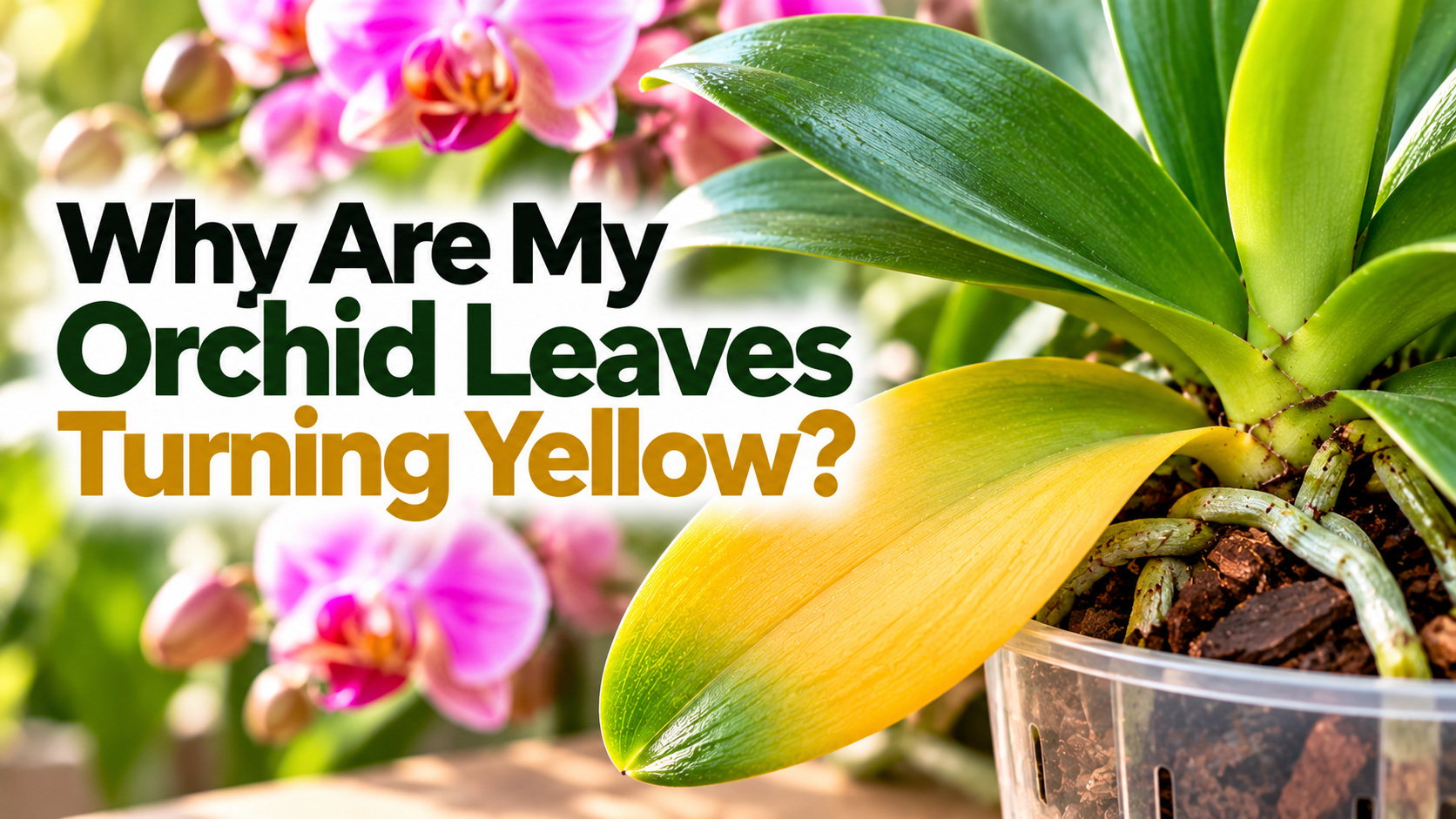
 Yellow orchid leaves can be worrying, especially when your plant has been growing well for months. However, a yellow leaf does not always mean your orchid is dying. In many cases, it is part of the plant’s natural life cycle. In others, it can signal watering problems, root damage, excessive sunlight, or environmental stress.
The key is to look at which leaves are turning yellow, how quickly the color is changing, and whether other symptoms are present.
In this guide, you will learn how to identify the most common causes of yellow orchid leaves, what to check before treating your plant, and how to help your orchid recover.
Quick Answer: Why Are My Orchid Leaves Turning Yellow?
Orchid leaves can turn yellow for several reasons:
- Natural aging: An older lower leaf gradually yellows before falling off.
- Overwatering: Persistently wet growing medium can deprive roots of oxygen and contribute to root rot.
- Underwatering: Insufficient moisture can cause stress, particularly when roots are already damaged.
- Root damage: Unhealthy roots may be unable to absorb enough water to support the leaves.
- Excessive sunlight: Strong direct light can bleach or yellow exposed leaf surfaces.
- Nutrient or environmental stress: Unsuitable growing conditions may contribute to yellowing.
- Pests or disease: Some infestations and infections can cause discoloration, sometimes accompanied by spots or damaged tissue.
Do not diagnose the problem by color alone. The location of the yellowing, leaf texture, root condition, and growing environment all provide important clues.
1. Natural Aging: When a Yellow Leaf Is Normal
One of the simplest explanations for yellow orchid leaves is natural aging.
Phalaenopsis orchids periodically shed their oldest leaves as part of their normal growth cycle. When this happens, the lowest leaf often turns yellow gradually while the remaining leaves stay firm and healthy.
Signs of natural aging
- Only one of the oldest lower leaves is turning yellow.
- The change happens gradually rather than overnight.
- The other leaves remain firm and green.
- The roots appear healthy and functional.
- The plant continues producing new leaves or roots.
What should you do?
If the symptoms match natural aging, you generally do not need to intervene.
Allow the leaf to finish yellowing and detach naturally when ready. Do not pull it off while it is still firmly attached, because doing so can damage the plant.
However, if several leaves begin turning yellow in a short period, investigate the roots and growing conditions rather than assuming the plant is simply aging.
2. Overwatering: A Common Cause of Yellow Orchid Leaves
Overwatering is a frequent problem for orchids, particularly when they are grown in a potting medium that retains too much moisture or has deteriorated over time.
Orchid roots need both moisture and oxygen. When the growing medium stays saturated for too long, roots can become stressed and begin to deteriorate.
Damaged roots may eventually lose their ability to absorb water effectively, causing leaves to yellow or become limp.
Signs that excessive moisture may be the problem
- The potting medium remains wet for an unusually long time.
- Roots appear brown or black and feel soft or mushy.
- The roots have lost their firm outer tissue.
- Several leaves become yellow or limp.
- The plant declines despite frequent watering.
How to fix the problem
Step 1: Inspect the roots.
If your orchid is in a transparent pot, examine the visible roots. Healthy roots are generally firm, although their color varies with moisture and growing conditions.
Step 2: Check the potting medium.
Old bark may decompose and retain more moisture than expected. A poorly ventilated pot can also slow drying.
Step 3: Correct the growing conditions.
If the medium has broken down or the roots are rotting, repotting into a suitable, well-aerated orchid medium may be necessary. Remove severely damaged roots with a clean cutting tool when appropriate.
Step 4: Adjust watering.
Water according to the plant’s needs, root condition, pot, medium, temperature, and drying rate. Do not water automatically just because a fixed number of days has passed.
For a more detailed diagnosis, read The Complete Guide to Orchid Roots: How to Identify Healthy Roots and Fix Common Problems.
3. Underwatering: Can Too Little Water Cause Yellow Leaves?
Yes. Insufficient water can stress an orchid and contribute to leaf discoloration. However, yellowing alone does not establish that the plant needs more water.
An orchid may dry out too quickly in warm conditions, in a small pot, or in a medium that does not retain enough moisture for its environment.
The situation becomes more complicated when the roots are damaged. Even if you water regularly, an orchid with few functioning roots may still struggle to absorb enough water.
Signs of underwatering
- The growing medium dries out quickly.
- Healthy roots become silvery or pale when dry.
- Leaves may become wrinkled or lose firmness.
- The plant shows signs of dehydration during warm or dry weather.
How to respond
If the roots are healthy and the growing medium is dry, water the orchid thoroughly and allow excess water to drain.
If the leaves remain limp despite appropriate watering, inspect the roots before increasing watering frequency. Root damage may be preventing the plant from absorbing enough moisture.
Avoid leaving the orchid standing in water in an attempt to restore its leaves.
4. Root Damage: When Yellow Leaves Are a Symptom of an Underground Problem
Sometimes the real problem is not in the leaves at all.
Orchid roots absorb water and nutrients and help anchor the plant. When roots are damaged by decay, prolonged dryness, physical injury, or unsuitable growing conditions, the leaves may begin to show the effects.
This is particularly important when yellowing appears alongside wrinkled leaves, slow growth, or deteriorating roots.
How to check for root damage
Look for these signs:
- Roots that are mushy or hollow.
- Roots whose outer tissue slips off easily.
- Extensive dead or deteriorating roots.
- A potting medium that stays wet for too long.
- Leaves that become limp even when the medium is moist.
Healthy roots can be green, silvery, cream-colored, or pale, depending on the orchid, root age, moisture, and growing conditions. Brown roots are not automatically dead; texture and firmness matter too.
What to do
Address the underlying cause of the root problem. This may involve correcting watering practices, replacing deteriorated potting medium, improving aeration, or removing severely damaged roots.
Do not repeatedly add water or fertilizer to an orchid with extensive root damage in the hope that the yellow leaves will turn green again.
Learn more in The Complete Guide to Orchid Roots.
5. Excessive Sunlight: When Yellow Leaves Are Caused by Too Much Light
Orchids need light for photosynthesis, but strong direct sunlight can damage their leaves.
Phalaenopsis orchids generally grow best in bright, indirect light. When they receive intense direct sunlight, particularly after being moved suddenly from a shaded location, exposed leaf surfaces may become pale, yellow, or scorched.
Signs of excessive light
- Yellowing is concentrated on the side facing the light.
- Pale or bleached patches develop on exposed leaves.
- Damaged areas later become tan or brown.
- The symptoms began after the plant was moved or light exposure increased.
How to fix it
Move the orchid away from harsh direct sunlight and provide bright, indirect light instead.
If you are changing its location, make the adjustment thoughtfully so the plant receives enough light without being exposed to damaging intensity.
Sunburned tissue usually does not return to its original green color. Focus on preventing further damage and maintaining healthy new growth.
For more information, read Orchid Sunburn: How to Recognize and Treat Damaged Leaves.
6. Nutrient Problems: Is Your Orchid Missing Fertilizer?
Nutrient deficiencies can contribute to leaf discoloration, but yellow leaves alone are not enough to diagnose a deficiency.
Similar symptoms can arise from root damage, unsuitable watering, excessive light, or other environmental problems.
Applying extra fertilizer without identifying the cause can worsen the situation, especially if salts accumulate around the roots.
What should you check?
- Is the orchid receiving a suitable fertilizer at an appropriate concentration?
- Has fertilizer been applied too frequently or too strongly?
- Is the potting medium old or deteriorating?
- Are the roots healthy enough to absorb nutrients?
- Are other symptoms present beyond yellow leaves?
How to respond
Review your fertilizer routine and follow the product’s instructions for dilution and application. Avoid increasing the dose simply because a leaf has changed color.
If root health or watering is the main problem, address that first. A plant with damaged roots may not benefit from additional fertilizer until its growing conditions improve.
7. Temperature and Environmental Stress
Sudden environmental changes can stress orchids and contribute to leaf problems.
Potential sources include temperature extremes, hot air from appliances, cold drafts, rapid changes in light exposure, and abrupt shifts in moisture conditions.
Signs of environmental stress
- Symptoms appear after a move or a significant change in growing conditions.
- Several leaves show changes around the same time.
- The orchid is exposed to unusually hot or cold air.
- The leaves develop additional signs of damage, such as soft areas or brown patches.
How to help your orchid
Keep the plant in a suitable environment for its species. Avoid placing it where hot or cold air repeatedly strikes the foliage.
Maintain stable growing conditions as much as practical, and make changes gradually when possible.
If yellowing continues, examine the roots and inspect the leaves for pests or lesions. Environmental stress may not be the only factor involved.
8. Pests and Disease: When Yellowing Comes With Other Symptoms
Some pests and diseases can cause orchid leaves to discolor. Yellowing becomes more concerning when it occurs with spots, lesions, sticky residue, or rapidly deteriorating tissue.
Possible pests include sap-feeding insects such as scale insects, mealybugs, and aphids. Different diseases can also cause leaf discoloration, but the symptoms vary and may overlap with noninfectious damage.
What to inspect
Look carefully at:
- The undersides of leaves.
- The joints where leaves meet the stem.
- New growth and flower stems.
- Yellow areas that develop spots or dark lesions.
- Sticky residue or visible insects.
What to do
If you suspect pests or a contagious disease, separate the orchid from nearby plants while investigating.
Use clean tools and avoid splashing water from an affected plant onto others. Identify the likely cause before applying a pesticide or fungicide, because different problems require different treatments.
If dark lesions are spreading rapidly or tissue is becoming soft and wet, take the problem seriously and seek a reliable diagnosis.
Related guide: Black Spots on Orchid Leaves: Causes and What to Do.
How to Diagnose Yellow Orchid Leaves Step by Step
If you are unsure why your orchid is turning yellow, use this simple inspection process.
Step 1: Identify the affected leaves
Is one old lower leaf yellowing, or are several leaves changing color? Gradual yellowing of a single older leaf is less concerning than rapid yellowing across the plant.
Step 2: Examine the texture
Check whether the affected leaf is firm, limp, wrinkled, dry, or soft. Texture helps distinguish different types of stress.
Step 3: Inspect the roots
Look for firm, intact roots and check whether the growing medium is staying wet for too long. Do not rely on root color alone.
Step 4: Review recent changes
Think about changes in watering, sunlight, temperature, potting medium, and fertilizer use.
Step 5: Look for additional symptoms
Check for brown patches, black spots, sticky residue, pests, or damage around the crown.
Step 6: Make a targeted correction
Correct the most likely underlying problem. Avoid changing every aspect of the orchid’s care routine at once, because that can make it harder to determine what is helping.
Step 7: Monitor the plant
Photograph the affected leaf and observe whether yellowing progresses or new symptoms develop. Healthy new growth and improved root condition are often more useful indicators of recovery than the appearance of an already damaged leaf.
Should You Cut Off Yellow Orchid Leaves?
Not every yellow leaf needs to be removed immediately.
If an older lower leaf is gradually yellowing from natural aging, allow it to finish the process and detach naturally when ready.
If a leaf has a localized damaged area, consider whether the tissue is stable or whether the damage is spreading. Cutting away healthy tissue unnecessarily can create additional injury.
When removal is justified because tissue is severely deteriorating or diseased, use a clean, appropriate cutting tool and avoid damaging the crown or stem.
Never pull a leaf off forcibly while it remains firmly attached.
Can Yellow Orchid Leaves Turn Green Again?
It depends on the cause and the extent of the damage.
If a leaf has become yellow because of permanent tissue damage, natural aging, or severe sunburn, it generally will not return to its original green color.
If discoloration is associated with a correctable environmental issue, preventing further stress may help protect the remaining healthy tissue. However, the yellow leaf itself may not fully recover.
The most useful signs of improvement are stable remaining leaves, healthy root activity, the absence of new damage, and continued growth when the orchid is in a suitable growing cycle.
How to Prevent Yellow Orchid Leaves
Although some yellowing is normal, good care can reduce many avoidable problems.
Water appropriately. Consider the potting medium, root condition, temperature, and drying rate rather than relying on a rigid schedule.
Use a suitable growing medium. Orchid roots need sufficient aeration and drainage. Replace medium when it has broken down or no longer supports healthy root conditions.
Provide suitable light. Give the orchid enough light for growth while avoiding damaging direct sunlight.
Maintain a sensible fertilizer routine. Follow product instructions and avoid excessive concentrations.
Inspect the plant regularly. Check roots, leaf undersides, and leaf joints for signs of pests, decay, or unusual changes.
Keep growing conditions stable. Avoid sudden changes in temperature, light, and moisture when possible.
Respond to symptoms rather than assumptions. A yellow leaf may indicate natural aging, root problems, excessive light, or something else. Investigate before treating.
Frequently Asked Questions
Why is only one of my orchid’s bottom leaves turning yellow?
If it is the oldest lower leaf and the rest of the plant looks healthy, natural aging is a likely explanation. Monitor the plant for additional yellowing or other symptoms.
Why are several orchid leaves turning yellow at once?
Multiple yellowing leaves deserve closer inspection. Possible causes include root damage, prolonged moisture problems, excessive sunlight, environmental stress, pests, or disease.
Should I water an orchid when its leaves turn yellow?
Not automatically. Check the roots and potting medium first. If the medium is dry and the roots are healthy, watering may be appropriate. If the medium is persistently wet and roots are deteriorating, adding more water may worsen the problem.
Can overwatering cause yellow orchid leaves?
Yes. Excessive moisture can deprive roots of oxygen and contribute to root decay, which may interfere with water absorption and lead to leaf discoloration.
Do yellow orchid leaves mean my plant is dying?
No. One naturally aging lower leaf may be completely normal. Rapid yellowing across several leaves, deteriorating roots, or damage around the crown warrants more careful investigation.
How long does it take for an orchid to recover?
Recovery varies with the underlying cause and the extent of root or leaf damage. Existing yellow tissue may remain yellow, so monitor the plant’s overall condition and new growth rather than expecting damaged leaves to become green again.
Learn to Diagnose Orchid Problems With Greater Confidence
Yellow leaves are only one of the many signals an orchid can display. Understanding the difference between natural aging, root damage, watering problems, and environmental stress can help you avoid unnecessary interventions and make better care decisions.
The Complete Orchid Care Library includes 2 ebooks and 8 Visual Guide Collections designed to help you understand orchid symptoms, assess growing conditions, and troubleshoot common orchid care problems with practical visual references.
Build your orchid care knowledge and learn how to make more confident decisions when your plants show signs of stress.