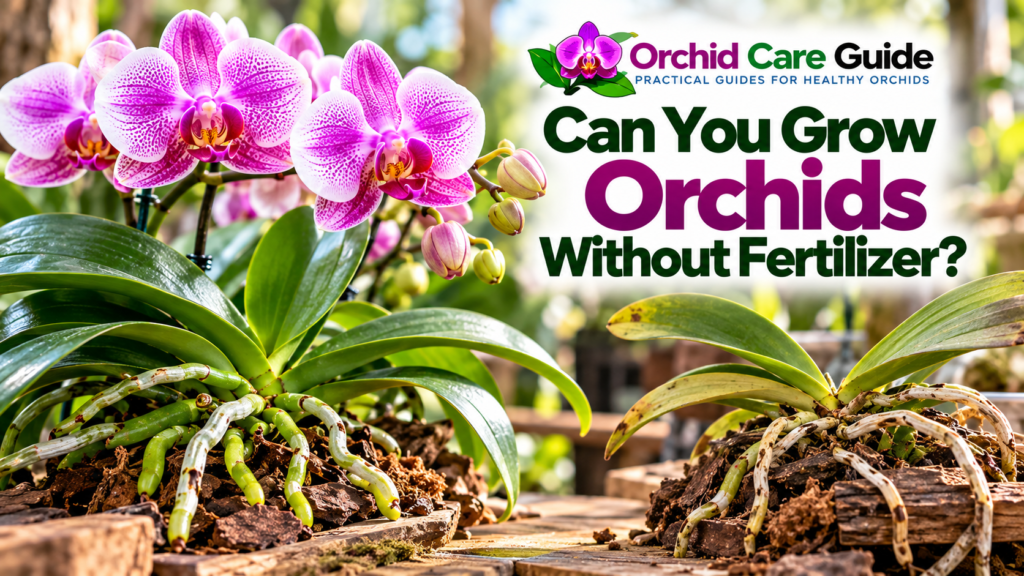
Can you grow orchids without fertilizer? Yes. Many orchids can survive and continue growing for extended periods without regular fertilizer. However, surviving without supplemental nutrients is not the same as achieving strong growth, healthy roots, and consistent flowering.
In nature, orchids obtain nutrients from their surroundings. Rainwater, decomposing organic matter, fallen leaves, and other materials provide small amounts of nutrients around their roots. Epiphytic orchids, which grow on trees rather than in soil, have adapted to environments where nutrients are relatively scarce.
Cultivated orchids can also obtain some nutrients from their growing environment. However, the amount available depends on the growing medium, water source, and growing conditions.
Understanding when fertilizer is unnecessary and when supplemental feeding becomes beneficial can help you maintain healthy orchids without overfertilizing them.
1. Can Orchids Really Survive Without Fertilizer?
Yes. Orchids are adapted to survive in environments where nutrients may be limited.
Many epiphytic orchids grow attached to tree branches, where their roots are exposed to rainwater, air, and small amounts of organic debris. They do not have access to the same continuous nutrient supply that plants growing in fertile soil may receive.
The American Orchid Society explains that epiphytic orchids have adapted to low-nutrient environments and can often grow for considerable periods even when nutrient availability is limited.
A 2021 review published in the Journal of Plant Nutrition, titled A Comprehensive Scenario of Orchid Nutrition, also discusses the special mechanisms that allow orchids to survive under limited nutrient conditions without immediately showing deficiency symptoms.
This ability helps explain why an orchid may remain alive for months without fertilizer.
However, surviving under nutrient limitations does not mean that the plant can maintain unlimited growth or flowering without additional nutrients.
2. Where Do Orchids Get Nutrients Without Fertilizer?
Orchids growing without supplemental fertilizer may obtain nutrients from several sources.
Rainwater
Rainwater carries small quantities of dissolved minerals and nutrients from the surrounding environment.
For orchids growing outdoors, rain can also wash nutrients from tree branches, leaves, and other surfaces toward their roots.
However, rainwater alone should not be assumed to provide every nutrient an orchid needs.
Decomposing organic matter
In natural habitats, small pieces of leaves, bark, moss, and other organic materials collect around orchid roots.
As these materials decompose, nutrients become available in the surrounding environment.
This is one reason epiphytic orchids can grow successfully without being planted in conventional garden soil.
Growing medium
Some orchid growing materials can retain nutrients from previous fertilization or natural sources.
Bark, sphagnum moss, and organic components may hold small quantities of nutrients, although their nutrient availability varies.
The American Orchid Society notes that organic growing media such as bark can retain some nutrients that orchids may absorb over time.
However, fresh bark is generally not a complete fertilizer source. As it ages and decomposes, its physical and chemical properties also change.
Water source
Tap water and well water may contain dissolved minerals, including calcium and magnesium.
These minerals can contribute to the plant’s nutrient supply, depending on their concentrations.
However, water containing minerals is not necessarily a complete nutritional solution. Some water sources also contain excessive dissolved salts that can negatively affect orchid roots.
3. What Happens If You Never Fertilize Your Orchids?
An orchid that receives no supplemental fertilizer may remain alive for a long time, especially if it receives suitable light, water, temperature, and airflow.
Nevertheless, prolonged nutrient limitation can affect its development.
Slower vegetative growth
New leaves, roots, and shoots may develop more slowly when essential nutrients become limiting.
Some orchids naturally grow slowly, so slow growth alone does not prove that a plant needs fertilizer.
Consider the species, season, and environmental conditions before diagnosing a nutritional problem.
Smaller new growth
In some circumstances, prolonged nutrient limitations may contribute to smaller leaves, weaker shoots, or reduced development of new pseudobulbs.
Other factors, including insufficient light and unhealthy roots, can produce similar symptoms.
Reduced flowering performance
An orchid may continue producing flowers without regular fertilizer, but inadequate nutrition can eventually limit its ability to support strong growth and flowering.
The American Orchid Society explains that orchids can grow and flower for extended periods without fertilizer when other requirements are met, although some level of feeding generally produces better results.
Iowa State University Extension also identifies inadequate fertilization as one of the possible reasons orchids fail to flower well.
Gradual nutrient depletion
A plant growing in a limited nutrient environment may use available resources over time.
Although orchids can tolerate low nutrient conditions, this does not mean that they can manufacture essential mineral nutrients themselves.
Eventually, nutrient availability may become a limiting factor.
4. Which Orchids Can Grow With Very Little Fertilizer?
Different orchid genera have different nutritional requirements and growth habits.
Some orchids are relatively light feeders, while others benefit from more regular nutrient supplementation.
Phalaenopsis
Phalaenopsis orchids are popular indoor orchids that can tolerate relatively low fertilizer concentrations.
They may survive for extended periods without feeding, but regular, appropriately diluted fertilizer generally supports better long-term growth.
Cattleya
Cattleya orchids are often considered moderate feeders.
Their pseudobulbs store water and nutrients, allowing them to tolerate temporary periods of reduced nutrient availability.
However, long-term nutrient limitations can affect new growth and flowering.
Dendrobium
Dendrobium includes many different species and hybrid groups.
Their feeding requirements vary according to growth habits and seasonal cycles.
Some types benefit from regular feeding during active growth but require reduced or no fertilizer during their resting period.
Paphiopedilum
Paphiopedilum orchids generally benefit from careful, moderate nutrient management.
Their growing conditions differ from those of many epiphytic orchids, and some species grow naturally in terrestrial or lithophytic environments.
Avoid assuming that a low-fertilizer routine suitable for one orchid genus will work equally well for another.
5. When Is It Reasonable to Grow Orchids Without Fertilizer?
There are situations in which temporarily withholding fertilizer is appropriate.
Newly repotted orchids
After repotting, roots may be disturbed or damaged.
Allow the plant time to establish itself in the new growing medium before returning to regular feeding.
The University of Florida IFAS Extension recommends withholding fertilizer for at least several weeks after repotting.
See Should You Fertilize Orchids After Repotting? for a more detailed recovery guide.
Orchids recovering from root damage
An orchid with damaged roots may not absorb nutrients efficiently.
Adding more fertilizer will not repair damaged roots.
Prioritize appropriate watering, drainage, and root recovery before resuming regular feeding.
Orchids entering dormancy
Some orchids have distinct resting periods during which growth slows significantly.
Fertilizing during dormancy may be unnecessary or inappropriate, depending on the species.
For example, certain Catasetum and soft-cane Dendrobium types require reduced watering and no fertilizer during their natural resting periods.
Orchids receiving excessive mineral inputs from water
If your water source already contains substantial dissolved minerals, additional fertilizer may increase the total salt concentration around the roots.
The American Orchid Society emphasizes that water quality should be considered when developing a fertilizer program.
In some situations, reducing fertilizer is more appropriate than increasing it.
6. Why Fertilizer Still Matters for Long-Term Orchid Growth
Although orchids can survive without fertilizer, supplemental nutrition can help maintain consistent growth when natural nutrient sources are insufficient.
A suitable fertilizer supplies essential elements that may not be available in adequate quantities from the growing medium or water.
These nutrients support several important functions:
- Nitrogen supports chlorophyll production and vegetative growth.
- Phosphorus participates in energy transfer and plant development.
- Potassium supports water regulation and enzyme activity.
- Calcium contributes to cell wall development.
- Magnesium is an essential component of chlorophyll.
- Micronutrients support numerous metabolic processes.
A 2021 review of orchid nutrition published in the Journal of Plant Nutrition describes the importance of mineral nutrition and discusses the benefits of combining organic and inorganic nutrient sources in orchid cultivation.
The objective is not to maximize fertilizer application. It is to provide enough nutrients to support healthy development without creating excessive salt accumulation.
For guidance on choosing a suitable fertilizer, see What Is the Best Fertilizer for Orchids?.
7. How to Grow Orchids With Minimal Fertilizer
If you prefer a low-fertilizer approach, focus on maintaining an environment that supports healthy roots and efficient nutrient use.
Choose an appropriate growing medium
Use a medium suited to the orchid’s natural growth habit and your growing environment.
Bark, sphagnum moss, and other materials have different moisture retention and nutrient retention characteristics.
Avoid using decomposed or compacted medium that restricts airflow around the roots.
Use suitable water
Rainwater can be a useful water source when collected and stored hygienically.
Reverse-osmosis water is another option for growers who want to control mineral inputs.
If you use tap water, consider its mineral content rather than assuming that all tap water is suitable for orchids.
Maintain appropriate light
Light is essential for photosynthesis and energy production.
An orchid receiving insufficient light may grow poorly even when nutrients are available.
Increasing fertilizer will not compensate for inadequate light.
Protect root health
Healthy roots are necessary for water and nutrient absorption.
Maintain appropriate moisture, drainage, and airflow for the orchid’s growing medium.
Monitor new growth
Observe new leaves, roots, and shoots.
Consistent healthy development suggests that the plant is receiving suitable growing conditions.
If growth becomes progressively weaker, investigate light, water, root health, and nutrient availability.
8. How Much Fertilizer Do Orchids Actually Need?
There is no universal fertilizer dose for every orchid.
The appropriate concentration depends on the fertilizer formulation, water quality, growing medium, orchid genus, and growth stage.
The Iowa State University Extension recommends a weakly weekly approach for many orchids during active growth, using a balanced fertilizer at a reduced concentration.
The American Orchid Society also discusses matching nutrient application to plant growth and adjusting feeding according to water quality and growing medium.
For growers who want to minimize fertilizer use, a practical approach is:
- Begin with a conservative dilution suitable for the fertilizer product.
- Apply nutrients primarily when the orchid is actively growing.
- Monitor roots and leaves for signs of excessive fertilizer.
- Flush the growing medium periodically with plain water.
- Reduce or pause feeding during appropriate resting periods.
Avoid applying fertilizer simply because a particular number of days has passed.
The plant’s actual growth and growing conditions should guide the feeding schedule.
Read How Often Should You Fertilize Orchids? for more details.
9. Signs Your Orchid May Need Additional Nutrients
Nutrient deficiency can be difficult to diagnose because many symptoms overlap with other growing problems.
Possible warning signs include:
- Progressively pale or yellowing leaves
- Reduced production of new leaves
- Smaller new growth
- Weak vegetative development
- Poor flowering performance
However, these symptoms do not automatically indicate fertilizer deficiency.
Yellow leaves, for example, may result from natural aging, root rot, excessive sunlight, or watering problems.
Before increasing fertilizer, inspect the roots and review the plant’s growing conditions.
Also consider the growing medium and water source. A plant may have access to sufficient nutrients but be unable to absorb them effectively because of root damage or unsuitable growing conditions.
10. Common Mistakes When Growing Orchids Without Fertilizer
Assuming orchids never need nutrients
Orchids can tolerate limited nutrient availability, but they still require essential mineral elements for growth.
Replacing fertilizer with ordinary garden soil
Most commonly cultivated epiphytic orchids are not adapted to conventional garden soil.
Using unsuitable soil can restrict airflow and create conditions that damage roots.
Using household ingredients as complete fertilizer
Banana peels, rice water, coffee grounds, and similar household materials are not reliable substitutes for a balanced orchid nutrient program.
Their nutrient content and availability are inconsistent.
Ignoring the condition of the growing medium
Old, decomposed bark may retain moisture differently and restrict airflow.
A deteriorated medium should not be treated as a dependable nutrient source.
Increasing fertilizer whenever growth slows
Slow growth may be caused by insufficient light, temperature changes, dormancy, or damaged roots.
More fertilizer is not always the correct solution.
11. Frequently Asked Questions
Can orchids bloom without fertilizer?
Yes. Orchids can flower without supplemental fertilizer when other growing conditions and available nutrients are sufficient. However, inadequate nutrition may eventually reduce flowering performance.
How long can orchids survive without fertilizer?
There is no fixed time limit. Some orchids can remain alive and grow for extended periods without supplemental feeding, depending on their species, nutrient reserves, growing medium, and water source.
Can I grow Phalaenopsis without fertilizer?
Yes. Phalaenopsis can survive without regular fertilizer, but appropriate supplemental feeding generally supports healthier long-term growth.
Is rainwater enough to feed orchids?
Rainwater may contain small amounts of dissolved nutrients, but it should not be considered a complete fertilizer source. Its mineral content varies according to the collection environment.
Can orchids get nutrients from bark?
Bark can retain some nutrients from previous feeding and organic sources. However, fresh bark is generally not a complete source of essential nutrients.
Is it better to use less fertilizer?
For many orchids, conservative feeding is preferable to excessive fertilization. However, using too little fertilizer for too long can also limit growth. The goal is appropriate nutrition, not simply the lowest possible fertilizer dose.
Conclusion
You can grow orchids without fertilizer, but that does not mean supplemental nutrients are unnecessary for every growing situation.
Orchids have evolved to survive in environments where nutrients are relatively scarce. Their roots can absorb nutrients from rainwater, organic debris, and surrounding materials. This natural adaptation allows many orchids to tolerate long periods without regular feeding.
However, cultivated orchids often grow in limited quantities of bark, moss, or other growing media that may not provide sufficient nutrients indefinitely.
A balanced approach is more reliable than either extreme. Avoid excessive fertilizer, but do not deliberately deprive actively growing orchids of nutrients when their environment cannot supply enough.
Focus first on healthy roots, appropriate light, suitable watering, and good airflow. Then use supplemental fertilizer when it provides a clear benefit.
Build your orchid care knowledge with The Orchid Care Guide: 200 Essential Orchid Care Posters, a planned collection of printable A5 visual guides covering practical orchid care topics explored throughout this blog.
Share this article