
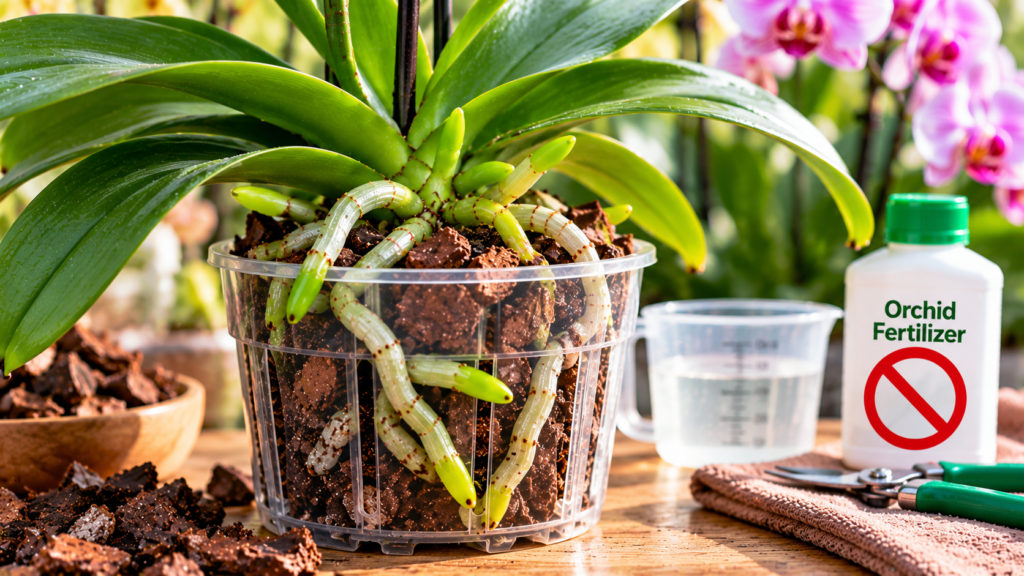
Repotting is an important part of orchid care. Over time, bark and other growing materials break down, drainage becomes less effective, and the root system may outgrow its container. Replacing deteriorated medium gives orchid roots a healthier environment for continued growth.
But repotting also disturbs the root system. Some roots may break, dry out, or need to be removed because they are dead or rotting. After this process, an orchid needs time to adjust before returning to its normal care routine.
One common question is whether fertilizer should be applied immediately after repotting or whether the plant should recover first.
In most situations, it is better to wait before fertilizing. The University of Florida IFAS Extension recommends watering an orchid after repotting but withholding fertilizer for at least several weeks. Other extension guidance emphasizes waiting until the root system has become established or new root growth is visible.
Understanding why this waiting period matters can help prevent unnecessary root damage and support a smoother recovery.
1. Why You Should Not Fertilize Immediately After Repotting
Repotting can temporarily reduce an orchid’s ability to absorb water and nutrients.
During the process, roots may be disturbed or damaged as the old medium is removed. Even when the work is done carefully, small injuries can occur.
Fertilizer contains dissolved mineral nutrients. When applied at an excessive concentration, these soluble salts can make it more difficult for damaged roots to absorb water and may contribute to further root injury.
There are three important reasons to avoid immediate feeding.
Damaged roots need time to recover
Healthy orchid roots absorb water and dissolved nutrients. Roots that have been cut, bruised, or damaged during repotting may not function normally.
Applying fertilizer before the root system recovers does not guarantee faster growth. Instead, it introduces additional dissolved minerals around roots that may already be under stress.
The orchid is adjusting to a new environment
A new growing medium may hold water differently from the previous one.
For example, an orchid moved from compact sphagnum moss into coarse bark will experience a different moisture and airflow environment. Its watering requirements may change even though the plant itself has not changed.
The orchid needs time to adjust to these conditions.
Fresh medium does not require an immediate fertilizer boost
New orchid bark is not necessarily a source of significant nutrients, but that does not mean fertilizer must be applied immediately.
The priority after repotting is establishing a stable root environment. Nutrient supplementation becomes more important when the plant is actively growing and capable of using those nutrients.
2. How Long Should You Wait Before Fertilizing?
There is no single waiting period that applies to every orchid.
The University of Florida IFAS Extension recommends not fertilizing for at least several weeks after repotting.
Other guidance offers additional context:
- The University of Florida IFAS Extension advises watering after repotting and withholding fertilizer for several weeks.
- The University of Vermont Extension emphasizes using orchid fertilizer according to its package directions and avoiding overfertilization that can damage roots and leaves.
- The University of Connecticut’s orchid care guidance stresses healthy roots, suitable growing media, and proper watering as essential parts of orchid maintenance.
A practical approach is to use the following recovery guide:
| Repotting condition | Practical approach |
|---|---|
| Minimal root disturbance | Wait several weeks and monitor the plant. |
| Several roots trimmed | Allow more time for recovery. |
| Extensive root damage | Wait until healthy new root growth is established. |
| Orchid already stressed or unhealthy | Prioritize recovery before resuming fertilizer. |
| Healthy orchid with active new roots | Gradually resume diluted feeding. |
These are practical guidelines, not fixed scientific deadlines. The condition of the roots matters more than the number of days on the calendar.
3. Signs Your Orchid Is Ready for Fertilizer Again
Rather than relying only on a calendar, observe the plant.
The appearance of new root growth is one of the most useful indicators that an orchid is recovering.
New root tips are developing
Look for fresh root tips emerging from the base of the plant or extending from existing roots.
On many Phalaenopsis orchids, actively growing root tips are green and shiny. The roots behind the tips may appear silvery when dry and green when wet.
New root growth indicates that the plant is establishing itself in the new medium.
Leaves remain firm
Healthy leaves should generally retain their natural firmness.
A newly repotted orchid may experience temporary changes, but persistent wrinkling, severe wilting, or rapidly yellowing leaves may indicate that the root system is not functioning properly.
The plant is stable in its pot
An orchid that moves excessively in its container may have difficulty establishing new roots.
Secure the plant with an appropriate clip or stake if necessary. Stability helps protect emerging roots from repeated movement.
No signs of ongoing root rot
Check for soft, mushy, or deteriorating roots.
If root rot continues after repotting, address the underlying moisture, drainage, or disease problem before resuming fertilization.
For more information about root condition, see How to Recognize Fertilizer Burn on Orchid Roots and Leaves.
4. Should You Water an Orchid Immediately After Repotting?
Watering and fertilizing are two different decisions.
The University of Florida IFAS Extension recommends watering an orchid immediately after repotting while withholding fertilizer for several weeks.
This distinction is important. Newly repotted orchids may need water to settle the medium around the roots, but they do not necessarily need additional nutrients at that moment.
However, watering practices should reflect the condition of the roots and the medium.
When roots have not been heavily damaged
If the orchid was repotted with minimal root disturbance, watering may help settle the fresh bark or other medium around the roots.
Allow excess water to drain completely.
When many roots have been cut
If substantial root trimming was necessary, the plant may need a more cautious recovery routine.
Avoid keeping the medium excessively wet. Damaged roots are especially vulnerable when the growing environment lacks sufficient airflow.
When using sphagnum moss
Sphagnum moss retains more moisture than coarse bark.
A newly repotted orchid in moss may need a different watering interval from one growing in bark. Check moisture inside the pot rather than relying only on the surface.
The goal is to maintain appropriate moisture without creating prolonged saturation.
5. What Happens If You Fertilize Too Soon?
Fertilizing immediately after repotting is not guaranteed to damage every orchid. However, it can increase the risk of problems when roots are injured or the fertilizer concentration is too high.
Potential consequences include:
- Root tip damage
- Brown or black root tips
- Reduced new root development
- Dehydration despite moist growing medium
- Leaf tip damage
- Slower recovery
Excess fertilizer can also contribute to soluble salt accumulation in the growing medium.
This is particularly concerning when the previous medium already contained mineral residues or when the orchid is placed in a container with poor drainage.
Learn to identify these deposits in What Does Fertilizer Salt Buildup Look Like on Orchids?.
If the orchid develops damaged roots and leaf tips after feeding, investigate the fertilizer concentration, water quality, and root condition before applying more nutrients.
6. How to Resume Fertilizing After Repotting
Once the orchid has recovered and new root growth is developing, fertilizer can gradually be reintroduced.
Avoid immediately returning to a strong feeding schedule.
Step 1: Start with a diluted fertilizer solution
Use an appropriate orchid fertilizer at a conservative concentration, following its product instructions.
Do not assume that a stronger solution will accelerate root development.
Step 2: Observe the root tips
Monitor the new roots after feeding.
Healthy new growth should continue developing without obvious signs of damage. If root tips become brown or stop growing, review the fertilizer concentration and watering conditions.
Step 3: Maintain suitable watering
Fertilizer should be applied as part of an appropriate watering routine.
Avoid allowing fertilizer solution to remain trapped in the pot or standing in a saucer.
Step 4: Adjust feeding to active growth
An orchid producing new roots and leaves may benefit from regular nutrient supplementation.
A plant that is resting, recovering, or experiencing stress may need a reduced feeding schedule.
For a more detailed feeding routine, read How Often Should You Fertilize Orchids?.
7. Does the Type of Orchid Affect Fertilizing After Repotting?
Yes. Different orchid genera have different growth habits, root structures, and seasonal patterns.
The basic principle remains the same: allow the plant to recover from root disturbance before resuming regular feeding. However, the recovery process may differ.
Phalaenopsis
Phalaenopsis orchids are commonly grown in bark or sphagnum moss.
After repotting, observe the development of new root tips. Resume diluted feeding when the plant is established and actively growing.
Cattleya
Cattleya orchids have pseudobulbs that store water and nutrients.
Avoid keeping the newly repotted plant excessively wet while it establishes itself. New root growth is a useful sign that the plant is adapting to the new medium.
Dendrobium
Dendrobium includes several groups with different growth patterns.
Some produce active new canes during particular seasons, while others have distinct resting periods. Fertilizer should be adjusted to the growth cycle rather than applied continuously.
Oncidium
Oncidium orchids often develop new growth from pseudobulbs.
Watch for developing roots and new shoots before returning to the normal feeding routine.
For broader guidance on nutrient requirements, see Orchid Fertilizer Ratios Explained: What NPK Numbers Mean.
8. Should You Fertilize Orchids After Repotting During Active Growth?
Active growth does not automatically mean that an orchid should receive fertilizer immediately after repotting.
A plant may be producing new leaves or shoots while its roots are still recovering from disturbance.
Consider two separate conditions:
Plant growth: The orchid is producing new leaves, shoots, or pseudobulbs.
Root recovery: The root system is establishing itself in the new growing medium and producing healthy new roots.
Both matter.
If the orchid is actively growing and has established new roots, it can gradually return to an appropriate fertilizer schedule.
If the roots remain damaged, prioritize recovery even when new leaves are appearing.
Fertilizer timing should also reflect the orchid’s natural growth and resting cycle. See How to Adjust Orchid Fertilizing During Active Growth and Rest Periods.
9. Common Fertilizing Mistakes After Repotting
Avoid these mistakes when caring for newly repotted orchids.
Applying full-strength fertilizer immediately
Newly disturbed roots do not need a concentrated fertilizer solution. Give the plant time to establish itself.
Fertilizing because the new bark contains no nutrients
Fresh bark may provide little nutrition, but immediate fertilization is not the solution to every nutrient concern. Root recovery comes first.
Following a fixed calendar without inspecting the plant
Two orchids repotted on the same day may recover at different rates.
One may produce new root tips quickly, while another may need considerably more time.
Keeping the medium constantly wet
Overwatering can create conditions that encourage root deterioration. A newly repotted orchid still needs appropriate moisture and airflow.
Using fertilizer to treat a struggling orchid
Fertilizer is not a treatment for root rot, dehydration, pests, or poor drainage.
Identify the underlying problem before changing the feeding routine.
10. Frequently Asked Questions
Can I fertilize my orchid one week after repotting?
It is generally better to wait longer. The University of Florida IFAS Extension recommends withholding fertilizer for at least several weeks. The appropriate timing depends on root damage and recovery.
Should I use root growth fertilizer immediately after repotting?
Not necessarily. A product marketed as a root growth fertilizer is still a fertilizer. Its label does not eliminate the need for root recovery.
Can I use half-strength fertilizer after repotting?
Dilution can reduce the concentration of soluble salts, but it does not make immediate feeding necessary. Wait until the plant is recovering and new root growth is developing.
What if my orchid has no new root growth after several weeks?
Check the growing medium, watering routine, drainage, temperature, and overall plant condition. Some orchids recover slowly, especially when the root system was severely damaged. Do not respond automatically by increasing fertilizer.
Should I fertilize after repotting into sphagnum moss?
The same recovery principle applies. Wait until the orchid has established itself before returning to regular feeding. Because sphagnum retains moisture, pay particular attention to watering and airflow.
Can I repot an orchid and fertilize it on the same day?
You can repot and water an orchid on the same day, but immediate fertilization is generally unnecessary. Use clean water to settle the medium and allow the plant to recover.
Conclusion
Should you fertilize orchids after repotting? Yes, but not immediately.
Repotting can disturb roots and temporarily reduce their ability to absorb water and nutrients. Applying fertilizer too soon may add unnecessary stress, particularly when roots have been cut or damaged.
Allow the orchid to recover, maintain suitable moisture and drainage, and watch for healthy new root growth. Once the plant is established, gradually resume an appropriate diluted feeding routine.
The most important principle is simple: prioritize root recovery before nutrient supplementation. A healthy root system is the foundation for stronger leaves, new growth, and future flowering.
Build your orchid care knowledge with The Orchid Care Guide: 200 Essential Orchid Care Posters, a planned collection of printable A5 visual guides covering practical orchid care topics explored throughout this blog.
Share this article