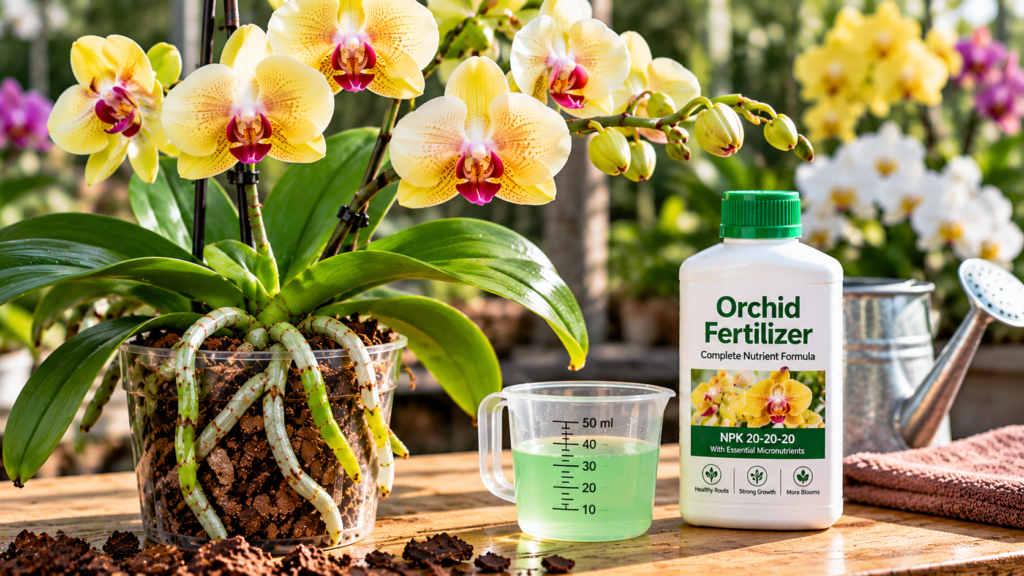
Yes, many orchids can continue receiving fertilizer while they are blooming, provided they are healthy, actively growing, and receiving an appropriately diluted solution. Flowering alone is not a reason to automatically stop fertilizing.
However, this is not a universal rule. Some orchids have distinct seasonal growth and resting periods, and their feeding requirements can change as they develop flower buds or enter dormancy. The type of orchid, its growing conditions, and the fertilizer concentration all matter.
University extension recommendations also differ. The University of Maryland Extension advises feeding actively growing and flowering Phalaenopsis every third or fourth watering, while a Rutgers Cooperative Extension publication recommends avoiding fertilizer during bloom for moth orchids. These differences are a good reason to avoid applying one rigid schedule to every orchid.
This guide explains when to continue feeding, when to reduce or pause fertilizer, and why increasing phosphorus to produce more flowers is not necessarily effective.
1. Can You Fertilize an Orchid While It Has Flowers?
For many healthy orchids, yes. A flowering orchid can continue receiving fertilizer if it is also actively producing roots, leaves, or other new growth.
Flowering requires energy, but the presence of flowers does not mean that the plant has stopped all other biological activity. Some orchids continue growing while their flowers are open, and an appropriate supply of nutrients can support their ongoing development.
The University of Maryland Extension’s Phalaenopsis care guide recommends light fertilization for actively growing and flowering plants. Its general recommendation is to fertilize every third or fourth watering using a commercial orchid fertilizer according to label directions.
However, this recommendation specifically addresses Phalaenopsis orchids. It should not automatically be applied to every orchid genus.
The important distinction is between a plant that is flowering while actively growing and one that is flowering during a period of naturally reduced growth.
If your orchid is healthy and continues producing new roots or leaves, there may be no reason to stop an established, gentle feeding routine simply because flowers have appeared.
2. Why Do Some Growers Stop Fertilizing During Flowering?
Some orchid growers prefer to reduce or temporarily stop fertilizer applications when flower buds appear or flowers begin opening.
There are several reasons for this practice.
Avoiding Excessive Nutrient Concentrations
An orchid does not need increasingly strong fertilizer just because it is producing flowers.
Excessive fertilizer can contribute to mineral salt accumulation, root damage, and declining plant health.
A plant with damaged roots may struggle to absorb water and nutrients, potentially affecting its overall condition.
Maintaining an appropriate concentration is more important than increasing the amount of fertilizer during flowering.
Following Species-Specific Growing Cycles
Some orchids have distinct seasonal growth and dormancy patterns.
They may produce new pseudobulbs or canes during one part of the year, flower during another, and enter a resting period afterward.
For these orchids, fertilizer should follow the natural growth cycle rather than the appearance of flowers alone.
Avoiding Unnecessary Changes
If an orchid is healthy and already follows a successful feeding routine, suddenly changing its fertilizer formula or concentration when flowers appear may be unnecessary.
Consistent growing conditions are generally preferable to experimenting with stronger fertilizers during flowering.
It is also important to understand that not every recommendation to stop feeding during bloom is supported by the same guidance for every orchid. Recommendations should be interpreted in the context of the species and growing conditions.
3. What Do University Extension Recommendations Say?
Published orchid care recommendations are not completely uniform. Comparing them helps explain why growers sometimes receive conflicting advice.
University of Maryland Extension: Light Feeding During Flowering
The University of Maryland Extension’s guide to Phalaenopsis orchids recommends fertilizing actively growing and flowering plants every third or fourth watering.
It also warns that overfeeding can encourage lush vegetative growth at the expense of flowers.
This suggests that continued feeding can be appropriate during flowering, but excessive fertilization is undesirable.
Source: University of Maryland Extension: Care of Phalaenopsis Orchids.
Rutgers Cooperative Extension: Avoid Feeding During Bloom
A Rutgers Cooperative Extension publication on reblooming orchids takes a more conservative approach for moth orchids. It advises against fertilizing during bloom because doing so may result in flower loss.
This is a different recommendation from the University of Maryland Extension.
Rather than assuming one source is universally correct, growers should consider the orchid’s condition, species, and established growing routine.
Source: Rutgers Cooperative Extension: Reblooming Orchids.
Iowa State University Extension: Feed During Active Growth
Iowa State University Extension recommends fertilizing orchids during active growth, particularly in spring and summer, using a weakly weekly approach with a balanced fertilizer.
Its guidance emphasizes growth activity rather than treating flowering as an automatic reason to increase fertilizer.
Source: Iowa State University Extension: Growing Orchids Indoors.
Taken together, these recommendations support a practical conclusion: flowering does not automatically require either continued feeding or complete fertilizer withdrawal. The orchid’s growth stage and species-specific requirements should guide the decision.
4. Should You Use Bloom Booster Fertilizer During Flowering?
Bloom booster fertilizers are commonly marketed with elevated phosphorus concentrations.
They are intended to encourage flowering, but their effectiveness is often misunderstood.
Phosphorus is an essential nutrient involved in energy transfer, metabolism, and plant development. However, supplying additional phosphorus does not automatically cause an orchid to produce more flowers.
A study published in HortScience by horticultural researcher Yin-Tung Wang investigated high-phosphorus fertilizer and flowering performance in a hybrid Phalaenopsis orchid.
The experiment found that high-phosphorus treatments did not improve flower initiation, flower size, or the timing of flowering. Plants receiving the high-phosphorus treatments actually produced fewer flowers than the control plants.
The research also found that maintaining adequate nitrogen supply was more important for optimal flowering than switching to a low-nitrogen, high-phosphorus fertilizer.
This is an important finding because it challenges the assumption that more phosphorus automatically produces better blooms.
For most home growers, maintaining balanced nutrition and healthy growing conditions is a more sensible approach than repeatedly changing to bloom booster products.
5. What Happens If You Fertilize Too Much During Flowering?
Excessive fertilization can affect an orchid even when its flowers appear healthy.
The main risk is the accumulation of soluble mineral salts in the growing medium.
When fertilizer is applied too frequently or at excessive concentrations, unused minerals can remain around the roots.
This can interfere with water absorption and damage root tissues.
Possible warning signs include:
- Brown or black root tips.
- Reduced development of new roots.
- White or pale mineral deposits on the potting medium.
- Brown leaf tips or margins.
- Yellowing leaves.
- Declining plant vigor.
These symptoms do not automatically confirm fertilizer burn, but they indicate that the plant’s growing conditions and feeding routine deserve closer inspection.
If you notice these problems, do not increase fertilizer to compensate for declining growth.
First investigate the root system, watering practices, and water quality.
Read How to Recognize Fertilizer Burn on Orchid Roots and Leaves for a more detailed diagnosis and recovery guide.
6. How Should You Fertilize an Orchid During Flowering?
If your orchid is healthy and actively growing while flowering, you can generally maintain an appropriate feeding routine rather than introducing a stronger fertilizer.
Follow these practical guidelines.
Use a Diluted Fertilizer Solution
Avoid applying concentrated fertilizer simply because the orchid is producing flowers.
A complete, balanced fertilizer diluted according to an appropriate feeding program can supply the nutrients required for continued growth.
For many commonly grown orchids, a weak solution is preferable to unnecessarily concentrated applications.
Avoid Sudden Fertilizer Changes
If the orchid has been growing well with its existing fertilizer, there is usually no reason to switch formulas when the first flower opens.
Changing fertilizer repeatedly can make it difficult to determine which conditions are supporting the plant.
Water Before Fertilizing When Necessary
If the potting medium is very dry, thoroughly wet it before applying fertilizer.
This helps reduce the risk of concentrated fertilizer solution contacting dehydrated roots.
Maintain Good Drainage
Allow excess fertilizer solution to drain freely from the pot.
Do not allow mineral-rich water to remain trapped around the roots.
Monitor Root and Leaf Condition
Healthy roots and leaves are more useful indicators of plant condition than the number of fertilizer applications alone.
If the roots begin deteriorating, reassess the feeding routine before applying more fertilizer.
For additional guidance on choosing an appropriate formula, read What Is the Best Fertilizer for Orchids?.
7. Should You Fertilize Different Orchid Types During Flowering?
Different orchid genera have different growth patterns. Their fertilizer requirements should therefore be considered individually.
Phalaenopsis
Many Phalaenopsis hybrids continue producing leaves and roots throughout much of the year under suitable indoor conditions.
The University of Maryland Extension specifically recommends light feeding for actively growing and flowering Phalaenopsis.
If the plant remains healthy and continues growing, maintaining a gentle feeding routine can be appropriate.
Cattleya
Cattleya orchids often develop new pseudobulbs before flowering.
Their feeding requirements are closely related to the development of new growth.
Continue appropriate feeding during active growth, but do not increase fertilizer concentration simply because the plant begins flowering.
Dendrobium
Dendrobium contains many species and hybrids with different growth cycles.
Some continue growing while others have distinct resting periods.
Certain seasonal types should receive reduced or discontinued fertilizer during dormancy.
Identify the particular Dendrobium type before deciding whether to continue feeding during flowering.
Oncidium Alliance
Many Oncidium alliance orchids produce pseudobulbs and develop new growth during particular seasons.
A healthy plant may continue receiving appropriate nutrition while flowering if it is also actively growing.
However, the schedule should be adjusted when growth slows.
Paphiopedilum
Paphiopedilum orchids are commonly grown in moisture-retentive media.
Their roots can be sensitive to excessive fertilizer concentrations and accumulated mineral salts.
A conservative feeding approach is preferable to strong fertilizer applications during flowering.
8. When Should You Stop or Reduce Fertilizer?
There are situations when reducing or temporarily stopping fertilizer is sensible.
Consider pausing or reducing feeding when:
The orchid is entering natural dormancy. Some seasonal orchids require little or no fertilizer during their resting period.
The plant has damaged roots. A severely damaged root system may not absorb nutrients effectively. Focus on recovery first.
The growing medium contains accumulated salts. Review the feeding routine and consider flushing the medium with suitable water.
The plant is under environmental stress. Extreme temperatures, poor drainage, and unsuitable watering can interfere with normal nutrient uptake.
The orchid has stopped active growth. Reduced growth may indicate a natural rest period, although it can also signal an underlying problem.
Do not confuse natural dormancy with poor plant health. Investigate the growing conditions before deciding that an orchid needs less fertilizer.
For a complete explanation of seasonal feeding, see How to Adjust Orchid Fertilizing During Active Growth and Rest Periods.
9. A Practical Decision Guide
Use the following framework when deciding whether to fertilize an orchid that is currently flowering.
| Orchid condition | Recommended approach |
|---|---|
| Healthy, flowering, and producing new roots | Continue appropriate diluted feeding |
| Healthy, flowering, but not actively growing | Maintain or reduce feeding according to the species |
| Flowering during natural dormancy | Follow the species’ rest-period requirements |
| Flowering with damaged roots | Pause fertilizer while addressing root problems |
| Flowering with visible salt deposits | Review fertilizer concentration and consider flushing |
| Flowering with brown root tips | Investigate possible fertilizer burn and other causes |
This is a practical decision framework rather than a universal feeding schedule.
The objective is to support the plant without forcing unnecessary growth or creating excess mineral accumulation.
10. Frequently Asked Questions
Does Fertilizer Make Orchid Flowers Last Longer?
Not necessarily. Flower longevity depends on several factors, including orchid genetics, temperature, environmental stability, and the condition of the plant.
Fertilizer supports overall plant nutrition, but increasing its concentration does not guarantee longer-lasting flowers.
Should I Stop Fertilizing When My Phalaenopsis Blooms?
Not automatically. The University of Maryland Extension recommends light feeding for actively growing and flowering Phalaenopsis.
However, some other published recommendations advise against feeding during bloom. Consider the plant’s condition and follow a consistent, conservative routine.
Can I Use 20-20-20 Fertilizer During Flowering?
A balanced 20-20-20 formula can be suitable for many orchids when appropriately diluted.
There is no general requirement to switch to a high-phosphorus formula simply because flowers have appeared.
Does Bloom Booster Produce More Orchid Flowers?
Not necessarily. Research on hybrid Phalaenopsis found that high-phosphorus fertilizer did not improve flowering performance and resulted in fewer flowers in the tested plants.
Should I Fertilize an Orchid With Flower Buds?
Consider whether the plant is actively growing and whether the species has a specific feeding requirement during bud development.
Avoid concentrated fertilizer applications and sudden changes to the feeding program.
Can Fertilizer Cause Orchid Bud Blast?
Bud blast has several possible causes, including temperature changes, low humidity, water stress, and environmental disturbances.
Excessive fertilizer may contribute to plant stress, but it should not automatically be identified as the cause of dropped buds.
Investigate the complete growing environment before changing the fertilizer routine.
Conclusion: Follow the Orchid’s Growth, Not Just Its Flowers
You can fertilize many orchids while they are blooming, but the decision should depend on the plant’s growth activity, species, and overall condition.
Healthy, actively growing Phalaenopsis orchids can often continue receiving light fertilizer applications during flowering. Other orchids may require reduced feeding or a natural resting period, even while flowers are present.
University extension recommendations differ, so avoid treating any single feeding rule as universal.
Most importantly, do not assume that stronger fertilizer or a high-phosphorus bloom booster will produce better flowers.
Maintain appropriate nutrition, healthy roots, suitable light, stable growing conditions, and careful watering.
The best fertilizing routine is one that supports the orchid’s natural growth cycle rather than trying to force flowering through additional fertilizer.
Share this article