Fertilizer helps orchids develop healthy roots, leaves, and flowers, but applying too much can damage the plant. One of the most common consequences of excessive fertilizing is fertilizer burn, a condition associated with the accumulation of soluble mineral salts around the roots.
Unlike some plant problems that develop suddenly, fertilizer burn can progress gradually. An orchid may initially show reduced root growth or damaged root tips. As the problem becomes more severe, brown leaf tips, yellowing leaves, and declining plant health may appear.
The difficulty is that fertilizer burn can resemble other orchid problems, including dehydration, root rot, and environmental stress. Brown roots or leaf tips alone are not enough to confirm the diagnosis.
Learning to recognize the warning signs can help you identify excessive fertilizer accumulation early, protect the remaining healthy roots, and prevent further damage.
This guide explains how fertilizer burn affects orchid roots and leaves, how to distinguish it from similar problems, and what to do when you suspect your orchid has received too much fertilizer.
1. What Is Fertilizer Burn in Orchids?
Fertilizer burn occurs when excessive soluble mineral salts accumulate around orchid roots and interfere with normal water absorption.
Commercial fertilizers contain mineral nutrients dissolved in water. When an orchid receives fertilizer, its roots absorb the nutrients required for growth. However, nutrients that are not absorbed can remain in the potting medium.
Repeated fertilizer applications, mineral-rich irrigation water, insufficient flushing, and excessive fertilizer concentrations can increase the amount of dissolved salts around the roots.
When salt concentrations become too high, the roots may struggle to absorb water. The surrounding solution can draw water away from root tissues, contributing to dehydration and tissue damage.
This explains why an orchid suffering from fertilizer burn may look dehydrated even when its potting medium is moist.
According to the American Orchid Society’s fertilizer burn guidance, excessive mineral salts can cause dead root tips, brown roots, leaf-tip damage, and eventually serious plant decline.
Fertilizer burn is not necessarily caused by one unusually strong feeding. It can develop gradually when fertilizer salts accumulate over an extended period.
2. Early Signs of Fertilizer Burn on Orchid Roots
The roots are often among the first parts of an orchid to show signs of fertilizer-related damage.
This is important because healthy roots are essential for absorbing water and nutrients. When roots become damaged, the entire plant may begin to decline.
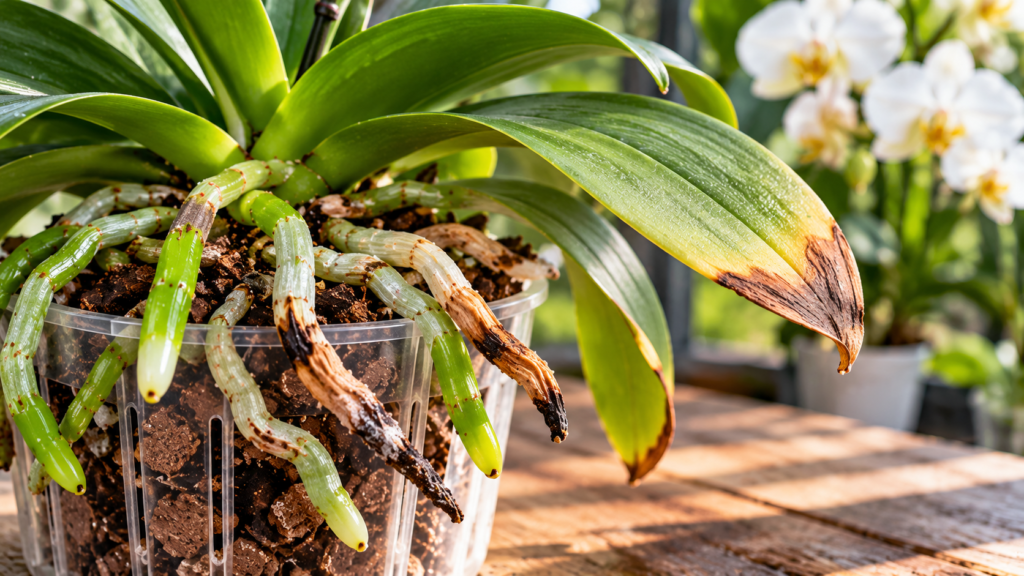
Dead or Damaged Root Tips
One possible early warning sign is the death of actively growing root tips.
Healthy orchid roots often produce fresh green, reddish, or other species-specific growing tips. These growing areas are sensitive to excessive mineral concentrations.
When fertilizer salts accumulate, new root tips may become brown, black, or stop developing.
An orchid that previously produced healthy new roots but suddenly stops growing deserves closer inspection.
Brown or Discolored Roots
Roots affected by excessive fertilizer salts may develop brown or darkened areas.
However, root color must be interpreted carefully.
Some healthy orchid roots naturally become silver or gray when dry and turn green when wet. Certain species also have naturally pigmented roots.
The texture of the root is often more useful than color alone.
If a root is brown and deteriorating, particularly near the growing tip, excessive salts may be involved. But brown roots can also indicate other problems, including root decay.
Reduced Root Growth
An orchid may continue producing leaves or maintaining existing growth while its root development slows.
A lack of new roots is one of the warning signs identified by the American Orchid Society.
Check whether the orchid has stopped producing new root tips, especially if the plant previously grew actively.
Do not assume that every pause in root development indicates fertilizer burn. Seasonal growth changes, temperature, light, and natural resting periods can also affect root activity.
Dry or Dehydrated Root Appearance
Excessive fertilizer salts can interfere with normal water absorption.
As root function declines, some roots may become dry, weakened, or unable to support normal plant hydration.
This can create a misleading situation: the medium appears wet, but the plant behaves as though it lacks water.
For a broader reference on identifying healthy and unhealthy orchid roots, see our orchid root health and diagnosis guide.
3. Signs of Fertilizer Burn on Orchid Leaves
Root damage can eventually affect the leaves because the plant becomes less effective at absorbing and transporting water and nutrients.
Leaf symptoms may appear after the root system has already experienced significant stress.
Brown Leaf Tips
Brown leaf tips are among the most recognizable possible signs of fertilizer-related damage.
The affected area may begin at the end of the leaf and gradually extend toward the surrounding tissue.
The damage may appear dry, brown, or black.
The American Orchid Society identifies brown leaf tips as a possible later-stage symptom of fertilizer burn.
However, brown tips are not exclusive to overfertilizing. Low humidity, inconsistent watering, salt accumulation from irrigation water, and other environmental problems can produce similar symptoms.
Brown Leaf Margins
In some cases, damage develops along the edges of the leaves.
The affected margins may become dry, discolored, or necrotic.
This can occur when excessive soluble salts interfere with water movement and damage plant tissues.
Examine the roots and growing medium before concluding that fertilizer is responsible.
Yellowing Leaves
As fertilizer-related root damage becomes more severe, leaves may begin turning yellow.
This can occur because damaged roots cannot maintain normal water and nutrient uptake.
Yellowing may affect individual leaves or become more widespread as the plant declines.
Natural aging can also cause older Phalaenopsis leaves to turn yellow and fall off. The location, progression, and condition of the rest of the plant are important when evaluating the symptom.
Blackening Leaf Tips
Blackened tips can indicate salt toxicity, but they are not a definitive diagnosis of fertilizer burn.
The American Orchid Society’s guidance on salt toxicity describes blackening that begins at leaf tips and progresses down the leaves.
New growth may also become stunted, and new roots may stop growing when they reach the potting medium.
Other problems, including certain fungal or bacterial conditions and environmental damage, can also cause dark leaf lesions.
If blackening spreads rapidly or appears as irregular spots, investigate possible disease and environmental causes rather than assuming fertilizer is responsible.
4. What Does Fertilizer Salt Buildup Look Like?
Fertilizer burn is often associated with accumulated mineral salts in the growing medium.
One visible warning sign is a pale crust or residue around the pot or on the surface of the potting medium.
Possible appearances include:
- White crusty deposits on bark or moss.
- Pale mineral residue around drainage holes.
- Whitish or brownish deposits on the inside of the pot.
- Mineral crust on exposed mounting material.
- Residue around areas where water regularly evaporates.
These deposits can provide useful clues about the orchid’s watering and fertilizing history.
However, not every white deposit is fertilizer residue. Hard water can leave mineral deposits, and fungal growth may sometimes resemble a pale coating.
Look at the plant’s root condition and review its fertilizer and irrigation history.
For a more detailed visual guide, read What Does Fertilizer Salt Buildup Look Like on Orchids?.
5. Fertilizer Burn vs. Root Rot: How to Tell the Difference
Fertilizer burn and root rot can both cause declining roots, but their underlying causes are different.
Root rot is commonly associated with growing conditions that keep the roots excessively wet for too long, often in combination with poor drainage and microbial activity.
Fertilizer burn is associated with excessive soluble mineral salts around the roots.
The two problems can also occur together. Roots damaged by excessive salts may become more vulnerable to further deterioration.
| Observation | Possible fertilizer burn | Possible root rot |
|---|---|---|
| Root tips | Brown or black, with growth stopping | May become dark and deteriorate |
| Root texture | May become dry or damaged | Often soft, mushy, or hollow |
| Leaf symptoms | Brown tips, yellowing, dehydration | Yellowing, wilting, declining leaves |
| Potting medium | May show mineral crust | Often remains excessively wet |
| Common contributing factor | Excess fertilizer salts | Poor drainage and prolonged wetness |
These are general diagnostic clues, not definitive tests.
The American Orchid Society’s orchid root troubleshooting guide explains that black or brown root tips can be associated with salt toxicity, while roots that are brown, firm, and wet may indicate excessive moisture.
Inspect the roots and medium together rather than diagnosing from one symptom.
6. Why Does Fertilizer Burn Happen?
Several factors can contribute to excessive mineral salt accumulation.
Applying Fertilizer Too Concentrated
Using fertilizer at a concentration higher than the plant can tolerate increases the amount of dissolved mineral salts around the roots.
A strong solution is not necessarily more effective.
Orchids generally benefit from an appropriate supply of nutrients rather than excessive concentrations.
Fertilizing Too Frequently
Repeated feeding without sufficient flushing can allow salts to accumulate.
This is particularly relevant when growers follow a frequent feeding schedule but do not account for fertilizer strength or water quality.
The correct frequency depends on the orchid’s growth activity and growing conditions.
See How Often Should You Fertilize Orchids? for guidance on adjusting feeding frequency.
Using Mineral-Rich Water
Tap water, well water, and other irrigation sources may contain dissolved minerals.
These minerals contribute to the total salt concentration reaching the roots.
Softened water can also be unsuitable because some water softening systems add sodium.
Allowing the Potting Medium to Dry With Fertilizer Residue
As water evaporates, dissolved salts become more concentrated.
When fertilizer residues remain in the medium and the roots become excessively dry, the risk of salt-related damage can increase.
Ignoring Natural Rest Periods
Some orchids require reduced watering during dormancy.
If fertilizer salts remain in the pot while watering is reduced, their concentration can increase.
Plants that need a dry winter rest should not automatically continue receiving their normal fertilizer routine.
7. What to Do If Your Orchid Has Fertilizer Burn
If you suspect fertilizer burn, the first priority is to stop adding fertilizer and assess the condition of the roots.
The appropriate treatment depends on how severe the damage has become.
Step 1: Stop Fertilizing Temporarily
Stop applying fertilizer while investigating the problem.
Adding more fertilizer to an already stressed root system may increase mineral accumulation.
Step 2: Inspect the Roots
If the symptoms are significant, carefully remove the orchid from its pot.
Examine the root system and look for:
- Dead root tips.
- Brown or deteriorating roots.
- Healthy firm roots.
- Evidence of salt deposits.
- Damaged or decomposed potting material.
Do not remove healthy roots simply because they are silver, pale, or naturally pigmented.
Step 3: Flush Accumulated Salts
The American Orchid Society recommends removing the old medium and thoroughly flushing the roots with plain water when an orchid has been seriously injured by overfertilizing.
For less severe accumulation, flushing the existing medium with suitable water may help remove soluble salts.
Make sure the container drains freely.
If the potting medium is severely deteriorated or heavily contaminated with accumulated salts, repotting may be necessary.
Step 4: Remove Dead or Severely Damaged Roots
Use clean, sterilized cutting tools when removing roots that are clearly dead or deteriorating.
Do not cut healthy roots unnecessarily.
If the plant has extensive root loss, preserve every healthy root that can reasonably be retained.
Step 5: Repot When Necessary
For severe fertilizer burn, remove the old medium and repot using fresh, suitable orchid potting material.
Use a clean pot with adequate drainage.
Avoid returning the orchid to heavily salt-contaminated media.
Step 6: Allow the Orchid to Recover
Keep the orchid in suitable growing conditions and protect it from temperature extremes.
Maintain appropriate watering without leaving the roots excessively wet.
Do not immediately resume concentrated fertilizer applications.
The American Orchid Society recommends reintroducing diluted fertilizer once the orchid begins to establish itself again.
8. How to Prevent Fertilizer Burn
Preventing fertilizer burn is easier than recovering a badly damaged orchid.
A few consistent habits can substantially reduce the risk.
Use Diluted Fertilizer
Begin with a conservative fertilizer concentration rather than applying the full label strength automatically.
The American Orchid Society discusses using a quarter of the recommended strength for plants recovering from fertilizer burn.
The correct concentration should still account for the fertilizer formulation, water quality, and orchid type.
Water Before Fertilizing
Thoroughly wet the growing medium before applying fertilizer.
This is particularly important for bark-based media, which can be difficult to wet evenly when dry.
Applying fertilizer to already dehydrated roots can increase the risk of damage.
Flush the Growing Medium Periodically
Use suitable plain water to remove accumulated soluble salts.
The American Orchid Society recommends flushing orchid media and root zones with plain, fresh water at least monthly.
The frequency may need adjustment according to the water source, growing medium, and fertilizer routine.
For practical instructions, see Should You Flush Orchid Potting Media to Remove Fertilizer Salts?.
Check Water Quality
If your water contains high mineral concentrations, consider using a more suitable source.
Rainwater, reverse osmosis water, and other low-mineral sources may help reduce unnecessary salt accumulation.
Match Fertilizing to Growth Activity
Orchids generally need more nutrients during active growth and less during slower growth or dormancy.
Avoid applying the same fertilizer concentration and frequency to every orchid throughout the year.
9. When Should You Expect Recovery?
Recovery depends on how much of the root system has been damaged.
An orchid with a few damaged root tips and several healthy roots may recover more easily than a plant that has lost most of its functional root system.
Possible signs of recovery include:
- New root tips appearing.
- Healthy roots extending into fresh medium.
- New leaves or shoots developing.
- Improved leaf firmness.
- No further progression of leaf-tip damage.
Existing brown or black leaf tissue generally will not turn green again. Evaluate recovery by observing new growth and the condition of the remaining healthy tissues.
Avoid repeatedly changing fertilizer products or moving the orchid between different growing conditions while it is recovering.
Consistent care is more useful than trying several treatments at once.
10. Frequently Asked Questions
Can Fertilizer Burn Kill an Orchid?
Yes. Severe fertilizer burn can destroy a large part of the root system and eventually kill the plant if excessive salt accumulation continues.
Early detection and appropriate treatment improve the chances of recovery.
Can Brown Orchid Roots Recover?
Roots with dead or severely damaged tissue generally do not return to healthy condition.
However, an orchid may recover by producing new roots if the underlying problem is corrected and enough healthy tissue remains.
Can I Save an Orchid With Black Root Tips?
Often, yes. Black root tips may indicate salt toxicity, but the cause should be investigated.
Flush the growing medium with suitable water, review the fertilizer routine, and check whether the roots are otherwise healthy.
Should I Fertilize an Orchid With Damaged Roots?
Avoid applying concentrated fertilizer to an orchid with significant root damage.
Prioritize correcting the cause and allowing the plant to establish new roots before returning to a normal feeding program.
Does White Residue Always Mean Fertilizer Burn?
No. White residue can result from fertilizer salts, hard water minerals, or other deposits.
Examine the plant’s roots and review the water and fertilizer history before making a diagnosis.
How Often Should I Flush Orchid Potting Media?
The American Orchid Society recommends flushing at least monthly as a general preventive practice.
However, the appropriate routine depends on the growing medium, irrigation water, fertilizer concentration, and orchid type.
Conclusion
Fertilizer burn is a preventable orchid problem caused by excessive soluble mineral salts around the roots.
Early warning signs may include reduced root growth, dead root tips, brown roots, and mineral deposits on the growing medium. As the problem progresses, leaf tips may turn brown or black, leaves may yellow, and the plant may gradually lose vigor.
The most important step is to recognize the difference between fertilizer-related damage and other problems that produce similar symptoms.
Use diluted fertilizer, water the medium before feeding, maintain good drainage, and flush accumulated salts periodically.
Most importantly, remember that fertilizer should support healthy orchid growth, not force it.
A careful feeding routine and regular root inspection can help prevent fertilizer burn and protect the long-term health of your orchid collection.
Share this article