Choosing the best fertilizer for orchids can be confusing. Garden centers offer balanced fertilizers, high-nitrogen formulas, bloom boosters, organic products, liquid concentrates, and slow-release granules. Each product promises benefits, but not every fertilizer is suitable for every orchid or growing environment.
The truth is that orchids do not need the strongest fertilizer or the most complicated feeding program. They need an appropriate supply of essential nutrients in a form and concentration their roots can use.
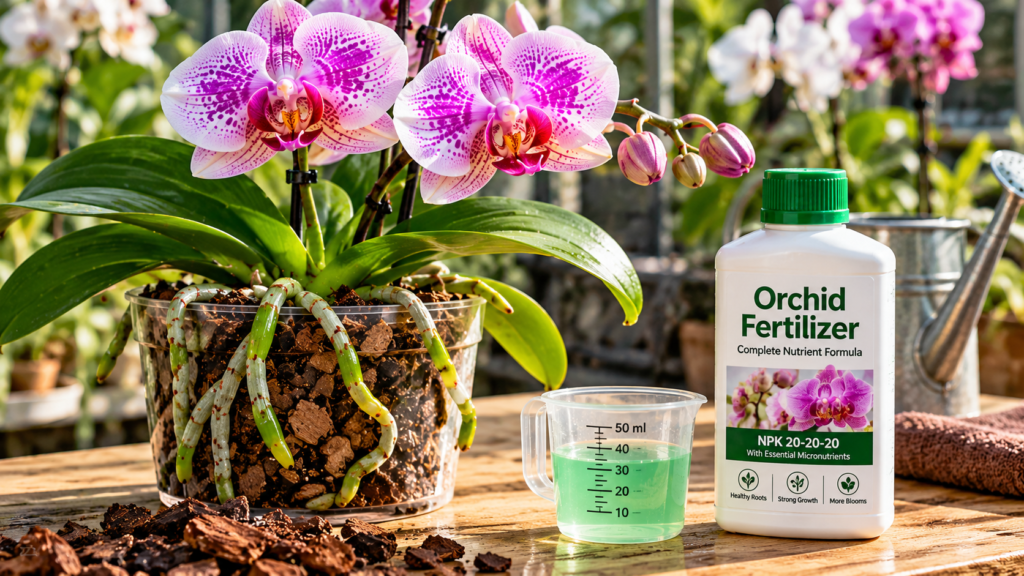
For many commonly cultivated orchids, a complete, water-soluble fertilizer containing nitrogen, phosphorus, potassium, and essential micronutrients is a practical choice. A balanced formula can provide general nutritional support without requiring growers to switch between several products.
However, the best fertilizer also depends on the potting medium, water quality, orchid species, and stage of growth.
This guide explains how to choose an appropriate orchid fertilizer, understand different formulations, compare NPK ratios, and avoid common mistakes that can damage roots.
1. What Makes a Fertilizer Good for Orchids?
A suitable orchid fertilizer should provide essential nutrients without creating excessive concentrations of dissolved mineral salts around the roots.
Unlike many garden plants, numerous cultivated orchids grow in bark, sphagnum moss, or other specialized media rather than ordinary garden soil. These materials provide physical support and manage moisture, but they may supply limited nutrients.
Consequently, container-grown orchids often depend on supplemental fertilizer.
According to the American Orchid Society’s fertilizer guidance, fertilizers supply both macronutrients and micronutrients. Macronutrients include nitrogen, phosphorus, potassium, calcium, magnesium, and sulfur. Micronutrients such as iron, zinc, boron, and copper are also important for normal plant processes.
When choosing a product, look for these characteristics:
- Contains nitrogen, phosphorus, and potassium.
- Provides essential micronutrients.
- Is suitable for dilution in water.
- Has clear mixing and application instructions.
- Does not require excessively concentrated applications.
- Is compatible with your irrigation water and growing medium.
A complete fertilizer is generally more useful than a product that supplies only one or two nutrients without considering the plant’s overall nutritional requirements.
2. Is Balanced Fertilizer the Best Choice for Orchids?
For many home growers, a balanced fertilizer is a sensible starting point.
A balanced formula supplies nitrogen, phosphorus, and potassium in similar proportions. Common examples include 20-20-20, 10-10-10, and other formulations with comparable NPK ratios.
The New York Botanical Garden’s orchid reference service recommends a balanced fertilizer such as 20-20-20 as a practical option for supplying primary nutrients.
A balanced product can support:
- Leaf and shoot development.
- Root growth.
- Normal plant metabolism.
- General plant maintenance.
- Development of healthy growth before flowering.
However, balanced does not mean universally perfect. A fertilizer’s micronutrient content, nitrogen sources, concentration, and compatibility with the water supply also matter.
The Chicago Botanic Garden similarly recommends looking for fertilizers containing nitrogen, phosphorus, potassium, and micronutrients. It notes that liquid or water-soluble products are convenient for container-grown orchids.
For most beginners, starting with a complete balanced fertilizer and applying it carefully is more straightforward than buying several specialized products.
3. Understanding Common Orchid Fertilizer Formulas
The three numbers on a fertilizer label represent nitrogen (N), available phosphate (P₂O₅), and soluble potash (K₂O).
These values describe the guaranteed nutrient analysis, not the exact amount an orchid should receive.
Here are some common formulations and their potential uses.
20-20-20: Balanced Fertilizer
A 20-20-20 formula supplies equal proportions of the three primary fertilizer components.
It is a commonly recommended balanced option for general orchid nutrition.
Potential advantages include:
- Provides all three primary macronutrients.
- Offers a straightforward general feeding option.
- Can be used for many commonly cultivated orchids when appropriately diluted.
- Reduces the need to switch formulas based solely on flowering expectations.
Its suitability still depends on the complete formulation and the grower’s water quality.
30-10-10: Higher-Nitrogen Fertilizer
A 30-10-10 fertilizer contains a higher proportion of nitrogen relative to phosphorus and potassium.
It has traditionally been recommended for orchids grown in bark-based media, particularly when growers want to support vegetative growth.
The American Orchid Society’s Phalaenopsis culture sheet discusses high-nitrogen fertilizer for plants grown in bark.
However, this does not mean every orchid in bark needs 30-10-10. The American Orchid Society also highlights that excessive nitrogen and fertilizer accumulation can create problems.
An important consideration is that additional nitrogen can accelerate the microbial breakdown of organic bark media, as discussed in the AOS article Fertilize Weakly, Weekly.
10-30-20: Higher-Phosphorus Fertilizer
This formulation contains a higher proportion of phosphorus relative to nitrogen and potassium.
It is often marketed as a bloom booster.
Phosphorus is essential for plant metabolism and reproductive development, but applying a high-phosphorus fertilizer does not guarantee more flowers.
Flowering also depends on adequate light, plant maturity, temperature, healthy roots, and the orchid’s natural growth cycle.
A high-phosphorus formula should therefore not be treated as a shortcut to flowering.
For a more detailed explanation of fertilizer labels and nutrient proportions, see Orchid Fertilizer Ratios Explained: What NPK Numbers Mean.
4. Liquid, Powder, or Slow-Release: Which Fertilizer Is Best?
The fertilizer’s physical form affects how easily it can be measured, mixed, and applied.
Liquid Fertilizer
Liquid orchid fertilizers are popular because they are easy to dilute and distribute through the growing medium.
Advantages include:
- Easy measurement and mixing.
- Convenient application during watering.
- Greater control over fertilizer concentration.
- Suitable for many bark and moss growing systems.
For most home growers, a water-soluble liquid fertilizer is a practical choice.
Water-Soluble Powder
Powdered fertilizers dissolve in water and are often economical for growers with larger collections.
They can provide the same essential nutrients as liquid products, depending on the formulation.
Measure the powder carefully and make sure it dissolves completely before application.
Do not assume that two products with the same NPK ratio require the same dilution rate.
Slow-Release Fertilizer
Slow-release fertilizers release nutrients over an extended period.
They can reduce the need for frequent liquid feeding, but their nutrient release may vary with temperature, moisture, and product composition.
This makes them less flexible when growing conditions change.
Use them according to the manufacturer’s instructions, especially in small orchid pots where excessive nutrient accumulation can be difficult to correct.
Which Should You Choose?
For most beginners, a complete water-soluble fertilizer is a good starting option because the concentration and feeding frequency can be adjusted more easily.
5. Should You Choose Fertilizer With or Without Urea?
Nitrogen can be supplied in different chemical forms, including nitrate, ammonium, and urea.
The American Orchid Society’s general orchid care guidance recommends fertilizers containing little or no urea.
One reason is that urea generally needs microbial conversion before its nitrogen becomes available in forms plants can use. The efficiency of this process can vary with growing conditions and the characteristics of the medium.
For growers who want a straightforward fertilizer selection, a product that supplies nitrogen primarily in nitrate and ammonium forms can be a practical option.
However, fertilizer selection should consider the complete nutrient formulation rather than rejecting a product based on one label detail alone.
The American Orchid Society also recommends avoiding unnecessarily high fertilizer concentrations and considering the orchid’s growing conditions.
6. Does the Growing Medium Affect Fertilizer Selection?
Yes. The growing medium can influence how much fertilizer an orchid needs and how easily mineral salts accumulate.
Orchids Grown in Bark
Bark-based media generally provide good air circulation and drainage but limited nutritional resources.
Some growers use higher-nitrogen fertilizers with bark, although this is not an automatic requirement.
Bark also decomposes over time. Fertilizer practices that encourage excessive microbial activity can influence how quickly the medium breaks down.
Orchids Grown in Sphagnum Moss
Sphagnum moss retains moisture more effectively than coarse bark.
It can also hold fertilizer salts within the medium, making excessive feeding particularly undesirable.
The American Orchid Society’s discussion of weak, regular feeding notes that moss and peat-based media can retain fertilizer salts more tightly than coarse or inorganic media.
When using moss, consider a more dilute fertilizer solution and monitor the medium regularly.
Orchids Grown in Inorganic Media
Materials such as clay pebbles and some mineral substrates generally provide physical support rather than significant nutrients.
The grower must supply appropriate nutrition through irrigation and fertilizer.
The exact approach depends on the material and how it interacts with dissolved minerals.
7. How Water Quality Influences Fertilizer Choice
Water quality is one of the most important factors when choosing orchid fertilizer.
Tap water may already contain calcium, magnesium, bicarbonates, and other dissolved minerals. These substances contribute to the total mineral concentration reaching the roots.
If the water already contains significant mineral levels, adding a concentrated fertilizer can create unnecessary accumulation.
Rainwater
Clean rainwater is often useful for orchid irrigation because it generally contains relatively low dissolved mineral concentrations.
However, the collection surface and storage container should be clean.
Reverse Osmosis Water
Reverse osmosis water removes many dissolved minerals.
It gives growers greater control over the nutrient solution, but it may also lack calcium and magnesium.
When using it, choose a fertilizer program that supplies the nutrients the water does not provide.
Tap Water
Tap water can be suitable for orchids, but its mineral composition varies by location.
Hard water may contribute to mineral deposits in orchid pots.
If you notice recurring white deposits or root problems, review the water quality as well as the fertilizer routine.
8. How Much Fertilizer Should You Apply?
Choosing the right fertilizer is only part of the process. Concentration and application frequency matter just as much.
The American Orchid Society’s general care guidance recommends using no more than half the manufacturer’s label strength for many commonly grown orchids.
Other experienced growers use a weak, regular feeding approach, often described as weakly weekly.
Iowa State University Extension also discusses this approach for indoor orchids and recommends flushing the growing medium with plain water at least monthly to help prevent salt buildup.
These are general approaches, not fixed rules for every species.
A practical starting routine is:
- Select a complete, water-soluble fertilizer.
- Read the manufacturer’s dilution instructions.
- Begin with a conservative concentration appropriate for your orchid.
- Water the plant before applying fertilizer if the medium or roots are dry.
- Apply the solution evenly and allow excess water to drain.
- Monitor root condition and mineral accumulation.
- Adjust feeding according to growth activity and water quality.
For a more detailed schedule, read How Often Should You Fertilize Orchids?.
9. How to Avoid Fertilizer Burn and Salt Buildup
Even a good fertilizer can damage orchids when it is applied excessively.
Fertilizer salts can accumulate in the growing medium and around the roots, particularly when fertilizer is applied repeatedly without sufficient flushing.
Possible warning signs include:
- White or pale crusty deposits on the medium.
- Mineral residue around drainage holes.
- Brown or damaged root tips.
- Leaf-tip or leaf-margin damage.
- Declining root condition.
These symptoms are not exclusive to fertilizer damage, so examine watering, drainage, and water quality before making a diagnosis.
The American Orchid Society recommends thoroughly wetting the growing medium before fertilizing. This is particularly useful with bark, which can be difficult to wet evenly when dry.
If you suspect fertilizer burn, review How to Recognize Fertilizer Burn on Orchid Roots and Leaves.
You should also learn how to recognize fertilizer salt buildup on orchids and when flushing the medium may be appropriate.
10. Does Every Orchid Need the Same Fertilizer?
No. Different orchid genera have different nutritional requirements and growth cycles.
For example:
- Phalaenopsis commonly benefit from regular, diluted feeding during active growth.
- Cattleya orchids need nutrition while producing new roots and pseudobulbs.
- Some Dendrobium types require reduced or discontinued feeding during a natural dormant period.
- Paphiopedilum orchids can be sensitive to excessive fertilizer salts.
- Some Vanda orchids grow vigorously and may require more frequent nutrient applications under suitable conditions.
The American Orchid Society emphasizes that fertilizer needs vary between orchid groups. Some genera tolerate or benefit from more frequent feeding, while others need substantially less.
Do not apply a fertilizer schedule designed for one orchid genus to an entire collection without considering their different growth habits.
11. Common Fertilizer Buying Mistakes
Avoid these mistakes when selecting fertilizer for your orchids.
Buying the highest NPK formula available
Higher numbers do not automatically mean better results. A concentrated fertilizer can increase the risk of salt accumulation and root damage.
Choosing a bloom booster because you want more flowers
High phosphorus does not guarantee flowering. Light, temperature, maturity, and plant health remain essential.
Ignoring micronutrients
A product that supplies only the primary NPK components may not provide a complete nutritional program.
Ignoring water quality
The fertilizer is not the only source of dissolved minerals entering the pot.
Buying several fertilizers without a clear purpose
Switching repeatedly between formulas can make it difficult to understand what is actually helping or harming the plant.
Following the same schedule throughout the year
Orchids have different growth cycles. Some continue growing, while others require reduced feeding during rest periods.
12. Frequently Asked Questions
What Is the Best All-Purpose Fertilizer for Orchids?
A complete, balanced, water-soluble fertilizer containing NPK and micronutrients is a practical all-purpose choice for many commonly cultivated orchids.
A balanced formula such as 20-20-20 is one option, provided it is diluted and applied appropriately.
Is 20-20-20 Fertilizer Good for Orchids?
It can be suitable for many orchids as a general fertilizer.
However, the concentration, micronutrient content, water quality, and growing medium should all be considered.
Is 30-10-10 Better Than 20-20-20?
Not necessarily. A 30-10-10 formula supplies a higher proportion of nitrogen and may be used in certain bark-based growing systems.
A balanced formula may be more convenient for general feeding.
Neither is automatically superior for every orchid.
Do Orchids Need Special Fertilizer?
Not always. Fertilizers formulated specifically for orchids can be convenient, but other complete fertilizers may also be suitable when their nutrient composition and dilution instructions are appropriate.
Can I Use Regular Houseplant Fertilizer on Orchids?
Some balanced houseplant fertilizers can be used on orchids if they provide appropriate nutrients and can be diluted safely.
Check the formulation and follow conservative application practices.
Should I Change Fertilizer When My Orchid Starts Flowering?
Not automatically. A healthy orchid may continue receiving its normal fertilizer during flowering.
Changing to a high-phosphorus fertilizer is not necessary simply because flowers are present.
Conclusion: Choose a Complete Fertilizer and Use It Carefully
The best fertilizer for orchids is not necessarily the most expensive product, the highest NPK formula, or a specialized bloom booster.
For many home growers, a complete water-soluble fertilizer with balanced nutrients and micronutrients is a practical starting point.
A formula such as 20-20-20 can provide general nutritional support when applied at an appropriate concentration. Other formulas may be suitable for particular growing conditions, but they should be selected for a clear reason rather than because their labels promise faster growth or more flowers.
Pay attention to the orchid’s roots, growing medium, water quality, and growth cycle.
Remember that fertilizer supports healthy orchid development, but it cannot compensate for poor light, damaged roots, unsuitable watering, or inadequate drainage.
Build your orchid care knowledge with The Orchid Care Guide: 200 Essential Orchid Care Posters, a planned collection of printable A5 visual guides covering practical orchid care topics explored throughout this blog.
Share this article