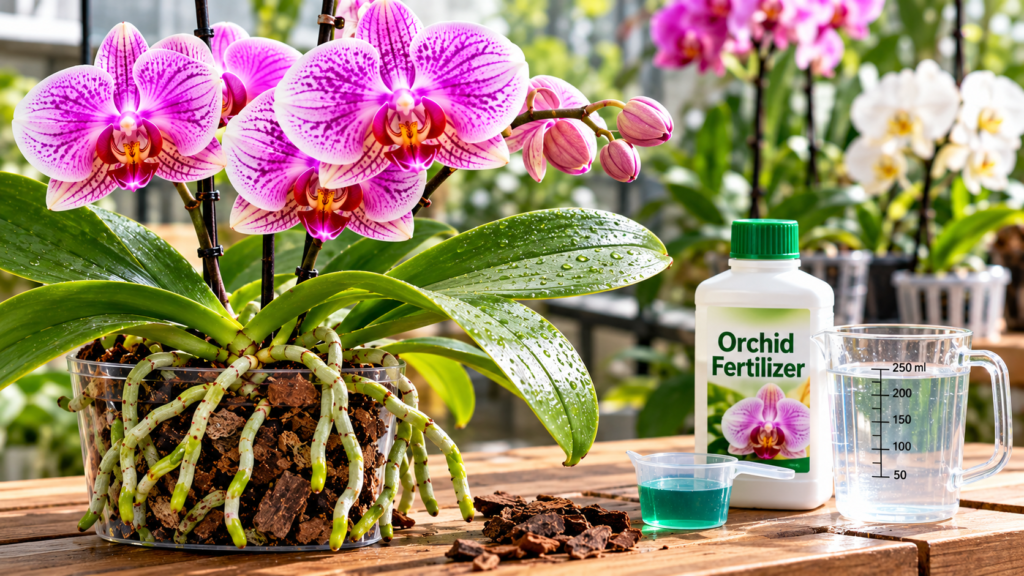
Fertilizing is an important part of growing healthy orchids, but it is also one of the most misunderstood aspects of orchid care. Some growers feed their orchids regularly, while others avoid fertilizer because they are concerned about damaging delicate roots. Both approaches can create problems when they are not based on the plant’s actual growing conditions.
Orchids need mineral nutrients to produce new leaves, healthy roots, strong pseudobulbs, and flowers. In nature, many epiphytic orchids receive nutrients from rainwater, decomposing organic matter, dust, and other materials that accumulate around their roots. These nutrients are generally available in small quantities rather than in the concentrated form found in many garden fertilizers.
When orchids are grown in containers, their natural nutrient sources are limited. Bark, sphagnum moss, and other common potting materials provide physical support and help manage moisture, but they do not necessarily supply all the nutrients an orchid needs. A suitable fertilizer program can help fill this gap.
However, more fertilizer does not automatically produce better growth or more flowers. Excessive feeding can damage roots, increase fertilizer salt accumulation, interfere with water absorption, and create conditions that weaken the plant.
The goal is to provide enough nutrients to support steady growth without exposing the orchid to unnecessarily high fertilizer concentrations.
This guide explains orchid nutritional requirements, fertilizer types, NPK ratios, feeding schedules, seasonal adjustments, common mistakes, and practical ways to prevent fertilizer-related damage. It also explains how to adapt fertilizing practices to different orchid growth habits and growing environments.
1. Why Do Orchids Need Fertilizer?
Like other plants, orchids require mineral nutrients for essential biological processes. These nutrients support photosynthesis, cell development, root growth, energy production, and flower formation.
In their natural habitats, orchids obtain nutrients from their surroundings. Epiphytic orchids, which grow on trees rather than in soil, collect nutrients from rainwater, decomposing leaves, organic debris, and other materials around their roots. Terrestrial orchids obtain nutrients from the soil and organic matter in their growing environment.
Container-grown orchids have a different situation. Their roots depend on the limited resources available in the potting medium and the water supplied by the grower.
Over time, these resources may become insufficient to support continued growth. This is particularly relevant when orchids are grown in relatively inert materials such as bark, which primarily provide structure rather than substantial nutrition.
Fertilizer supplies nutrients that may otherwise be unavailable in sufficient quantities.
Nutrients Support Root Development
Healthy roots are essential for orchid survival. They absorb water and mineral nutrients, help anchor the plant, and support the growth of leaves and flowers.
Nitrogen, phosphorus, potassium, calcium, magnesium, and several micronutrients contribute to different aspects of root function and development.
However, fertilizer cannot compensate for damaged roots caused by poor drainage, prolonged waterlogging, unsuitable potting media, or root disease. If an orchid has unhealthy roots, correcting the growing environment should come before increasing fertilizer.
Nutrients Support New Leaves and Shoots
Orchid leaves capture light and produce energy through photosynthesis. New leaves and shoots depend on an adequate supply of nutrients to develop properly.
Nitrogen is particularly important for chlorophyll production and vegetative growth. A plant receiving insufficient nitrogen may develop slowly or produce smaller leaves, although these symptoms can also result from inadequate light, damaged roots, or other environmental problems.
Nutrients Support Flowering
Flower production requires energy and resources accumulated during the plant’s growth cycle.
A healthy orchid needs sufficient light, suitable temperatures, appropriate watering, functional roots, and adequate nutrition to reach flowering condition.
Fertilizer contributes to overall plant development, but it is not a flowering switch. Increasing fertilizer concentration does not reliably force an orchid to bloom.
For many orchids, correcting light levels, temperature conditions, and seasonal growth patterns is more important than changing fertilizer formulas.
2. Understanding the Main Nutrients Orchids Require
Commercial fertilizers contain different combinations of mineral nutrients. Understanding their functions helps growers choose suitable products and avoid relying entirely on marketing labels.
Plant nutrients are generally divided into macronutrients and micronutrients.
Macronutrients are required in relatively large quantities, while micronutrients are needed in much smaller amounts.
Nitrogen (N)
Nitrogen is essential for the production of chlorophyll, proteins, enzymes, and other compounds involved in plant growth.
It supports the development of leaves and shoots and contributes to the plant’s ability to capture and use light.
Insufficient nitrogen can contribute to slow growth, pale older leaves, and reduced leaf development. However, leaf yellowing should never automatically be diagnosed as nitrogen deficiency.
Overwatering, root damage, natural leaf aging, insufficient light, and other nutritional problems can produce similar symptoms.
Excessive nitrogen can also be undesirable. It may encourage soft vegetative growth and create an imbalance between growth and flowering when other environmental conditions are unsuitable.
Phosphorus (P)
Phosphorus plays an important role in energy transfer, cell development, and several metabolic processes.
It contributes to root development and is involved in the biological processes required for flowering and seed production.
Although phosphorus is essential, orchids do not necessarily need a fertilizer with an unusually high phosphorus concentration to produce flowers.
A balanced nutritional program is generally more useful than attempting to manipulate flowering with a high-phosphorus product.
Potassium (K)
Potassium helps regulate water movement, enzyme activity, and several processes involved in plant metabolism.
It contributes to overall plant function and helps maintain normal growth.
Potassium is particularly important because it participates in processes that influence how plants respond to environmental stress.
However, excessive potassium can interfere with the availability or uptake of other nutrients. The objective is to maintain appropriate nutrient balance rather than maximize the amount of any single element.
Calcium (Ca)
Calcium contributes to cell wall structure and the development of growing tissues.
It is relatively immobile within plants, which means a consistent supply is important for actively developing areas.
Calcium availability can be influenced by water quality, fertilizer composition, and root function.
Some growers use calcium-containing supplements, but additional calcium should not be added automatically. The existing water and fertilizer may already supply enough.
Magnesium (Mg)
Magnesium is the central element in chlorophyll molecules and is essential for photosynthesis.
A magnesium deficiency may contribute to interveinal chlorosis, where tissue between leaf veins becomes pale while the veins remain relatively green.
Similar symptoms can also result from other problems, so diagnosis should consider the plant’s overall condition and growing environment.
Sulfur (S)
Sulfur is involved in protein production and several metabolic processes.
It is generally supplied through some fertilizer formulations and may also be present in the water or other growing inputs.
Micronutrients
Orchids also require small amounts of micronutrients, including iron, manganese, zinc, copper, boron, molybdenum, and chlorine.
These elements participate in enzyme activity, photosynthesis, nutrient metabolism, and normal tissue development.
A complete orchid fertilizer generally contains at least some of these micronutrients.
A product containing only nitrogen, phosphorus, and potassium may not provide a complete nutritional program if the remaining nutrients are not supplied elsewhere.
3. Understanding Orchid Fertilizer Labels and NPK Ratios
Most commercial fertilizers display three prominent numbers on the package. These numbers represent the guaranteed analysis of nitrogen, available phosphate, and soluble potash, commonly expressed as NPK.
For example, a fertilizer labeled 20-20-20 contains:
- 20% nitrogen.
- 20% available phosphate, expressed as P₂O₅.
- 20% soluble potash, expressed as K₂O.
These numbers describe the percentage of the specified fertilizer components by weight. They do not indicate that the plant needs equal amounts of all three nutrients.
Other common formulas include 30-10-10, 10-30-20, and 13-13-13.
A higher number does not automatically mean a better fertilizer. What matters is the nutrient composition, concentration used, frequency of application, and whether the formula suits the plant’s growing conditions.
For a more detailed explanation of fertilizer labels and the differences between common formulas, see Orchid Fertilizer Ratios Explained: What NPK Numbers Mean.
Is a Balanced Fertilizer Suitable for Orchids?
A balanced fertilizer contains similar proportions of nitrogen, phosphorus, and potassium.
Many growers use balanced formulations because they provide a straightforward source of the three primary macronutrients.
A balanced fertilizer can be suitable for many commonly cultivated orchids when applied at an appropriate concentration.
However, the label ratio alone does not determine whether a product is suitable. Its micronutrient content, formulation, and compatibility with the grower’s water quality also matter.
Is High-Nitrogen Fertilizer Better for Leaf Growth?
Some fertilizers contain a higher nitrogen proportion. These products are sometimes marketed for vegetative growth.
They may be useful in particular growing situations, but a high-nitrogen formula is not automatically necessary for healthy orchids.
The plant still needs other nutrients, and excessive nitrogen can create nutritional imbalance.
Does High-Phosphorus Fertilizer Produce More Flowers?
High-phosphorus fertilizers are often promoted as bloom boosters.
Although phosphorus is essential for plant metabolism and reproductive development, applying extra phosphorus does not guarantee flowering.
Orchid flowering depends on several interacting factors, including maturity, light, temperature, water availability, and species-specific seasonal requirements.
A high-phosphorus product cannot correct inadequate light or an unhealthy root system.
4. Choosing the Best Fertilizer for Orchids
There is no single fertilizer that is best for every orchid.
Different products may be suitable depending on the type of orchid, growing medium, water source, environmental conditions, and feeding routine.
Some fertilizers are specifically formulated for orchids, while others are general-purpose products that can also be used when diluted appropriately.
A useful fertilizer should provide the nutrients required by the plant without making the feeding routine unnecessarily complicated.
Liquid Orchid Fertilizer
Liquid fertilizers are popular because they are easy to measure, dilute, and apply during watering.
They allow growers to control the concentration more precisely than many slow-release products.
This makes them practical for orchids grown in bark, moss, or other container media.
The main disadvantage is that liquid fertilizer must be applied according to a consistent schedule. It is also easy to make measurement mistakes when preparing concentrated solutions.
Water-Soluble Powder Fertilizer
Water-soluble fertilizers are available as powders or crystals that dissolve in water.
They are often economical and allow growers to prepare different concentrations.
However, the product must dissolve properly before application. Undissolved fertilizer particles may produce uneven concentrations, especially when mixed carelessly.
Slow-Release Fertilizer
Slow-release fertilizers release nutrients over an extended period.
They can reduce the need for frequent feeding, but their release rate depends on factors such as temperature, moisture, and product formulation.
This can make nutrient delivery less predictable in some orchid environments.
Slow-release products should be used cautiously in small orchid pots, particularly when the grower cannot easily monitor nutrient accumulation.
Organic Fertilizers
Organic fertilizers may contain materials such as fish-based products, seaweed extracts, or other organic substances.
Their nutrient composition and release rates can vary considerably.
Some products provide relatively small quantities of nutrients, while others may contain more concentrated ingredients.
Organic fertilizers can be useful in certain growing systems, but they are not automatically safer than mineral fertilizers. Their suitability depends on formulation, sanitation, and the condition of the growing medium.
For a detailed comparison of fertilizer types and selection criteria, see What Is the Best Fertilizer for Orchids?.
5. How Often Should You Fertilize Orchids?
Fertilizing frequency depends on the orchid’s growth activity, environmental conditions, fertilizer concentration, and the type of growing medium.
There is no universal schedule that works for every orchid.
An orchid growing actively in warm conditions with sufficient light may use nutrients more quickly than a plant growing slowly in cooler conditions.
Likewise, an orchid grown in a relatively inert bark medium may require a different feeding approach from one grown in a medium containing more organic material.
Feeding During Active Growth
When an orchid is actively producing new roots, leaves, shoots, or pseudobulbs, its demand for nutrients generally increases.
During this period, regular feeding with an appropriately diluted fertilizer can support continued development.
Many growers prefer applying a relatively weak fertilizer solution more frequently rather than using a highly concentrated solution occasionally.
This approach can help reduce sudden exposure to concentrated fertilizer salts.
Feeding During Slow Growth
When growth slows, nutrient demand may also decrease.
This can happen because of seasonal temperature changes, reduced light, natural resting periods, or environmental stress.
Continuing the same feeding routine throughout every season may result in unnecessary fertilizer accumulation.
The appropriate response is to observe the plant rather than follow a rigid calendar.
For practical schedules and examples of feeding frequency, see How Often Should You Fertilize Orchids?.
Why Weak, Consistent Feeding Can Be Useful
Some orchid growers follow the principle of feeding weakly and regularly.
The purpose is to supply small amounts of nutrients during active growth without exposing the roots to unnecessarily concentrated solutions.
However, this approach still requires attention to water quality and salt accumulation.
Frequent feeding does not eliminate the need for occasional flushing or careful monitoring of the potting medium.
The fertilizer label should always be considered when preparing a solution. Any reduced concentration should be measured rather than estimated.
6. Should You Fertilize Orchids While They Are Blooming?
Flowering does not automatically mean that an orchid must stop receiving fertilizer.
Some orchids continue producing roots and leaves while flowers are open. Others slow their vegetative growth during flowering.
The decision should depend on the plant’s condition rather than the presence of flowers alone.
If an orchid is healthy, actively growing, and receiving an appropriate fertilizer concentration, there may be no reason to stop feeding simply because it is blooming.
However, increasing fertilizer concentration to extend flowering or produce larger flowers is not a reliable strategy.
Flowers depend on resources accumulated during earlier growth, and excessive feeding can create unnecessary stress.
Avoid making sudden changes to the feeding program while the plant is flowering, particularly if it is otherwise healthy.
If the orchid is stressed, dehydrated, or recovering from root damage, correcting those problems should take priority over maintaining a fertilizer schedule.
For more guidance, read Can You Fertilize Orchids While They Are Blooming?.
7. Fertilizer Burn: Recognizing and Preventing Damage
One of the most important risks associated with orchid fertilizing is fertilizer burn.
Fertilizer solutions contain dissolved mineral salts. When the concentration around the roots becomes excessive, the roots may struggle to absorb water normally.
High salt concentrations can damage root tissues and interfere with water movement.
This can produce symptoms that resemble dehydration, even when the potting medium is moist.
Common Signs of Fertilizer Burn
Possible signs include:
- Brown or blackened root tips.
- Damaged or discolored root surfaces.
- Dry, shriveled, or weakened roots.
- Brown leaf tips or margins.
- Leaf damage that develops alongside evidence of salt accumulation.
- Declining root activity despite apparently adequate watering.
These symptoms are not exclusive to fertilizer burn.
Root rot, poor drainage, water quality problems, excessive drying, and other environmental stresses can produce similar signs.
The grower should examine the roots, potting medium, watering history, and fertilizer routine before reaching a conclusion.
Why Fertilizer Burn Happens
Several factors can increase the risk:
- Applying fertilizer at a concentration that is too high.
- Feeding too frequently without sufficient water to remove accumulated salts.
- Using hard or mineral-rich water without considering its existing nutrient content.
- Allowing fertilizer solution to dry around roots.
- Using a potting medium that has accumulated mineral deposits.
- Applying fertilizer to severely dehydrated or damaged roots.
A healthy feeding routine should consider all of these factors.
Learn how to distinguish possible fertilizer damage from other orchid problems in How to Recognize Fertilizer Burn on Orchid Roots and Leaves.
8. Understanding Fertilizer Salt Buildup in Orchid Pots
Fertilizer salts do not always disappear after watering.
Some dissolved minerals remain in the potting medium, particularly when water evaporates and leaves mineral residues behind.
Over time, repeated fertilizer applications can contribute to salt accumulation.
The risk is especially relevant when orchids are grown in containers with limited drainage or when the grower uses mineral-rich water.
What Does Salt Buildup Look Like?
Possible signs include:
- White or pale crusty deposits on the potting medium.
- Mineral residue around drainage holes.
- White deposits on the inside of plastic pots.
- Discoloration or damage around root tips.
- Declining root condition despite apparently reasonable care.
However, white deposits are not always fertilizer salts. Mineral deposits from irrigation water and fungal growth can sometimes look similar.
The appearance of the potting medium should therefore be considered alongside the plant’s condition and watering history.
Why Salt Accumulation Matters
High concentrations of dissolved salts can make it more difficult for roots to absorb water.
This may result in dehydration symptoms even when the medium contains moisture.
Salt accumulation can also contribute to root damage over time.
A useful preventive approach is to avoid excessive fertilizer concentration, use suitable water, maintain adequate drainage, and periodically flush the growing medium when appropriate.
For a closer examination of these deposits, read What Does Fertilizer Salt Buildup Look Like on Orchids?.
9. Should You Flush Orchid Potting Media?
Flushing involves passing a relatively large amount of suitable water through the potting medium to help remove accumulated soluble salts.
It can be useful for orchids that receive regular fertilizer or are grown in conditions where mineral deposits accumulate.
However, flushing should not be treated as a substitute for correcting an unsuitable fertilizer routine.
If fertilizer concentration remains excessive, salts will accumulate again.
How Flushing Works
Water passes through the potting medium and carries away some dissolved salts.
For this process to work effectively, the container must have adequate drainage.
The water should be able to move through the pot rather than remain trapped around the roots.
Using suitable water is important. If the irrigation water itself contains high levels of dissolved minerals, flushing may not remove as much accumulated material as expected.
When Flushing May Be Useful
Consider flushing when:
- White mineral deposits appear on the pot or growing medium.
- The orchid has been receiving fertilizer regularly.
- The potting medium may have accumulated fertilizer salts.
- The roots show possible signs of salt stress.
- You want to reduce soluble mineral accumulation as part of routine maintenance.
Flushing should be performed carefully, particularly when the orchid is already suffering from root problems.
A pot with poor drainage or deteriorated medium may need repotting rather than repeated flushing.
For practical instructions and precautions, see Should You Flush Orchid Potting Media to Remove Fertilizer Salts?.
10. Fertilizing Orchids After Repotting
Repotting can disturb orchid roots, remove damaged tissues, and change the relationship between the plant and its growing medium.
Some roots may break during the process, while others may need time to adapt to the new environment.
Immediately applying concentrated fertilizer to a recently repotted orchid is generally unnecessary.
A better approach is to allow the plant to recover and resume normal root activity before returning to its usual feeding routine.
Why Newly Repotted Orchids Need Attention
Damaged roots may be less effective at absorbing water and nutrients.
Applying fertilizer at an excessive concentration can increase the stress on already vulnerable tissues.
The risk depends on the extent of root disturbance, the condition of the plant, the potting medium, and the type of orchid.
A healthy orchid that has been repotted carefully may recover quickly. A plant with extensive root loss may require a longer recovery period.
When Should Feeding Resume?
There is no fixed waiting period suitable for every orchid.
Observe the plant for signs of recovery, particularly new root tips, root extension, or resumed vegetative growth.
Once the orchid is establishing itself in the new medium, an appropriately diluted fertilizer can be reintroduced.
The type of potting medium also matters. Some products contain added nutrients, while others provide little nutritional value.
Avoid combining several fertilizer sources without understanding their total nutrient contribution.
For a more detailed recovery guide, read Should You Fertilize Orchids After Repotting?.
11. Adjusting Fertilizer During Active Growth and Rest Periods
Orchids do not all grow continuously throughout the year.
Some species and hybrids produce new growth during particular seasons, while others have periods of reduced activity.
This variation means that a successful fertilizing routine should respond to the plant’s growth cycle.
Active Growth Periods
During active growth, orchids may produce:
- New leaves.
- New roots.
- New pseudobulbs.
- New shoots or growths.
- Developing flower spikes in some species.
These activities require energy and nutrients.
When the plant is healthy and environmental conditions are suitable, regular feeding can support development.
Rest Periods
Some orchids experience a natural rest period during which growth slows considerably.
Certain deciduous or seasonally adapted orchids may require reduced watering and little or no fertilizer during dormancy.
Other orchids continue growing throughout the year but at a slower rate during less favorable conditions.
It is important not to assume that every orchid needs a dry winter rest or that every orchid should receive fertilizer continuously.
The correct routine depends on the species or hybrid.
Do Not Confuse Stress With Dormancy
A plant that has stopped growing is not necessarily entering a natural rest period.
Root damage, insufficient light, unsuitable temperatures, pests, and disease can all cause growth to slow or stop.
Before reducing fertilizer because an orchid appears inactive, check its roots and growing environment.
A detailed approach to seasonal feeding is available in How to Adjust Orchid Fertilizing During Active Growth and Rest Periods.
12. Can You Grow Orchids Without Fertilizer?
Orchids can survive for some time without supplemental fertilizer, especially when their growing environment supplies nutrients through water, organic matter, or other sources.
However, survival and sustained healthy growth are not the same thing.
A container-grown orchid in a relatively nutrient-poor medium may eventually become limited by the nutrients available to its roots.
This can affect leaf production, root development, and the plant’s ability to maintain healthy growth.
Why Some Orchids Survive Without Regular Feeding
Several factors can explain why an orchid continues growing despite receiving little or no fertilizer.
The potting medium may contain organic material that releases nutrients as it decomposes.
Irrigation water may contain dissolved minerals.
The plant may also be using nutrients stored in older tissues or accumulated during previous periods of growth.
These sources can help sustain the orchid for a period of time.
When Fertilizer May Be Less Necessary
Some growing systems provide nutrients through decomposing organic materials or other inputs.
In these situations, the grower may need less supplemental fertilizer than someone growing orchids in relatively inert bark.
The plant’s condition remains the most important indicator.
A healthy orchid with active roots and normal growth may not need an immediate change to its nutritional routine.
However, consistently poor growth should prompt an examination of light, roots, watering, potting medium, and nutrient availability.
See Can You Grow Orchids Without Fertilizer? for a closer look at the benefits and limitations of fertilizer-free orchid culture.
13. How Water Quality Affects Orchid Fertilizing
Water quality is one of the most overlooked parts of orchid nutrition.
Two growers can use the same fertilizer and concentration but achieve different results because their water contains different amounts of dissolved minerals.
Tap water may contain calcium, magnesium, sodium, bicarbonates, and other dissolved substances.
Some of these minerals are useful nutrients, while excessive concentrations of others can contribute to mineral accumulation.
Hard Water
Hard water contains relatively high concentrations of calcium and magnesium.
These minerals are essential plant nutrients, but hard water may also contribute to mineral deposits in containers and potting media.
A grower using hard water should consider its existing mineral content when selecting fertilizer.
Adding a complete fertilizer without accounting for the water composition may result in unnecessarily high total dissolved mineral concentrations.
Reverse Osmosis Water
Reverse osmosis systems remove many dissolved substances from water.
This can provide greater control over the mineral content of irrigation water.
However, reverse osmosis water may contain very little calcium, magnesium, and other minerals.
When using it, growers should ensure that the fertilizer program supplies the nutrients that would otherwise be absent.
Rainwater
Clean rainwater can be useful for watering orchids because it generally contains relatively low concentrations of dissolved minerals.
However, collection and storage conditions matter.
Rainwater collected from contaminated roofs, dirty gutters, or unsuitable storage containers may contain pollutants or debris.
The quality of the source should always be considered.
Distilled Water
Distilled water contains very few dissolved minerals.
Like reverse osmosis water, it can be useful when growers want greater control over the nutrient solution.
However, it should not be assumed that distilled water alone provides complete nutrition.
The fertilizer must supply the necessary mineral elements.
14. How to Prepare and Apply Orchid Fertilizer Correctly
Even a suitable fertilizer can cause problems if it is mixed or applied incorrectly.
A careful application routine helps reduce the risk of root damage and nutrient accumulation.
Step 1: Read the Fertilizer Label
Check the recommended dilution rate, application instructions, and nutrient composition.
Do not assume that all fertilizers use the same concentration.
Some products are more concentrated than others.
Step 2: Measure the Fertilizer
Use a suitable measuring device rather than estimating the quantity.
Small measurement errors can significantly change the concentration when preparing a small volume of fertilizer solution.
Step 3: Mix Thoroughly
Dissolve the fertilizer completely according to the manufacturer’s instructions.
Uneven mixing may result in different nutrient concentrations throughout the solution.
Step 4: Check the Orchid’s Condition
Avoid applying fertilizer simply because the calendar says it is time.
Check whether the plant is actively growing, whether the roots are healthy, and whether the medium is suitable for watering.
Step 5: Apply Evenly
Distribute the fertilizer solution throughout the potting medium.
Avoid leaving concentrated fertilizer deposits on exposed roots or around the base of the plant.
Step 6: Maintain Good Drainage
Excess solution should drain freely from the container.
Orchids grown in pots without adequate drainage are more vulnerable to water and mineral accumulation.
Step 7: Monitor the Plant
Observe root tips, leaves, new growth, and the condition of the potting medium.
A feeding program should be adjusted when the plant’s condition or growing environment changes.
15. Common Orchid Fertilizing Mistakes
Many fertilizer-related problems result from simple mistakes that can be avoided through observation and consistent measurement.
Using Too Much Fertilizer
More fertilizer does not mean faster growth.
Excessive nutrient concentrations can damage roots and contribute to salt accumulation.
Follow the product instructions and adjust concentrations cautiously.
Feeding Every Orchid the Same Way
Different orchid genera have different growth patterns and environmental requirements.
A Phalaenopsis grown indoors does not necessarily need the same feeding routine as a seasonally growing Catasetum or a cool-growing Masdevallia.
A successful program considers the plant’s growth habit.
Ignoring Water Quality
A fertilizer solution contains only part of the mineral content reaching the roots.
The irrigation water itself may contribute significant dissolved minerals.
Ignoring this factor can lead to unnecessary accumulation.
Using Bloom Booster Products Without a Clear Reason
High-phosphorus fertilizers are often marketed as a shortcut to better flowering.
However, flowering depends on several factors that fertilizer alone cannot control.
A bloom booster cannot compensate for insufficient light, immaturity, or unsuitable temperatures.
Fertilizing an Orchid With Severe Root Damage
A plant with extensive root loss may be unable to absorb nutrients effectively.
Increasing fertilizer concentration does not repair damaged roots.
Correct the underlying problem first.
Forgetting to Monitor Salt Accumulation
Even relatively weak fertilizer solutions can contribute to mineral buildup when applied repeatedly without sufficient flushing.
Inspect the potting medium and roots regularly.
Fertilizing During Natural Dormancy Without Adjusting the Routine
Some orchids need reduced feeding during periods of natural rest.
Continuing an active-growth feeding schedule may be unnecessary.
Learn the growth cycle of the orchid rather than applying one routine to every plant.
16. Building a Practical Fertilizing Routine for Different Orchid Types
Although there is no universal fertilizer schedule, growers can use a few basic principles to develop an appropriate routine.
Phalaenopsis Orchids
Phalaenopsis are among the most commonly cultivated orchids.
Many hybrids can grow throughout the year when provided with suitable indoor conditions.
They generally benefit from a consistent supply of nutrients during active growth.
However, root health, watering practices, and adequate light remain essential.
Avoid allowing fertilizer salts to accumulate in the potting medium.
Cattleya Orchids
Cattleya orchids produce pseudobulbs that store water and nutrients.
Many grow actively during particular periods and may slow down after completing a growth cycle.
Fertilizer applications should reflect the development of new growth and the plant’s seasonal behavior.
Adequate light is particularly important for healthy growth and flowering.
Dendrobium Orchids
Dendrobium includes many species and hybrids with different growth habits.
Some types continue growing through much of the year, while others experience seasonal changes and may require reduced watering and feeding during rest.
It is important to identify the general growth pattern of the particular Dendrobium being cultivated.
Oncidium Alliance Orchids
Many Oncidium alliance orchids produce pseudobulbs and active root growth during particular periods.
They benefit from appropriate nutrition while developing new growth.
However, their watering and fertilizer requirements vary among species and hybrids.
Paphiopedilum Orchids
Paphiopedilum are terrestrial or lithophytic orchids with different growing requirements from many epiphytic orchids.
They are commonly grown in moisture-retentive media and may require a different approach to fertilizer application.
Their roots should not be exposed to excessive fertilizer concentrations or prolonged unsuitable moisture conditions.
Catasetum Orchids
Many Catasetum species have a distinct seasonal growth cycle.
They produce vigorous growth during their active season and may enter a pronounced dormant period after their leaves die back.
Fertilizing practices should follow this cycle rather than a year-round schedule.
These examples illustrate why identifying the orchid is an important part of developing a feeding routine.
17. How to Tell Whether Your Orchid Is Receiving Enough Nutrients
An orchid’s overall condition provides useful clues about its nutritional status.
No single symptom can reliably confirm a fertilizer deficiency, but several observations can help identify possible problems.
Signs of Healthy Growth
A healthy, appropriately nourished orchid may show:
- Firm, normally colored leaves.
- Active root growth.
- New leaves or shoots during the appropriate growing period.
- Normal pseudobulb development in genera that produce them.
- Consistent growth without unexplained decline.
- Flowering when the plant is mature and environmental conditions are suitable.
These signs should be interpreted in relation to the orchid’s natural growth pattern.
A dormant orchid may not produce new growth even when its nutritional status is adequate.
Possible Signs of Nutrient Deficiency
Potential signs include:
- Unusually slow growth.
- Pale or discolored leaves.
- Small or weak new growth.
- Reduced plant vigor.
- Poor development over an extended period.
However, these symptoms are not specific to fertilizer deficiency.
Insufficient light, damaged roots, poor drainage, unsuitable temperatures, pests, and disease can produce similar results.
Before increasing fertilizer, inspect the roots and review the growing conditions.
When to Change the Fertilizing Program
Change the feeding routine only when there is a reasonable basis for doing so.
If the orchid is growing well, there may be no need to change a successful program.
If growth is poor, investigate the root system, watering, light, temperature, potting medium, and water quality before assuming that fertilizer is the problem.
A measured adjustment is usually safer than making several changes at once.
18. A Simple Orchid Fertilizing Checklist
Use this checklist when reviewing your orchid feeding routine.
Before Fertilizing
- Identify the orchid’s general growth habit.
- Check whether it is actively growing or resting.
- Inspect the roots for signs of damage.
- Review the condition of the potting medium.
- Consider the mineral content of your water.
- Read the fertilizer label.
During Fertilizing
- Measure the fertilizer accurately.
- Prepare the solution according to the instructions.
- Avoid unnecessarily concentrated mixtures.
- Apply the solution evenly.
- Ensure that excess water can drain freely.
After Fertilizing
- Observe the roots and leaves.
- Watch for unusual discoloration or root damage.
- Inspect the pot for mineral deposits.
- Adjust the feeding routine when growth conditions change.
- Flush the potting medium when appropriate.
This routine is more reliable than following a rigid fertilizer calendar without considering the plant’s actual condition.
19. Frequently Asked Questions About Fertilizing Orchids
What Is the Best Fertilizer Ratio for Orchids?
There is no single NPK ratio that is best for every orchid.
A balanced fertilizer can be suitable for many commonly grown orchids when diluted and applied appropriately.
The complete nutrient composition, water quality, growing medium, and plant growth stage should also be considered.
Should I Fertilize Orchids Every Time I Water?
Some growers use a weak fertilizer solution during regular watering, while others feed less frequently.
The appropriate approach depends on the concentration, water quality, growing medium, and orchid growth activity.
Frequent feeding should not be confused with applying concentrated fertilizer every time.
Is Orchid Fertilizer Different From Regular Plant Fertilizer?
Some orchid fertilizers are formulated specifically for orchid growing conditions, but many general-purpose fertilizers can also be used when their composition and dilution are suitable.
The important factors are nutrient balance, concentration, and application method.
Can Too Much Fertilizer Kill an Orchid?
Yes. Excessive fertilizer can damage roots, interfere with water absorption, and contribute to serious plant decline.
The risk increases when concentrated fertilizer is applied repeatedly or when salts accumulate in the potting medium.
Should I Fertilize Orchids in Winter?
That depends on the orchid and its growing environment.
Some orchids continue growing during winter, particularly when grown indoors in stable conditions.
Others slow down or enter a natural resting period.
Adjust feeding according to actual growth activity rather than the calendar alone.
Do Orchids Need Fertilizer to Bloom?
Fertilizer supplies nutrients required for healthy growth and flowering, but it does not guarantee blooms.
Light, temperature, maturity, water management, and the orchid’s natural seasonal cycle are also important.
Can I Use Homemade Fertilizer for Orchids?
Homemade fertilizers can vary considerably in nutrient concentration and composition.
Some materials may release nutrients unpredictably or create sanitation problems in the growing medium.
A complete, appropriately diluted fertilizer is generally easier to measure and manage.
How Do I Know If I Am Overfertilizing?
Look for possible salt deposits, damaged root tips, declining root condition, or leaf-tip damage.
These signs are not conclusive on their own, so also examine water quality, drainage, and the plant’s watering history.
Conclusion: Feed Orchids According to Their Growth, Not a Fixed Formula
Fertilizing orchids is not about applying the strongest fertilizer or following the most complicated feeding schedule.
It is about understanding what the plant needs and providing nutrients in a controlled, consistent way.
Healthy orchid nutrition depends on several connected factors: suitable fertilizer composition, appropriate concentration, water quality, healthy roots, adequate drainage, and an understanding of the plant’s growth cycle.
A balanced approach can support strong root development, healthy leaves, new growth, and flowering over time.
Remember that fertilizer cannot correct every orchid problem. A plant with poor roots, inadequate light, unsuitable temperatures, or an inappropriate potting medium may continue struggling even when it receives regular feeding.
Observe the plant, adjust your routine when conditions change, and avoid unnecessary fertilizer applications.
With careful attention to nutrition and growing conditions, you can develop a fertilizing program that supports healthier orchids and more reliable long-term growth.
Build your orchid care knowledge with The Orchid Care Guide: 200 Essential Orchid Care Posters, a planned collection of printable A5 visual guides covering practical orchid care topics explored throughout this blog.
Share this article